Book Summary
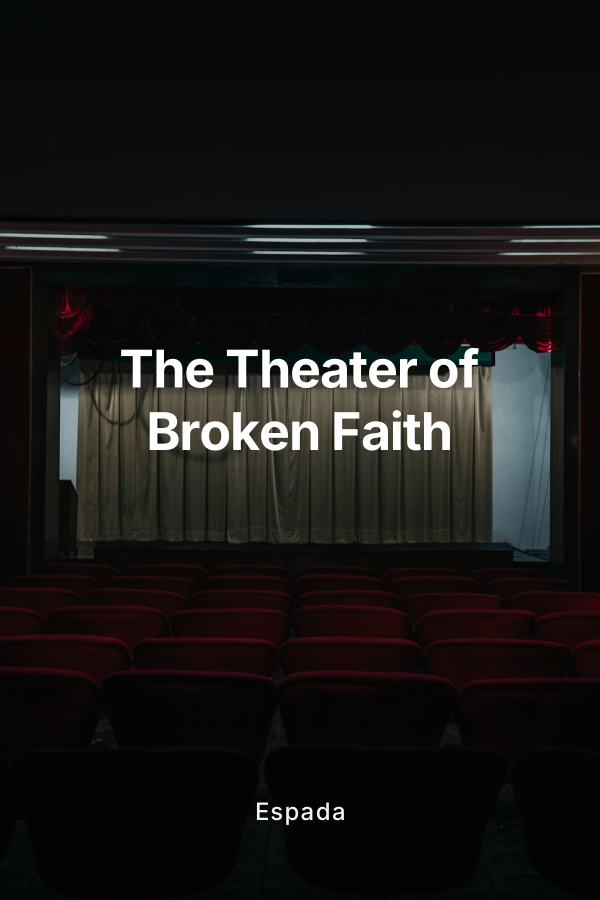
In a place that should not exist, outside all charts and calendars, a vast theater wakes to life without a single word of introduction. No host appears, no vox announces a purpose, no sigils mark allegiance. Stone, metal, and shadow define the space, stripped of all iconography, as if the architecture itself refuses to take sides. The only certainty is that every soul present has been summoned.
Across the theater’s sweeping tiers sit Imperial Guardsmen of a hundred regiments, nobles in rich fabrics and polished augmetics, guilders and laborers, savants and scribes, planetary royals and their retinues. Beyond them, segregated by invisible lines, sit Eldar in severe, luminous poise and other xenos whose very presence should have sparked bloodshed. Yet no one can rise. Restraints hold without chains. The theater enforces a single law: you may watch, you may speak, but you will not leave.
They do not know why they are here. They do not know that what they are about to see will hollow out the foundations of their world.
When the lights dim, the screen awakens. There is no fanfare, no overture. What appears is not prophecy announced, nor parable explained, but an image as clear as unfiltered daylight. A war fleet. Drop craft. Titans. Armored columns. The banners of the Astartes. The Imperium’s might in full, ordered motion.
“The Theater of Broken Faith: Witnesses to the Massacre That Shattered History” follows the unfolding of a single impossible event: a cross section of the galaxy’s sentient peoples, all drawn from a time before the Horus Heresy, forced to watch an unedited, omniscient account of the Drop Site Massacre on Isstvan V. None of them knows the term “Heresy” yet. None of them believes that the legions on the screen could ever turn on one another. That ignorance is the point.
The book does not cling to a single protagonist. Instead, it builds a mosaic of reactions, a storm of intersecting voices. The point of view leaps from a Cadian veteran sergeant clutching his rosary to a young noble who has only ever seen war in celebratory frescoes, from an overworked administratum scribe to an Eldar seer who watches with unnerving stillness. Faces recur, but no one is safe behind the comfort of centrality. The real protagonist is the collective: humanity and its uneasy neighbors, caught in the moment their faith in history itself breaks.
Across five chapters, each divided into two substantial subchapters, the book moves in lockstep with the images on the screen and the rising tension in the seats.
Chapter I: A Stage Outside Time
The first chapter establishes the impossible theater and its unwilling audience. Soldiers bellow questions; nobles demand answers; adepts try to catalog details; xenos test invisible restraints. The cause of the summoning remains unspoken and undefined. Whispers range from “psyker snare” to “divine tribunal” to “alien trickery,” but the space itself never responds. Subtle, deniable hints suggest some interplay of warp, time displacement, or an intelligence vast enough to treat entire epochs as data, yet nothing is confirmed. The theater is a closed mystery, and that very absence of explanation becomes its own kind of terror.
When the screen first shows the mustering for Isstvan V, awe settles over the crowd. Guardsmen recognize formations, march rhythms, and vox protocols. Junior officers murmur commentary under their breath, explaining unit insignia and deployment patterns to nervous civilians. Nobles sit a little straighter, basking in the visible proof that their galaxy is ordered, stratified, and under control. The Eldar watch with an expression that is not quite contempt and not quite pity. The opening stretches are long and immersive, allowing pride and certainty to root themselves deeply before anything threatens them.
Chapter II: Certainty on Parade
Now the visual narrative of the campaign rises to its full, confident height. Loyalist Astartes descend in their thousands, armor polished, heraldry unblemished, tactical movements executed with inhuman precision. Titans stride across ash plains. Imperial Army regiments deploy in disciplined waves. Vox traffic hums with resolve, routine check-ins, matter of fact orders. It is the Imperium as it imagines itself: united, invincible, destined.
The audience responds accordingly. Guardsmen feel a vicarious lift in their chest, some whispering unit mottos as if sharing in the glory. Civilians weep with pride at the sight of humanity’s defenders. Nobles point out familiar legion colors with proprietorial satisfaction. Early doubts about the theater’s purpose soften; if this is a test or a warning, it appears to affirm what they already believe.
Subchapter by subchapter, the book tracks small fissures that will soon split wide. An experienced sergeant notices that the camera’s perspective is impossible, as if no single observer could stand where it stands. An administratum adept frowns at dates and designations that do not quite align with current records. An Eldar quietly names a Primarch on sight, unnerving the humans around them. The idea that this might not be a theatrical reconstruction but something else begins to nibble at the back of the collective mind.
Chapter III: The First Cut in the World
Then the second wave lands.
Without narration, without change in tone, the betrayal unfolds. Heavy weapons pivot toward what should be friendly lines. Barrages fall on advancing loyalists. Recognition codes blare over the vox and go unanswered. The camera stays with the battlefield for long, merciless stretches, refusing to telegraph any twist. A Salamander turns in disbelief as shells from supposed allies tear his squad apart. Raven Guard fire signal flares that no one honors. Commanders demand clarification, flagging what they insist must be miscommunication.
Inside the theater, confusion takes root. Some jump to rationalizations. A noble insists it must be a drill gone wrong or a clever feint. An officer mutters about underinformed observers misreading complex doctrines. A Guardsman shouts that the angle is wrong, that the screen lies. Civilians look from uniform to uniform, trying to distinguish friend from foe in the chaos. Eldar exchange a look that speaks of old wounds and remembered catastrophes.
The argument becomes explicit. Certain veterans and savants, recognizing exact regimental markings, personal heraldry, or even tactical signatures of particular legions, insist that what they are seeing is either real history or an inescapable future. Others reject that stance as heresy or manipulation. The question “Is this true?” hangs over every frame. No answer comes from the theater. The only replies are the scenes themselves and the audience’s own clashing interpretations.
By the end of this chapter the emotional structure has shifted from awe to confusion sharpened into defensive anger. The first taboo cracks appear. Someone snaps that no legion would ever fire on its brothers, their voice edging toward panic rather than certainty. An Eldar suggests, in a soft, precise tone, that empires have turned on themselves before. The reaction is immediate and furious, proof that denial is already under strain.
Chapter IV: The Massacre Revealed
The next chapter drags all hesitation into the open. The betrayal on Isstvan V becomes undeniable. Word Bearers, Night Lords, Alpha Legion, and Iron Warriors enact a slaughter that is not chaotic but methodical. Loyalist Astartes are trapped in crossfires designed long in advance. Retreat routes collapse. Vox channels fill not with commands but with fragmented pleas and garbled last messages. Primarchs clash with force that warps the very landscape.
The book shifts to faster cross cutting. Each brutal escalation on-screen is met with a sharp reaction cut in the theater. A loyalist line is annihilated, and we see a Guardsman in the audience go gray, fists shaking against restraints as he whispers that discipline means nothing when the commanders themselves betray. A Primarch is wounded in close combat, and a noble gasps like a child seeing a parent bleed for the first time. A regiment is erased by friendly fire, and a civilian stares in dawning horror at the recognition that uniforms and oaths do not shield against treachery from above.
Blame fractures along every visible fault line. Guardsmen curse their officers and the highborn for sending men to die on promises of unity that were never true. Some lash out verbally at the Astartes on-screen, calling them monsters wearing human faces. Officers defend the legions by reflex, then fall to bitter silence as more evidence piles up. Nobles and royals, their own authority mocked by the sight of demigods butchering one another, turn their fear outward, accusing xenos, psykers, or seditionists in the cheap seats of orchestrating an illusion. Civilians fling anger in every direction at once, condemning the Imperium, the legions, war itself.
Eldar voices cut through the noise. They do not shout. They speak in low tones that carry, remarking on patterns of hubris that echo their own distant history. One of them quietly states that the Imperium has already passed the point of no return. The words drop like a stone into a toxic pool. For a moment the entire theater seems to recoil, not from physical threat, but from the recognition that this might be less a singular disaster and more a hinge of destiny.
Taboos break one by one. A Guardsman spits a curse at a Primarch’s name. Someone, voice shaking, asks whether the Emperor foresaw any of this. The response from the crowd is a mix of horrified shushing, furious condemnation, and fearful silence. The idea that the highest authority might have failed or allowed such a thing to happen is more destabilizing than any individual death on the screen.
The theater grows hotter with breath and panic, yet still no one can move. All agency is verbal and emotional. They can scream, but they cannot intervene. In that powerlessness they mirror the loyalists dying on Isstvan V, trapped within decisions made above their heads and long before they arrived.
Chapter V: Aftermath in Ash and Silence
The massacre on screen dwindles not in victory, but in absence. The camera glides across slagged armor, shattered banners, corpses half buried in soot. Vox signatures fade to static one by one. There is no summation, no score, no final voice to explain what has been lost. The images simply grow quieter, grimmer, more empty until finally the screen goes dark.
Inside the theater the noise collapses. Shouts die out mid phrase. Accusations wither. What remains is silence thick enough to feel. No one breathes easily. No one cheers. The theater has accomplished what no inquisitor’s threat could have managed: it has made an entire cross species audience see the limits of their myths.
The book’s final subchapter lives inside that silence, anatomizing it through the mosaic lens. Rank and file Guardsmen sit hollow eyed, their faith in infallible protectors shattered. They do not suddenly become rebels. If anything, many cling more tightly to discipline because it is the last structure left to them, but they do so without illusion. Their obedience is now built on fear and fatalism rather than reverence.
Veteran sergeants and commanders wear an even heavier expression: cold understanding that the galaxy has just moved into a phase where ordinary soldiers are pawns in wars between beings who can betray one another without warning. Their professionalism remains, but it is leached of hope.
Nobles and planetary elites confront an existential downgrade. The titles, bloodlines, and privileges they once assumed mattered crumble beside the spectacle of Primarchs tearing each other apart. Some resolve, in whispers, to suppress or reinterpret what they have seen, to file it away as heresy or xenos trickery. Others simply tremble, aware that in a true civil war of demigods, their estates and charters are dust.
Civilians hover between despair and fanaticism. Some, overwhelmed, retreat into muteness, their worldview too thoroughly broken to repair. Others lurch in the opposite direction, clinging to an even more absolute belief that the Emperor will somehow fix all of this, that this must be a dark test with a hidden lesson. A dangerous few translate their horror into a hunger for blame and vengeance that could easily be turned upon neighbors, officials, or outsiders.
The Eldar and other xenos leave with grim recalculation and reluctant pity. They have seen great powers fall. They recognize the pattern and understand that this is not an isolated collapse but the opening wound of a long convulsion that will bleed across the stars. For some, it is an opportunity. For others, a warning that no one will stand outside the blast radius.
Through all of it, the core theme coils tighter: this was not only a massacre of bodies. It was the assassination of trust. Trust in institutions, in legends, in the narrative that the Imperium is unbreakable and unified. The theater forces beings who should never have sat together to share the moment history pivots into something darker and more uncertain.
At the very end, when the screen has gone black and the theater remains mute, a handful of tiny reactions stand out against the ocean of silence: the faint scrape of a Guardsman whispering a vow never to trust so freely again, a noble’s barely audible promise to bury this knowledge, an Eldar’s soft statement that the age to come will consume far more than one battlefield. These are not answers. They are fractures that will widen later, off page, back in the lives to which these witnesses will one day return.
“The Theater of Broken Faith” is not a war chronicle in the traditional sense. It is an autopsy of certainty, conducted in real time upon an audience drawn from every rung of a fragile civilization. By refusing to name the force that convened the theater or to settle the question of whether the vision is fixed history or avertable future, the book preserves a deep, unsettling ambiguity. Its power lies in the collision between unbearable clarity on the screen and unsolvable mystery in the seats.
In that collision the reader is invited to stand with the summoned, watching as gods bleed, armies betray, and the story everyone thought they lived inside reveals itself as far more fragile than they ever dared imagine.