Summary:
On a quiet December afternoon, with snow pressing gently against the windows and the house feeling far too big without Mum and baby Leo, eight-year-old Oliver curls under a patchwork blanket on his father’s lap. Mum is at the hospital with Leo, and no one can promise that everything will be fine. When Oliver whispers that he does not want to go to Grandma’s by the sea for Christmas, his dad understands completely. He once felt the same way.
To help Oliver face a Christmas shadowed by worry, Dad begins to tell a story he has never shared with anyone before. It happened when he was a little boy, just about Oliver’s age, the year his own father was awaiting a life-saving heart operation and he was sent to spend Christmas at his grandma’s storm-battered cottage on the coast.
That Christmas began with a storm.
In the past, young Peter arrives at Grandma’s cottage feeling abandoned, frightened, and secretly angry at the grown ups who keep saying “the doctors are taking good care of him” as if that could chase away his fear. The sea outside is dark and furious, the sky bruised with snow clouds, and the wind claws at the old stone walls of the house. Inside, Grandma is brisk and practical, stirring soup on the stove, making hot chocolate, and promising that the cottage has withstood worse storms than this. Even so, Peter lies awake listening to the storm roar, his mind full of his dad in a distant hospital and questions no one can answer.
In the night, something slams against the balcony outside his window. At first Peter thinks it is just part of the storm, but the sound is different, desperate. When he gathers enough courage to look, he finds a young seagull crumpled in the snow, soaked, shivering, and terribly still. The bird’s wing hangs at a wrong angle, one eye is glued shut, and each shallow breath looks like a battle.
Grandma helps Peter scoop the seagull into a cardboard box lined with an old jumper and carry it into the warm kitchen. Together they make a plan. The roads are flooded, the phone lines are down, and no vet can reach them yet, so they will have to do their best alone. They speak in calm, practical voices about warmth, quiet, water, and shock, but Peter can see the worry in Grandma’s eyes. She tells him the truth: even if they do everything right, the bird might still die. Life sometimes works that way. Yet she also tells him something else that matters just as much: even when we cannot control the ending, we still try.
While the storm isolates the cottage, Peter and Grandma fall into a careful rhythm of care. They set the box by the stove, move softly around the kitchen, and check the bird’s breathing. Peter talks to the seagull in whispers, telling it about his dad’s bad heart and the scary word the adults keep using. He realises that the bird is frightened and broken too, waiting in its own way to see if help will come. In the stillness of those days, a quiet companionship grows between a boy whose world feels cracked and a wild creature that had no reason to trust him.
When the floodwaters finally begin to sink back, Grandma reaches the vet, Dr. Harrison, who arrives in a muddy Land Rover with a bag full of strange tools and bandages. In the little kitchen, he examines the gull’s broken wing with gentle hands and a serious face. The diagnosis is blunt and honest: a bad fracture that might never heal quite right, weeks of recovery, and no guarantee the bird will ever fly properly again. Yet there is hope. With pain medicine, steady hands, and a makeshift splint, they can give it a chance.
Peter is allowed to help, holding a torch with trembling hands while Dr. Harrison aligns the fragile bones and wraps the wing with tongue depressors and soft bandages. The work is slow and delicate, and the kitchen becomes very silent except for the creak of the table, the rustle of gauze, and the bird’s slowed breathing. When it is finally done, the seagull lies swaddled and sleepy, its wing secured against its body. Dr. Harrison praises Peter for his courage and care, calling the treatment a kind of Christmas gift. In that moment, Peter feels something he has not felt for days: that he is not helpless, that even a child can stand beside suffering and make a difference.
From there, the story becomes one of small, dogged acts of hope. While Peter waits for news from the hospital about his father’s operation, he feeds the seagull bits of sardines, changes its water, and keeps its box clean. He watches eagerly for each sign of progress: an eye that stays open longer, a beak that finally dips to drink, a cautious shuffle of webbed feet. Every tiny step forward for the bird seems to echo the invisible work happening in a far off operating theatre, where surgeons are trying just as carefully to mend his dad’s damaged heart.
Around them, despite the worry, Christmas quietly arrives. Grandma pulls a battered box of decorations from the cupboard and enlists Peter’s help to transform the cottage. Together they string fairy lights that flicker over the windows, hang a handful of treasured ornaments on a small tree they prop in an old bucket, and lay out a crooked trail of paper chains across the mantle. The smell of baking creeps into every corner as they make biscuits and mince pies, and Peter discovers that measuring flour and licking sticky spoons is oddly comforting when the world feels uncertain. There is laughter when a strand of tinsel falls directly onto the seagull’s box and the bird, now a little stronger, snaps at it indignantly, sending sparkling strands flying.
As the seagull grows more alert, its personality emerges. It is decidedly ungrateful at first, glaring with one bright eye, huffing at Peter’s attempts at conversation, and turning its beak up at any food it does not like. It manages to splash fishy water over the clean floor, topples a carefully placed bowl with an offended flap, and at one memorable moment lets out a very badly timed squawk that makes Peter jump and send a spoonful of custard sailing across the table. Grandma’s dry comments about “their honoured guest” keep both of them laughing more often than Peter would have thought possible at the start of this strange Christmas.
Intertwined with these domestic disasters and cosy scenes is the quiet, serious thread of Peter’s father’s surgery. Phone calls from Mum, crackling through patchy lines, carry news in halting phrases: a heart has been found, the operation is scheduled, the surgeons are working, now they must wait. Peter shares every update with the seagull, sitting by the box and speaking softly about his fears and hopes. The bird, resettling its bandaged wing and blinking in its solemn way, becomes his listener and silent companion, an anchor when the unknown feels too large.
Eventually, the story’s two great questions find their answers in gentle, realistic ways. The seagull’s wing, kept still and protected, begins to knit. Under Dr. Harrison’s watchful eye on later visits, the splint is adjusted and then removed. The bird cannot be rushed; it must stretch and rebuild strength at its own pace. Its first attempts to stand properly are wobbly and slightly ridiculous, and its early flaps send more feathers than air into motion, but progress is undeniable. In time, Peter and Grandma open the door and carry the box outside on a calm day. There, on the edge of the winter-bright garden, the seagull faces the sea again.
Its first short flight is crooked and clumsy yet bravely determined. It lands somewhat sideways and shakes out its feathers, clearly displeased with gravity, yet also clearly alive and free. Peter’s heart swells as he realises that healing does not always mean returning to exactly how things were before. Sometimes it means moving forward with a few scars and a new kind of strength.
News from the hospital finally arrives in a call that will stay with Peter forever: his father has come through the operation. The surgeons have done what they could. His new heart is beating. Recovery will be slow and careful, but there is real hope. As Peter shares this news with Grandma and then, as he always does, with the seagull, he understands the quiet lesson this Christmas has been teaching him. You cannot stop storms from coming, you cannot always choose who gets hurt or how badly, but you can choose how you stand beside those who are hurting. You can choose to care.
Back in the present, Oliver listens to all of this with wide eyes, feeling the storm in his father’s childhood echo his own fear for baby Leo. The tale of the Christmas seagull does not magically erase his worry, but it gives him something else instead: a picture of courage that looks like gentleness, patience, and stubborn kindness. It shows him that it is possible to be frightened and brave at the same time, to light a tree and bake biscuits and laugh at a grumpy bird even when hospitals and unsure futures still exist beyond the snow.
By the time the story ends, the room around them has changed. The patchwork blanket is still warm, the snow still falls outside, but Oliver’s shoulders have loosened. When Dad quietly suggests that Grandma’s cottage by the sea might hold its own surprises this Christmas, Oliver does not protest quite as strongly. He asks, instead, whether they might see seagulls there and whether any of them might remember his dad. They smile together at the thought of some slightly crooked-winged bird still circling the bay.
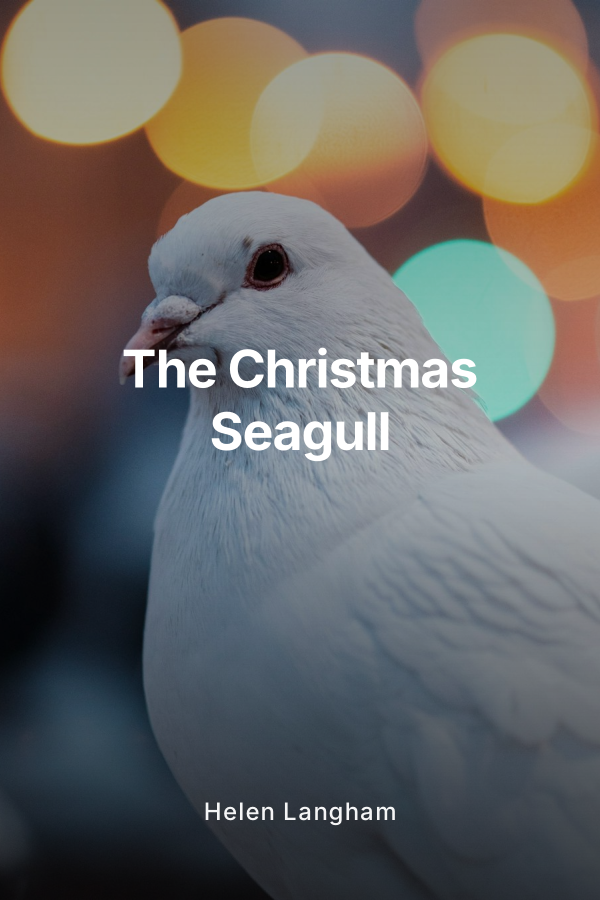
The Christmas Seagull is a gentle, hopeful children’s book for readers from eight years old and up. It weaves together two timelines to explore grief, anxiety, and resilience with honesty that never becomes overwhelming. Through storms, flooded roads, cosy kitchens, chaotic bird care, and the glow of a small decorated tree, it offers young readers a story that says: you cannot fix everything, but your care matters, your kindness counts, and even a single frightened child can help a broken creature find its way back to the sky.