Book Summary
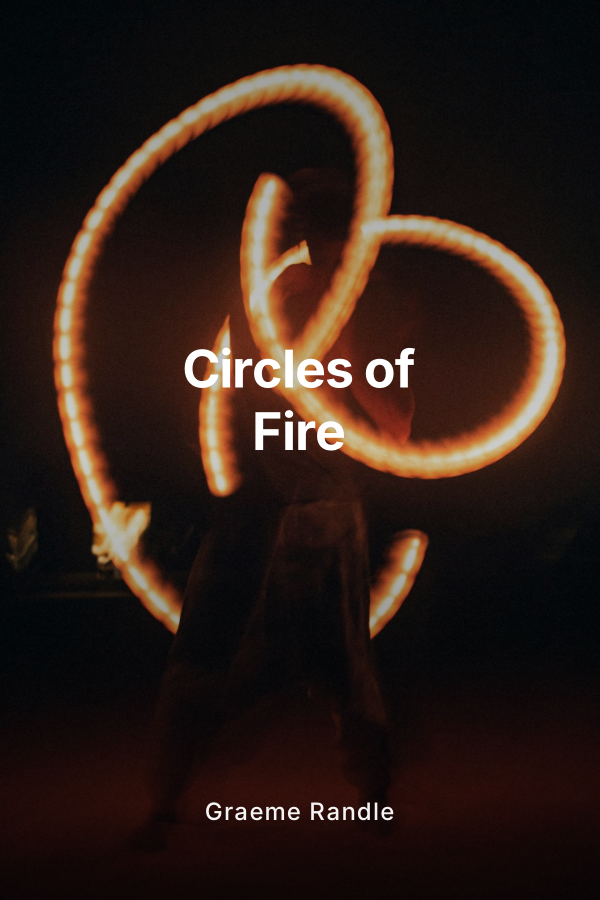
This book begins with a single circle of light in the dark. It takes the reader back to the earliest human nights, when survival, love, law, and spirit were all held by the same small fire. In that glow we see how our nervous systems were shaped, how lovers learned to trust, how chieftains earned their authority, and how the clan’s first ideas of medicine, justice, and the sacred were born in one shared place.
From there, the book follows one core idea: every step of human “progress” widened the rings around that fire. At first the ring grew from family to clan, from clan to village hearths, and then to temples, courts, and markets that tried to replace the campfire as our source of order and meaning. Over time, we built walls to protect ourselves from predators and enemies, then systems and institutions to manage wealth, faith, and power. With each new layer the circle stretched, until the centre that once held us became distant, abstract, and optional.
The first chapters read like an immersive story. We watch hunters return from the river, a grandmother tending embers, children learning without language, and a young couple discovering what commitment means in front of the whole circle. Romance, conflict, forgiveness, and bonding all happen within sight of everyone, under the eye of a chieftain whose only real status is how well he keeps the people safe. Leadership is measured in warmth, food, and protection, not in territory or wealth. The spiritual world is not a doctrine but a felt presence in flame, river, sky, and ancestor.
From this origin, the book turns to non fiction. It lays out, in clear and unsentimental terms, how each function of the fire was gradually removed and centralised elsewhere. Health moved from the knowledge of elders to distant medical systems. Law shifted from open truth telling in the circle to remote courts and prisons. Government evolved from a chieftain whose power depended on shared risk to impersonal states that answer to status, ideology, and global interests. Spiritual life turned from lived relationship with land and kin into belief systems that can reward one group while creating new victims in another.
Across five chapters, the book traces this widening in two intertwined threads. The first is human and intimate. It shows how early campfires created secure attachment, resilient relationships, and natural discipline, precisely because belonging was never in question. Lovers could disagree without becoming enemies, children could be corrected without feeling discarded, and elders could guide without hiding behind titles. The second thread is structural. It explains historically and psychologically how walls rose around houses, how villages became cities, how tribes became nations and empires, and how digital technology finally created a “fire” that glows in every hand yet gathers no bodies in a shared place.
The later chapters shift fully into analysis. They examine how modern people now live in grids rather than circles: identities fragmented across screens, families scattered by work and mobility, communities replaced by institutions and algorithms. The book argues that loneliness, relationship breakdown, political rage, and spiritual numbness are not random problems. They are predictable outcomes of a world that has forgotten the original shape human beings were designed to live in a small, visible circle where love, law, protection, and meaning were one field instead of separate systems.
Throughout, the book maintains a clear boundary between inspiration and evidence. It draws on broad concepts from anthropology, psychology, and history without leaning on any one specific source, inviting the reader to later add precise attributions where needed. It shows that the story of the campfire is not nostalgia but a map. We cannot go back to caves, nor should we romanticise hardship. Yet if we understand what that early circle gave us, we can start to rebuild its logic inside our homes, communities, and even technologies today.
In its final movement, the book turns practical and hopeful. It asks what it would mean for romantic partners to behave like keepers of a shared fire instead of consumers of each other, for parents to become modern elders, and for leaders to reclaim the chieftain’s burden of real protection over status. It offers concrete principles for creating “new campfires” in a fragmented age small circles of trust and responsibility that sit inside large systems without being swallowed by them.
By the end, readers are left with a simple, unsettling, and empowering question. If everything important once happened around a fire, what is the centre of your life now, and does it deserve that place? The book does not promise easy solutions. It offers something more valuable a clear picture of what we lost when the circle widened, and a language for rebuilding the warmth, honesty, and spiritual connection that make human life feel like home again.