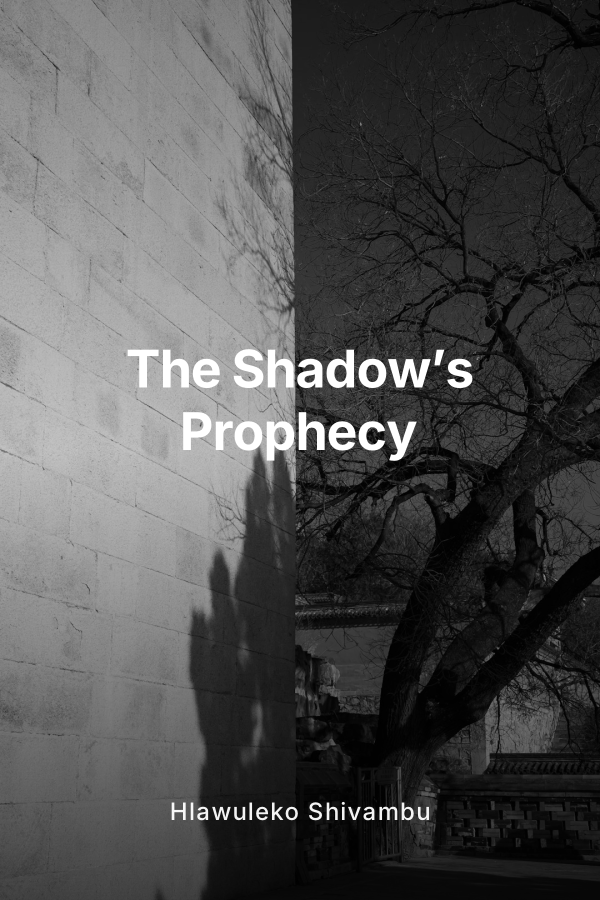
In the realm of Aethoria, where dragons coil through aurora veils and the bones of fallen titans shape mountain ranges, magic is not a gift but a covenant. Elemental currents flow like rivers beneath the skin of the world, and the Council of Mages has long stood as the silent weaver that keeps those currents in balance. Yet from the chasms left by an age old cataclysm, something older than the Council and colder than the void begins to stir. A nameless absence creeps into the seams of reality and takes a single, whispered title. The Shadow.
At the heart of this awakening stands Lyra, a young mage of El’goroth whose power has always been a little too wild and a little too bright. Struggling to master the elemental arts under the stern, watchful eye of her mentor Zorvath, she hides a secret that scorches her dreams. In those dreams, the sky burns black, rivers turn to liquid glass, and a vast silhouette stretches across the horizon, calling her by name. When disturbances ripple through Aethoria and creatures of old legend turn feral without cause, the Council suspects a resurgence of forgotten horrors. Lyra alone feels something deeper. The Shadow is not simply returning. It is searching.
The Shadow’s Prophecy follows Lyra from the sheltered towers and crystalline bridges of El’goroth to the fractured edges of a realm that remembers more than its people do. The story unfolds as a trilogy of escalating revelations. The first chapter of her journey explores the quiet before the storm. Within El’goroth, luminous spires rise from lakes of glass, and floating gardens drift through the sky on currents of tamed wind. Lyra moves through this splendor as an outsider in her own life, marked by sudden surges of uncontrolled fire and strange lapses where the world falls eerily silent around her. When rifts of darkness begin to bloom like bruises in the air and lesser spirits go mad with terror, the Council convenes. Their scrying pools show not a face, but a void. A void that pulses in rhythm with Lyra’s heartbeat.
In whispered conversations behind warded doors, ancient records speak of a prophecy from the time of the Great Cataclysm, when mountains sank and seas climbed to swallow kingdoms. It speaks of a “heart of light” born within the shadow’s gaze, a mortal who can either bind the devouring dark or unchain it fully. Zorvath sees the shape of these words falling over his apprentice like a shroud. Lyra sees only an accusation. When the Council’s attempts to contain the growing disturbances fail, when elemental flows twist in violent knots and a dragon erupts from a volcano wreathed in unnatural darkness, the mages reach an uneasy decision. Someone must seek the source of the Shadow itself. Someone who can stand in its presence and survive. Lyra is chosen not because she is ready, but because the prophecy insists she cannot be ignored.
The second movement of the tale spins outward across Aethoria as Lyra leaves the gleaming certainty of El’goroth and steps into lands where old scars have never truly healed. She is not alone. Arin, a warrior whose blade carries runes older than his bloodline, joins her as protector and blunt moral anchor. He has seen villages swallowed by creeping gloom and carries his own quiet fury against the unseen enemy. Lila, a nimble thief whose past is written in lies and sealed doors, slips into their journey for reasons that seem mercenary at first. She knows how to vanish in cities that have never officially existed and how to listen to the parts of a story everyone else overlooks. Together, the three cross forests that remember the screams of dying continents, deserts dotted with bones of half buried titans, and storm ravaged coasts where corrupted phoenixes fall as black cinders.
With each step beyond the Council’s reach, the truth of Aethoria begins to peel back. Ancient shrines defect from the worship of light and fire to something colder. Wind speaks with two voices, one belonging to the living sky, the other to a silence that tries to mimic it. In a buried archive beneath a city cloaked in illusory sunlight, Lyra discovers a fragment of the original prophecy that the Council never shared. The Shadow, it claims, is not an invader but a reflection. Aethoria’s magic once burned too bright. The world itself called forth a counterweight so existence would not tear apart. The Shadow is that counterweight given form. It can be sealed. It cannot be erased.
This realization reshapes Lyra’s journey. She is not destined simply to destroy a monstrous thing. She must learn to balance something that exists to unmake excess. Her own power, wild and radiant, is precisely the kind of excess the Shadow is drawn to devour. As monsters born of tangled nightmares close in and chasms open beneath once stable ground, she begins to understand why the Shadow calls to her. Part of it recognizes in her a suitable vessel. Part of her, buried deep and unacknowledged, recognizes in it an end to fear and uncertainty. Power without cost, clarity without doubt. The temptation is as real as the horror.
While Lyra wrestles with this inner pull, the external threat sharpens its claws in the form of Kael. Once a bright star within the Council’s ranks, Kael disappeared into exile after daring to suggest that stability without change is another form of decay. In the emptiness beyond sanctioned magic, he discovered the scars left by the Great Cataclysm and the dormant veins of shadow fused with the elemental core. Where others saw a wound, Kael saw potential. To him, the Shadow is not a monster but a tool for cleansing a stagnant age and recasting Aethoria in a stronger mold. As he delves deeper into its currents, his own body shifts, veins threaded with chill luminescence, eyes black at the center with a halo of white fire. He no longer seeks the Council’s favor. He seeks their replacement.
Kael tracks the same clues as Lyra, but with answers written in opposite ink. He believes the prophecy’s “heart of light” is never meant to restrain the Shadow, only to stabilize it long enough for him to shape it. Lyra’s existence becomes the lynchpin of his design. He sabotages her path with corrupted storms, sends emissaries formed of pure darkness to test her strength, and whispers through familiar faces turned traitor. Trust frays within Lyra’s small band. Lila’s hidden allegiance to a shadow cult that views Kael as a necessary harbinger collapses into the open. Arin’s iron faith in the obvious path through danger is shaken when he learns that the Council once chose to blind themselves rather than face the full truth of the Cataclysm.
The third and final arc of The Shadow’s Prophecy draws all these threads together into a confrontation that is as much about identity as it is about survival. From the shattered ruins of Eldrador, once a fortress city and now a graveyard of half melted towers, to the very brink of the world where elemental currents plunge into an abyss of unlight, Lyra is forced to redefine the boundaries of what she will risk. Each battle against Kael’s growing host of shadow forged warriors pushes her power to greater heights and, with it, pulls the Shadow closer. When she stands in the heart of an obsidian crater where the first tear in reality opened, she sees for the first time the Shadow not as an amorphous hunger but as a vast tide of memoryless existence. It carries vestiges of every civilization that has ever burned itself too fiercely. It offers her a bargain. Become its lens in Aethoria, and she can end fear, war, and chaos. All she must sacrifice is choice.
The final convergence sets Lyra against Kael in a battlefield where the ground pulses with liquid night and the sky fractures under conflicting storms. Kael wields the Shadow like a sculptor’s chisel, carving chunks from reality, attempting to excise what he calls the realm’s “rotted roots.” He tears down old wards, shatters ancestral oaths, and breaks the Council’s carefully woven constraints in moments. At his side march creatures that were once dragons, unicorns, phoenixes now remade as skeletal forms wreathed in cold black luminance. At Lyra’s side stand those who have chosen to believe in her not because of prophecy but because of the choices she has made along the way. Arin with his battered blade, its runes now glowing not with inherited power but with the trust he has placed in a future he cannot clearly see. Lila, stripped of her tricks and illusions, burning with a need to atone for the paths she once walked. Zorvath and a splintered Council, forced at last to abandon aloof neutrality and fight for the living world instead of the neatness of their own designs.
In that crucible, Lyra confronts the core of the prophecy. It was never a legend about a single battle and a single victor. It was a warning about extremes. Absolute light can blind as thoroughly as absolute darkness can swallow. To wield the Shadow as a weapon or lock it away entirely would eventually lead Aethoria back to another catastrophic breaking. So Lyra chooses a path that no scribe predicted to write. She opens herself fully to the Shadow’s presence not to serve it, and not to eradicate it, but to anchor it. Through visceral, harrowing moments that blur the line between pain and transcendence, she lets the Shadow see Aethoria through her eyes, feel the weight of individual lives rather than anonymous flickers. At the same time she allows her own wild light to flood into its void. The collision nearly tears her apart.
Kael tries to seize that merging, to twist it to his vision of a remade world, but finds that in tethering the Shadow to a single, flawed mortal heart, Lyra has given it something he cannot manipulate. Perspective. When the energies finally erupt, it is not a clean victory. Whole tracts of land are remapped. Seas shift their borders. Some beings steeped too far in corruption simply unravel into ash. The great elemental flows settle into new courses less easily governed by any council or tyrant. Kael vanishes in the maelstrom, not slain before the eyes of the world, but scattered like smoke carried into distant, unknown hollows.
In the hush that follows, Aethoria is not the same, yet it still exists. The Council of Mages stands broken and humbled, many of its members lost, its authority no longer absolute. New voices rise from cities and tribes that once stood mute beneath the Council’s protection, demanding a say in how magic is tended and shared. Elemental power feels stranger, no longer a tame river but a living partner that can refuse or question. Creatures once thought purely mythic emerge from long hiding, drawn to the altered balance. Dragons descend not as conquerors but as wary negotiators. Phoenixes rise with plumage streaked in both firelight and a cool, starless sheen.
Lyra survives the forging of this new order, but she does not walk away unchanged. The Shadow now lives as a quiet tension in her blood, a second heartbeat she must learn to live with instead of fear. She gains not unchallenged mastery, but a deeper, more fragile understanding of the powers she channels. There are costs. Parts of her past blur at the edges, some memories dimmed to shadows as the price of standing between extremes. The more she reaches for raw strength, the more she must reckon with what that strength really touches. Yet she also finds an unexpected peace. She is no longer the vessel of someone else’s prophecy. She is the living hinge on which Aethoria’s future can swing, but the direction of that swing will come from choices made day by day, not from words etched in forgotten stone.
The Shadow’s Prophecy ends not in a world neatly restored, but in one bristling with possibility. Arin lays aside dreams of simple heroism to become a bridge between warrior clans and the new Council, arguing that battle skills must now guard peace instead of borders. Lila walks into the ruins of networks that once trafficked in forbidden relics, determined to twist their reach toward safeguarding knowledge that nearly undid the world. Zorvath and the remaining mages begin the patient, humbling work of listening. Lyra, standing atop a cliff where the sea meets a yawning scar of transformed land, feels both the warmth of the sun and the cool, watchful hum of the rebalanced Shadow. She understands, at last, what it means to be a “heart of light” in a world that must forever contain darkness.
Within the echoes of dragons’ wings and the hush of newly respectful winds, Aethoria draws its first breath in an age no longer defined solely by fear of a returning cataclysm. The old prophecy has been fulfilled, but not as carved. The story that follows now belongs not to seers and shadows, but to those willing to stand in the narrow place between extremes and refuse to let either consume the sky.