Summary
In a gleaming five star hotel that prides itself on flawless service and subtle perfection, one small act of generosity opens the door to a tidal wave of cinnamon. What begins as a simple potluck, hosted by a well meaning “everyone belongs” enthusiast, slowly mutates into a story about talent without restraint, kindness without boundaries, and a manager whose patience is tested far beyond reason.
At the heart of The Cinnamon House stand two sharply drawn characters. The first is the manager, a meticulous guardian of standards who believes that excellence comes from care, craft, and quiet discipline. The second is the cinnamon lady, a brilliant maker of dinner rolls who cannot resist leaving her personal “touch” on everything she sees. She loves people, loves affirmation, and above all loves cinnamon in every possible form.
The story opens in a casual, messy potluck world where quality is secondary to participation. The cinnamon lady is in her element here. She works hard to make everyone feel important, especially the least committed and most negative guests. She hugs them, flatters them, and hunts for the one tiny nice thing they may have done long ago. Her mission is inclusion at any cost, even if that means protecting laziness and mediocrity from any form of challenge.
Everything changes after she experiences the quiet perfection of a five star restaurant. The precision of the dishes, the artistry of the kitchen, and the sheer beauty of doing one thing extraordinarily well awaken a new hunger in her. She no longer wants to coast in the land of leftovers. She wants to move into the world of craft. Yet she drags all her habits with her.
The hotel manager gives her a chance. He places her in the role that suits her genius: dinner rolls. In that narrow space, she is exceptional. Her rolls are light, perfect, and consistent. The guests love them. The staff respect her skill. If she simply stayed in her lane, she could have been one of the quiet heroes of the hotel, contributing beauty in a small, vital way.
Instead, she starts adding cinnamon. Not just to her rolls, but to everything.
Fascinated by the idea that her personal signature can improve any situation, she slides into other departments uninvited. She stirs cinnamon into the pork sauce, alarming the main kitchen. She sprinkles cinnamon on delicate pastries, irritating the pastry chef who never asked for help. She sneaks into the refrigerator and dusts cinnamon over duck that was meant to marinate in something entirely different.
Her cinnamon is not just a spice. It becomes a symbol of unsolicited interference, of the belief that good intent alone justifies invading other people’s work.
The manager rages, but his anger is tempered by complex feelings. He likes her. He cannot deny that her dinner rolls are flawless. He sees her drive, her eagerness, and her odd form of affection. So he keeps her, despite the chaos. He tries to correct her gently, hoping she will understand that being brilliant at one thing does not grant automatic authority over everything.
She does not understand.
The cinnamon lady’s campaign intensifies. She slips cinnamon into the manager’s tea, into his car, even into his home. She befriends his wife, crosses the boundary between workplace and personal life, and ensures that he can never escape the warm, sweet smell that now feels like a threat. Cinnamon gets into his sofa cushions. It clings to his quiet evenings. It haunts his rest.
Her affection is real, but so is her invasion. She confuses closeness with entitlement. To her, “we are like family” means “there is no such thing as privacy.” To the manager, this is suffocating.
Yet he continues to be patient. He clings to his appreciation for her rolls, his belief in kindness, his desire not to crush enthusiasm. He tolerates what feels intolerable, reassured only by the knowledge that the bread will be perfect, round, light, and made with sincere care.
Then comes her grand idea. She suggests renaming the entire hotel the Cinnamon House, a complete rebranding around her personal obsession. The manager, already stretched thin, nearly collapses under the weight of this proposal. The story pushes his reaction to a dark comic extreme. He suffers a small stroke, a physical manifestation of what happens when someone’s relentless self-expression tramples all limits.
Instead of retreating, the cinnamon lady doubles down. She attempts a hostile takeover of the hotel, buying up as many shares as she can. Her dream is absolute control, where every surface, every scent, and every offering is infused with her favorite spice. She wants a cinnamon themed empire, with no regard for whether others share her taste or vision.
The manager endures another stroke. His body and mind reach their limit. He closes the hotel for Christmas, not as a strategic business move, but as an act of survival. For him, rest becomes the only defense against someone who cannot or will not stop imposing her flavor on everything around her.
The story ends on a deceptively simple image. Each morning, as he returns to work, the manager holds one modest hope. He wishes the cinnamon lady will simply make perfect rolls, tend lovingly to the task that suits her so well, and help only in the ways he actually asked for. His quiet longing captures the core of the book: the need for boundaries, respect for roles, and the recognition that talent gains its true power when it knows where to stop.
The Cinnamon House is a compact, satirical fable tailored for adults who recognize the emotional dynamics of workplaces, families, and communities where “help” is often mixed with control. The manager and the cinnamon lady are not just characters; they are familiar archetypes. The overly tolerant leader who tells himself that patience is always virtuous. The enthusiastic meddler who cannot separate identity from influence. The suffocating version of “we are all family here” that erases personal space under the banner of warmth.
This story uses humor, exaggeration, and the recurring visual of cinnamon everywhere to explore serious questions in an accessible way.
It asks:
• When does encouragement turn into enabling?
• How much damage can be done by someone who is genuinely kind but completely unable to accept limits?
• What happens to a culture when mediocrity is protected and high standards are undermined in the name of inclusion?
• How does a leader decide where tolerance should end and firmness should begin?
Throughout, the narrative avoids neat moralizing. The cinnamon lady is not a villain in the traditional sense. She is affectionate, diligent in her own specialty, and driven by a sincere, if misguided, desire to make everything “better.” The manager is not purely noble. He waits too long to act, hoping that quiet correction will succeed where clarity and boundaries are truly needed. Their interaction paints a nuanced picture of how good intentions can collide and create something close to havoc.
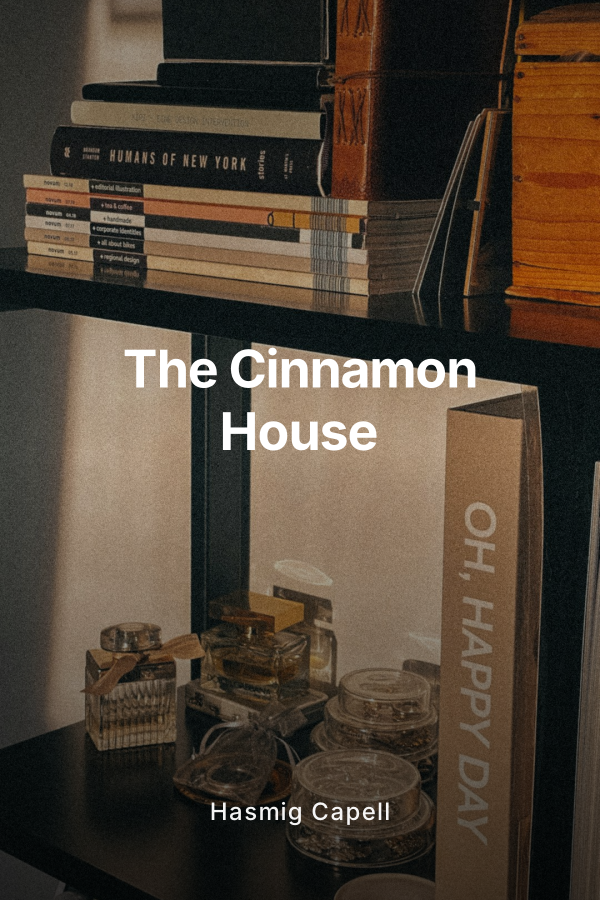
Illustrations inspired by the cover image bring this tension to life. The cinnamon lady appears warm, almost glowing, with flour on her hands and delighted eyes that sparkle at the sight of every new surface she can flavor. The manager appears composed but increasingly strained, his polished uniform and carefully arranged office slowly becoming invaded by stray grains of brown powder. Subtle visual jokes, like tiny cinnamon trails, spice jars hidden in odd places, and the creeping discoloration of once pristine spaces, echo the deeper theme: what you tolerate quietly will eventually fill every corner of your world.
The Cinnamon House is intentionally short, tight, and sharply focused. It is designed to be read in a single sitting, then revisited in conversation. Managers, team leaders, and anyone who has lived through the tension between kindness and standards will recognize themselves in these pages. So will those who have been accused of “doing too much” under the guise of helping.
By the final scene, readers are left with more than a quirky tale about a woman obsessed with a spice and a manager at the end of his rope. They are left with a lingering question about their own lives:
Where, in my world, am I the manager silently praying for someone to simply do the thing they are great at, without invading everything else?
Or more uncomfortably:
Where am I the cinnamon lady, convinced that my special touch belongs everywhere, even when no one asked for it?
The Cinnamon House does not answer these questions for the reader. Instead, it offers a vivid, memorable, and often darkly funny lens through which to examine them. In a marketplace flooded with heavy-handed leadership manuals and sterile case studies, this story chooses a different path. It smuggles insight inside comedy, hides reflection inside absurdity, and invites readers to laugh even as they wince in recognition.
At its core, this book is about the fragile relationship between talent and restraint, love and intrusion, warmth and control. It shows how a single, simple gift turning dough into perfect, airy rolls can be both a blessing and a curse if it refuses to stay where it belongs. And it quietly insists that sometimes the highest form of contribution is not to do more, not to touch everything, but to do one thing beautifully, faithfully, and only where it is truly needed.