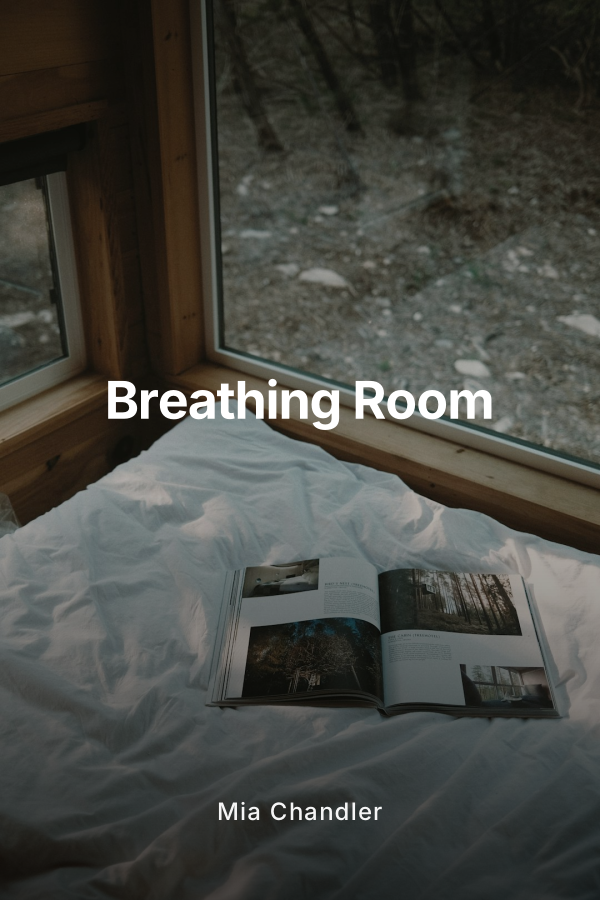
Summary:
Nineteen year old Riya has spent her entire life holding her breath. Top of her class, obedient daughter, future doctor in the making, she is exactly what her parents in a small, conservative town always wanted. Except none of it feels like her. When she gets into an elite college in the city, everyone calls it a dream come true. For Riya, it becomes the place where her carefully controlled world finally starts to crack.
College is supposed to be freedom, but her parents’ grip only tightens. They call between classes. They check her grades every week. They remind her of the sacrifices they made and the future she owes them. The more they push, the more the pressure turns inward, until Riya’s old unease erupts into full blown panic attacks in crowded lecture halls and silent exam rooms. Her heart pounds, her vision blurs, her hands shake over incomplete notes. She learns how to fake being fine even as her chest feels caged.
Then there is Aarav, the quiet boy from her statistics class who always sits in the same seat, headphones dangling around his neck, sketchbook open instead of a laptop. He is everything Riya has been warned about: uncertain future, artistic ambitions, a refusal to live by anyone else’s script. He notices the way she grips her pen a little too hard. He sees the way she disappears after class when the room gets too loud. He is also the first person who stays with her when she slides to the floor outside a classroom, breath stuttering, convinced she is dying.
Their connection grows in the in between spaces of college life: cafeteria coffee breaks, late night study sessions, long walks across campus where the world feels suspended. For the first time, Riya feels seen beyond her grades and her usefulness. Aarav coaxes her out of her rigid routines, into art rooms and abandoned stairwells, into conversations about what she actually wants instead of what she is supposed to want. In his small, stubborn acts of care, she discovers a version of herself that laughs too loud and feels too much.
The attraction between them is immediate and intense, but it is not simple. Their most intimate moments are not only about bodies pressed close and breathless kisses in dim dorm rooms. They are about hands that do not flinch at the scars of anxiety, about whispered confessions in the dark, about the terrifying relief of being wanted not for perfection but for the messy truth underneath. Their sex is charged, raw, and deeply emotional, where consent is given in words and in the way they keep checking on each other. Each encounter becomes an unspoken negotiation between fear and trust, shame and acceptance.
Yet love does not magically fix panic attacks or controlling parents. Riya’s anxiety does not disappear. It spills into her life with Aarav: cancelled plans after a bad call from home, snapping at him when she feels watched, pulling away when vulnerability feels too dangerous. Aarav, who carries his own wounds from a family that dismissed his dreams, has limits too. Their bond is tested when her parents discover the relationship and threaten to cut off financial support unless she ends it and dedicates herself fully to their chosen path. The same love that gave her room to breathe suddenly feels like a risk that could ruin everything.
As the semester grinds on, Riya’s world narrows to three constant pressures: her parents’ expectations, the demands of college, and the fragile, fierce love she shares with Aarav. Panic attacks become more frequent and public. Rumors spread. Professors grow impatient. Friends are not sure how to help. Caught between being the dutiful daughter and the girl who has finally tasted a different kind of life, Riya feels split in two. She starts to believe she might lose it all: her future, her family, and the one person who has seen her at her weakest.
The turning point arrives with a breakdown Riya cannot hide. After a catastrophic panic attack during an important presentation, she is forced into a conversation she has avoided for years: with herself. Hospital corridors, counseling referrals, and a series of quiet, brutal realizations follow. She can no longer pretend her anxiety is just stress or weakness. It is real, it is serious, and it will not be managed by perfection and obedience. Faced with the prospect of dropping out or disappearing into a life chosen for her, Riya has to decide what kind of pain she is willing to live with.
Breathing Room follows her journey from self denial to self recognition, as she learns to name her anxiety, seek help, and slowly build boundaries where none existed. It traces how love can be both a sanctuary and a mirror, revealing the parts of ourselves we most want to hide. In late night conversations and tender, charged encounters, Riya and Aarav re negotiate what their relationship means when it is no longer a secret escape, but part of a larger, more complicated life.
The story unfolds almost entirely on campus: in dorm corridors that echo with laughter and muffled sobs, in libraries that smell of paper and panic, on rooftops where the city lights feel close enough to touch. This tight focus on college life amplifies every brief, intense moment: the first time Riya has a panic attack in front of Aarav, the first argument where he refuses to be another person controlling her, the first time she chooses to stay in bed and rest instead of forcing herself to perform. Each chapter explores how identity, desire, and mental health collide in the pressure cooker of young adulthood.
In the end, Riya’s coming of age is not about abandoning her family or glorifying rebellion. It is about claiming the right to exist as a flawed, feeling person rather than a project to be perfected. Her final choice is not between love and independence, but between a life shaped entirely by fear and one that makes space for both fear and courage. She confronts her parents, not with rage, but with a quiet, firm truth about who she is and what she can no longer sacrifice, even if it costs her comfort and certainty.
Breathing Room is a romantic drama for older teens and new adults who recognize the suffocating weight of expectations and the invisible ache of anxiety. It is for anyone who has ever felt their heartbeat spiral out of control in a classroom, for anyone who has hidden their panic behind perfect grades, and for anyone who has found, in the touch of another person, a reason to stay through the hardest nights. It offers no easy fixes and no perfect heroes, only two young people trying, failing, and trying again to build a love that holds space for the fullness of who they are.
At its core, this is a story about learning to inhale on your own terms. About realizing that love is not meant to replace the air in your lungs, but to remind you that you deserve to breathe.