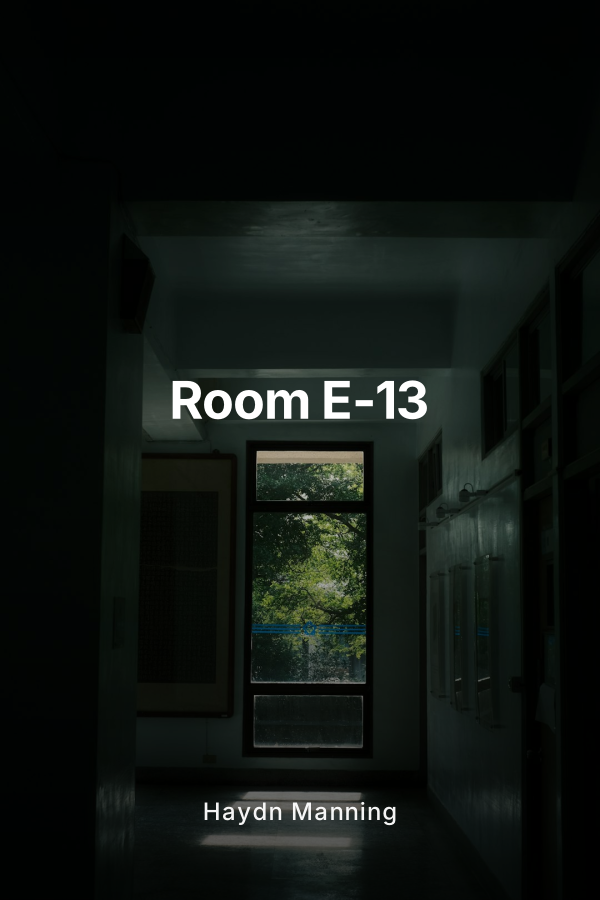
Summary:
James arrives at Cambridge with a suitcase full of sketchbooks and secrets. On paper he is a fine art student. In reality he hides every trace of his talent behind lies about some sensible degree his family would approve of. His older brother Steph is the only one who knows the truth about his art and his sexuality, and even with Steph’s support, James still flinches when anyone gets too close.
His new roommate in E‑13 is Dax, a Swiss literature student who smells faintly of espresso and rain and carries his own quiet storms. Dax has a girlfriend back home, a family that jokes cruelly about “people like that,” and a gnawing suspicion that the way he looks at boys is something he will never be allowed to say out loud.
They become friends first. Then best friends. The kind of late night, shared hoodie, instant‑ramen at 3 a.m. friendship that feels like home. James sketches Dax when he thinks he is not looking. Dax drapes his legs over James’s while they watch bad TV and pretends he does not notice how James goes stiff at every accidental brush of fingers.
One drunken night after a party, want slips past fear. Clothes scatter on the floor of E‑13, James’s careful boundaries blur, and Dax kisses him like he has been falling toward this moment since the first time he saw James’s blue eyes in the doorway. In the morning, hungover and terrified of what it means, Dax calls it a mistake that “means nothing”.
The word shatters James’s fragile trust. Their room shrinks with the silence. They still share a bunkbed and a desk, still pass in and out of each other’s space, but there is an ache between them made of unsaid apologies and unslept nights.
Under exam pressure and family expectations, Dax unravels. He is failing classes, drowning in shame, and burning with jealousy because James skips lectures and still passes, because talent seems to pour out of James without effort. One day, sober and angry, Dax lashes out where he knows it will cut deepest, mocking the one part of James’s body that has only ever known fear.
It is a private, vicious joke about size that sears itself into both of them.
James does not move out. They cannot afford it, and part of him cannot bear to leave E‑13 yet. Instead they become something colder than strangers, something smaller than friends. Acquaintances who share a room and a history and nothing that feels safe to touch.
When everything cracks, Dax drops out. Literature fails to light him up, and Cambridge becomes a place where his mistakes echo too loudly. He takes a job as a barista in a nearby café and tells himself that scraping milk from metal is easier than scraping shame from his own ribs.
On his last day before he leaves the university for good, he finds James buttoning his shirt for an exam and finally stops him in the doorway. The apology that spills out is clumsy, late, and raw. He admits the insult came from his own insecurity, from watching James succeed where he failed, from loving him and hating himself for it. He names what he did and the wound he left. James walks away to his exam with his heart pounding and something heavy finally uncoiling.
Outside the exam hall, Dax waits. Hands in his pockets, coffee cooling at his feet, fear buzzing under his skin. When James steps out, Dax says the words that have been choking him for a year: I am still in love with you. To his shock, James says them back.
They do not leap straight into bed or back into boyfriend. They choose friendship again first, this time with open eyes. Steph visits, sees through James’s casual stories, and corners Dax for a blunt, brotherly heart‑to‑heart. Amid laughter and crude, harmless comparisons that belong to straight‑faced male bonding, Steph makes one thing clear: if Dax wants a place in James’s life, he has to cherish every part of him, especially the parts he once turned into a weapon.
Slowly, carefully, trust returns. In the privacy of their room, Dax asks before he touches. James shakes the first few times, then breathes through it and lets himself stay. The next time they are naked together, Dax’s apology is all devotion. Mouth and hands and unashamed praise turn the old insult into something gentler, something that tells James his body is not a punchline but a place of pleasure and love. After-glow is filled with jokes, tangled legs, Dax burying his face in the warm, slightly sweaty scent of James’s skin, and a new ritual of silly, affectionate aftercare that makes James laugh until he is half in tears.
They date for real. They fight. They work. They fall apart once more and choose each other again with clearer eyes. Dax navigates life as a barista who never finished his degree. James pushes himself through his final year, Steph at his back, and walks out of Cambridge with an art degree he can finally claim out loud. They move into a rented house. They sign papers. They adopt a cat that prefers Dax’s lap and James’s paint‑stained hands.
In time, it is Dax who drops to one knee. Not in England, but in Switzerland, on a small hillside that holds his childhood and his parents’ uneasy questions. His father still stumbles over pronouns and expectations, still clings to old fears about neighbours and grandchildren, yet he tries. A chapter at the family home brings every buried wound to the surface. Dax refuses to shrink. James stands at his side, not in front. Through arguments and halting apologies, they carve out new boundaries: respect is not optional, slurs are not jokes, and love is not something to be endured in silence.
By the time the wedding comes, it is small, imperfect, and exactly theirs. In a quiet Swiss village, beneath mountains and sky, Dax’s father sits in the second row with his hands knotted and his eyes wet. Steph stands up to speak, blending jokes about dorm rooms and too much PDA with a single, devastating line about the boy his brother used to be and the man he has become.
James’s vows are messy, honest, full of art metaphors and admissions about fear. Dax’s vows mix easy humour with tearful truth about dropping out, about jealousy, about the night he waited outside an exam hall because he finally understood what he could not afford to lose. They slide rings onto shaking fingers, kiss to soft applause, and fall into each other’s arms like the ending of one story and the beginning of another.
In France, on honeymoon, they discover they like breakfasts on balconies and late mornings in hotel sheets. Their sex is explicit, hungry, affectionate, and never again cruel. Dax still cannot resist James’s scent. James now laughs and tugs him closer, entirely unafraid.
Years later, the house in England is bigger and quieter than E‑13, but the same closeness hums under its roof. Their desire to be parents grows from a series of small, ordinary moments: watching Steph with his own kids, catching Dax crying over a news story about foster care, James sketching the empty second bedroom without quite knowing why.
When they meet twelve‑year‑old Evan, something clicks into place. He is quiet and reserved at first glance, all hunched shoulders and watchful eyes, but there is a fierce, stubborn flame inside him that refuses to go out. He has bounced between places that never quite felt like home, between adults who were temporary. He is used to keeping his passions tucked away where no one can break them.
James sees the way Evan lingers over a box of old sketchbooks. Dax notices the way he devours story after story. They offer him a room and more than that, a place. Adoption is paperwork and interviews and nights filled with what if. It is also the day Evan walks into their house, drops his battered bag on the floor, and sees that the sheets on his bed have been washed twice because James cannot stop imagining every trace of someone else’s life still clinging there.
Even so, there are shocks. The first time Evan strips his new bed and accidentally finds the unmistakable, dried evidence of his dads’ love life woven into old linens, his teenage brain delivers a vivid, horrified commentary complete with colourful vocabulary and the fervent wish to scrub his eyes. He learns, with appalled laughter, that his new parents are very much in love and very much human. The conversation that follows is mortifying and oddly gentle, full of half‑choked jokes and serious talks about laundry, privacy, and the reality that sex exists even when a door is closed.
Evan’s adolescence in this house is a series of comic disasters and deep, quiet joys. He walks in on Dax at exactly the wrong moment one afternoon at fourteen, sees more than any child ever wants to see, and slams the door so hard the frame rattles. The description that runs through his head is embarrassingly precise, filled with internal shrieks, dramatic vows about moving out, and a bone‑deep certainty that his fathers owe him new eyes. Later, over dinner, Dax attempts to joke, James attempts to die of embarrassment, and all three of them end up in a lopsided, honest conversation about knocking, boundaries, and what healthy, private intimacy looks like.
There are other moments too. The day Evan stands in a school corridor and hears someone sneer about “your two dads.” Fury blazes first. His voice shakes, but he defends them, defends himself, refuses to shrink from their love as if it is something dirty. That evening, James sits with him at the table and pulls out a sketchbook while Dax emails the school. They talk about shame and pride and the difference between anger that burns you up and anger that teaches you where to draw your lines.
Through his eyes, the reader watches his dads not as romantic leads, but as the context of a life. He sees James flinch less and less from casual touch, until a hand on his shoulder in the kitchen is simply affection. He sees Dax come home from a long shift at the café, drop his bag, and bury his face in James’s neck, inhaling the familiar, beloved scent that once terrified him. He sees the way they still look at each other across crowded rooms the way they did in that cramped dorm in E‑13.
Over the last pages, Evan grows taller. His voice deepens. He has crushes that break his heart and friends who make him laugh. He learns to be embarrassed and proud of his family at the same time, to tell stories about his dads’ most mortifying moments with affectionate eye‑rolls and an underlying gratitude that he has people safe enough to cringe about.
At eighteen, on a quiet evening in the rented house that stopped feeling temporary a long time ago, Evan catches a glimpse through the kitchen doorway. James and Dax are slow dancing barefoot to music too soft to really hear. There are a few streaks of grey at Dax’s temples now, paint on James’s fingers, and the same soft smiles they wore in their wedding photos. Evan stands there and thinks of everything he has seen and everything he wishes he could unsee, from dried stains on sheets to unguarded, whispered vows.
He realises that, for all the chaos and the cringe, he has grown up in a home where love is not hidden or apologised for. Where apologies are made and kept. Where messy boys in a cramped room once turned all their unspoken hunger and hurt into a life that could hold a quiet, passionate kid who refuses to let anyone mock his family without a fight.
Room E‑13 is a slow burn gay romance that follows James, Dax, and eventually Evan through twenty‑four chapters of aching tension, explicit intimacy, cruel words and careful healing, awkward parenting, and the ordinary miracles of domestic life. It is equal parts spicy and soft, a story about bodies and how they are touched, words and how they can wound or mend, and the long, winding path from strangers in a dorm to husbands in a foreign country to two dads with a teenager who loves them fiercely enough to roll his eyes and stay.