Summary:
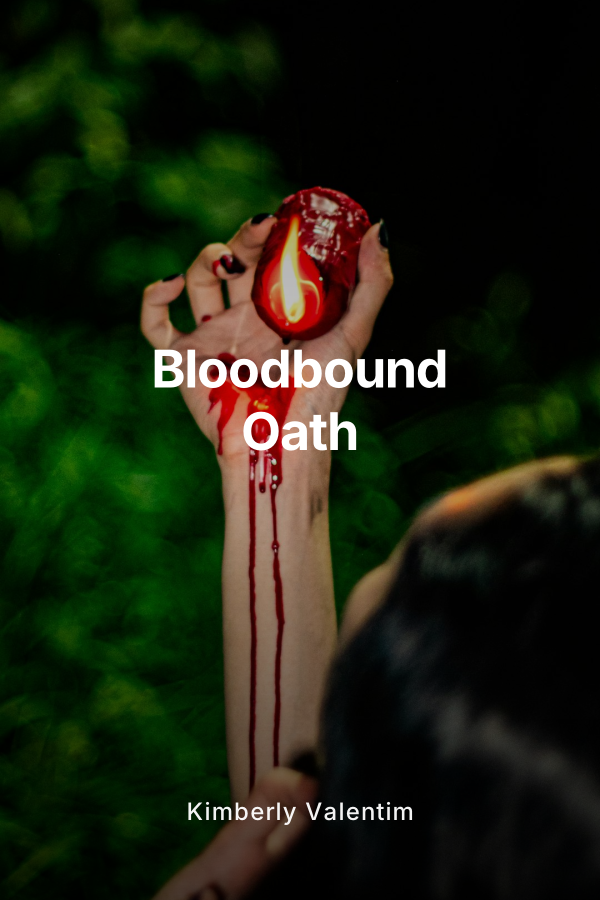
Six years after the War ends, the wizarding world pretends it has healed. The Ministry of Magic is rebuilt, the Dark Mark has faded from the sky, and new Aurors patrol the fractured peace. Yet beneath the polished marble of the Ministry halls, rot still spreads: secret experiments, buried crimes, and monsters the public is not allowed to know exist.
Ana Thorne, twenty‑three and already notorious, is one of the Ministry’s sharpest blades. A half‑blood Auror with a ruthless streak and a past no one quite understands, she has built her career on defiance. She survived the War and clawed her way into the Auror ranks by refusing to bow, not to Death Eaters, not to superiors, and certainly not to Draco Malfoy.
Draco Malfoy, pale heir of a disgraced name, should have vanished into obscurity after the War. Instead, he was quietly recruited into a covert Auror strike unit and buried under classified seals. Officially, he is an Auror. Unofficially, he is a weapon that the Ministry does not acknowledge in daylight. The scars of his choices are written into his body and his magic, but the deepest mark is the one no one is meant to see.
Draco is not fully human anymore.
Turned in the last chaotic weeks of the War under circumstances the Ministry has erased from its records, Draco is a predator bound in human shape. Blood steadies him, enslaves him, and gnaws at him. He has learned to live with it with brutal discipline and careful lies. He feeds in the shadows, hunts strangers, and keeps his monstrous hunger far from the clean corridors of the Auror Office.
Only around Ana does his control begin to crack.
Ana and Draco have spent years at each other’s throats. On missions they fight side by side, then against each other. Their files are full of disciplinary notes: shouting matches in briefing rooms, hexes thrown in training, bruises that heal slowly, broken noses, and a near-fatal incident at the Black Lake where he drove her under the water with a curse. Every encounter ends with snapped wands, split lips, and paperwork.
Their superiors call it “incompatibility.” The Minister of Magic, Clearwater, calls it “opportunity.”
When a dangerous, politically explosive case threatens to expose secrets the Ministry will kill to keep, Clearwater needs leverage. He needs to bind his wildest assets together, forge control from chaos, and create a distraction convincing enough to hide what is being done in the dark. The solution is chillingly simple.
A forced marriage contract.
Ana is called into the Minister’s office alone, handed parchment that smells of old magic and cold ink. There is no gentleness in the offer, only veiled threats. Her job, her wand, every hard‑won inch of her life is at stake. She knows the Ministry can ruin her as easily as it elevated her. So she swallows her pride, presses her name to cursed parchment, and signs herself into a marriage she does not want, to a man she has every reason to hate.
She does it in silence, with her jaw locked and her hands shaking.
Minutes later, Draco storms into the same office, unaware. He reads the contract and refuses in a cold, immediate fury. Marry Ana Thorne, even on paper, even as a ruse? He would rather be dismissed, rather go to Azkaban, rather burn his own name from the family tree. But Clearwater knows things. About the Black Lake. About other missions that never officially happened. About the bodies no one ever found. About the things Draco needs to feed and what happens when he slips.
The Minister lays Draco’s future on the desk between them like another contract: comply or lose everything that still bears the name Malfoy. And more than that. Draco’s secret, if exposed, will not end with his imprisonment. It will scorch everyone connected to him, including the few people he still begrudgingly protects. Including Ana.
Coldly cornered, Draco consents.
A date is set. A Ministry wedding, efficient and empty.
Their marriage is staged as a political symbol of “post‑war reconciliation”: Malfoy and Thorne, pure‑blood and half‑blood, ex‑Death Eater heir and war-torn Auror, now united. The ceremony is stripped of warmth. The hall is plain, the vows are mechanical, and the rings are nothing but enchanted chains. Their wedding photographs catch stiff shoulders, clenched jaws, and a bride and groom who cannot stand to look at each other.
No one seeing the official photos would suspect that beneath Draco’s gloves his hands tremble with hunger. No one looking at Ana’s tight smile would know that her pulse races not from love, but from the instinctive awareness that the man at her side is more dangerous than anyone suspects.
Ana believes she has married the worst mistake of her life: a man who has insulted, injured, and humiliated her, who once hit her hard enough to fracture bone and laughed when she bled. She tells herself she will outlast him. She will survive this sham as she survived the War. She will turn his arrogance into a weapon and never, ever forgive him.
She has no idea he is starving himself not to hurt her.
Draco accepts the marriage as a sentence. He vows to keep his distance, to treat Ana with cold, professional contempt. He will not make this easier for her, but he will not feed on her. He will not sink his fangs into the throat of the one person whose hatred keeps him honest. He will hold every feral impulse under iron restraint.
Until he breaks.
Bound by order of the Minister, they become partners in every sense that matters: cohabiting a warded flat, sharing missions of escalating danger, and walking into the heart of a conspiracy swirling around missing witches and wizards, corrupted blood rituals, and a black-market trade in creatures the War should have eradicated. Their arguments sharpen. Their duels behind closed doors become vicious, magic slamming into stone until walls crack and furniture splinters. They push each other to the edge.
The more they fight, the more Draco’s hunger turns in one direction only. Every cut on Ana’s skin, every drop of blood from a split lip, every bruise he leaves or heals with shaking hands burrows into his senses. Her scent threads through his self-control like a curse. His world narrows to the sound of her heartbeat.
Ana senses something is wrong with him, but not what. He moves too fast in the dark, heals too cleanly, bleeds almost not at all. His eyes gleam faintly when he is furious. He goes cold when others are injured, yet she has caught him once, very late, pressing a hand over a wound on her arm as if he is restraining himself from something unspeakable.
She does not run. She sharpens her knives.
Outside their war of wills, the Ministry tightens its grip. Clearwater uses their marriage as a leash, sending them on increasingly suicidal assignments while keeping them under watch. Healers nod too briskly over Ana’s injuries. Supervisors look away from the severity of the bruises. There are whispers of classified experiments, of victims whose wounds look like savage attacks but carry a faint trace of sanctioned magic.
Someone else is breeding monsters.
Then there is Pansy Parkinson. Once Draco’s lover, now a woman with her own secrets and grudges, Pansy crashes back into Draco’s life determined to reclaim him. She remembers a boy who belonged to her by pure-blood birthright and adolescent vows. She does not understand the creature he has become, but she recognizes obsession when she sees it. Draco’s eyes follow Ana. His magic shields Ana first. His temper ignites only when Ana is touched.
Pansy wants Draco back. If she cannot have the boy she remembers, she will tear apart the thing that replaced him.
As missions grow bloodier and the conspiracy coils tighter around them, Ana and Draco become trapped in a spiral of violence and attraction that neither wants to name. They hurt each other on purpose. They taunt, provoke, and test limits. Ana starts to use his fixation on her as a weapon, stepping closer when she should step back, offering herself as bait when they need a distraction, daring him to lose control and show her what he truly is.
The breaking point comes on a night of alcohol, failure, and blood.
Drunk on stolen firewhisky and the high of a mission gone brutally wrong, Draco staggers into the flat they share, soaked in enemy blood and shaking from lack of his own. Ana confronts him, furious, exhausted, and already injured. Words become weapons, then curses. He throws her against a wall; she hexes him hard enough to drive him to his knees. They are both bleeding and laughing without humor when he finally crosses a line he swore he never would.
In a single, savage motion, he shoves her to the floor, spreads her legs to brace himself between them, pins her wrists, and bows his head to her throat. It looks like an obscene parody of passion. It is not. His voice is a hoarse snarl against her skin, his teeth scraping where a lover’s mouth would kiss. Then he bites.
There is nothing gentle in it. No seduction, no hesitation. Only a starving monster finally taking what it has craved for years. Pain flares, white‑hot. Shock freezes them both in that moment: Ana pinned and breathless, Draco racked with raw, shuddering hunger as he drinks the one blood that was forbidden to him.
Ana should be terrified. Instead, she feels something darker, more complicated, coil inside her. The taste of her own helplessness, the sense of his absolute need, the knowledge that if she speaks the right word or casts the right spell she could stop him and yet she does not, leaves a mark deeper than any wound.
When he tears himself away, horrified by what he has done, their fragile balance is shattered.
From there, Bloodbound Oath follows the jagged, slow-burning descent of two people chained together by law, lies, and a hunger neither of them understands. Draco’s obsession with Ana mutates into something almost worshipful and violently possessive. Ana begins to change in ways she cannot explain: her magic thickens, her senses sharpen around him, and danger feels less like something to avoid and more like something to claim.
Meanwhile, the Ministry’s secrets crawl into the light. The conspiracy they uncover is not just about missing people. It is about the creation and control of unnatural beings, about the way power feeds on blood, about the line between sanctioned violence and monstrosity. Draco’s vampirism, long buried, becomes the key to understanding a weapon the Ministry is building. Ana must decide whether to use his secret against him, or with him, even as it tightens its claws around her own life.
Pansy, furious and relentless, becomes both threat and catalyst. She digs into Draco’s past, tracks his nocturnal disappearances, and finally glimpses the feeding that binds him to Ana. Armed with that knowledge, she can expose them, destroy them, or twist them into tools for her own agenda.
Across five chapters, their story winds through cold vows, bloodstained missions, psychological warfare, and the gradual, terrifying intimacy of sharing a life with a predator who wants no one but you. The War may be over, but for Ana Thorne and Draco Malfoy, the real battle begins with the stroke of a pen on a marriage contract and ends in the moment when the line between enemy and obsession vanishes in the taste of blood.
There is no soft redemption here, no easy forgiveness. Only a forbidden bond forged in hatred, sharpened by violence, and sealed with teeth.