Summary:
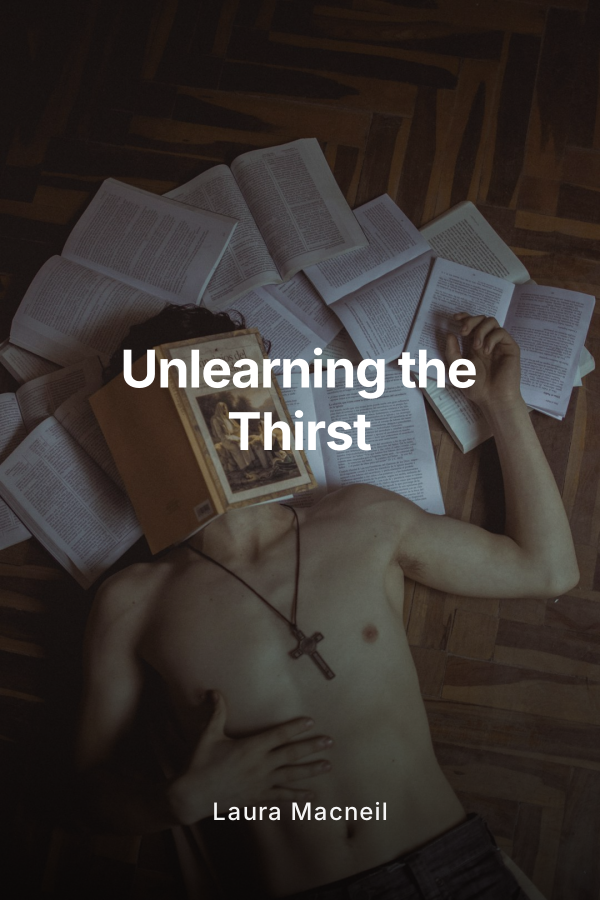
Unlearning the Thirst is a brutally honest memoir of a woman who did not just lose a boyfriend. She lost the man she most respected, the faith of her family, and the sense of who she truly was, all to a drinking habit she thought was harmless and social, until it was not.
The story opens on the night everything finally broke. In one raw, unforgettable scene, we see the relationship’s last conversation: accusations, silence, and a heart walking out the door for the final time. From that moment, the book pulls the reader back through the previous two years, unraveling how a funny, loving, neurodivergent woman slowly built her entire social worth around alcohol and the approval of people who never really saw her.
She tells the truth about choosing bars over movie nights, strangers over her partner, and every crowded weekend over family dinners. She shows the quiet cruelty of avoidance: unanswered texts, last minute cancellations, coldness that made a kind, protective partner feel like a jailer in her mind, even while he was trying to keep her safe. Her need to fit in, to never be the “boring one,” twisted into resentment. She convinced herself he was controlling her when he was the only one truly seeing her drown.
With heartbreaking clarity, she reveals how she sabotaged herself and the relationship: blaming, pushing away, disappearing into nights out that ended in blackouts, shame, and a growing distance she refused to admit. The woman her partner loved slipped further behind a mask of jokes, drinks, and crowded rooms where she could hide the anxiety and sensory overload of being neurodivergent. By the time she realized what she had done, the damage was irreparable. He was gone. Their shared future dissolved. Her family’s patience snapped.
Then comes rock bottom. Not in a single dramatic event, but in a collection of small, unbearable realizations: waking up to days she could not fully remember, to empty weekends, to a phone that no longer lit up with his name, to the echo of her family’s disappointment. In this darkest stretch, she faces the hardest truth. The problem was not “them.” It was the way she used alcohol to dodge herself.
From there, the memoir traces her decision to get sober and mean it. Early sobriety is not glamorous. It is awkward, raw, and often painfully quiet. She invites the reader into the humiliations and strange comedy of sober firsts: standing in a bar with a soft drink, still surrounded by the same people who encouraged her worst habits; realizing how loud and bright everything feels without that blur; stumbling through social interactions, overthinking every word while trying to stay true to her choice. She still tries to fit in with the same crowd, still hoping she can be the old version of herself, only without the drink. Slowly, she accepts that she cannot. Sobriety forces a different question: Who is she, really, when she is not performing to be liked?
As the fog lifts, the book shifts from loss to reconstruction. She begins filling her time and soul with things that have nothing to do with alcohol or chasing validation. Travel becomes a kind of therapy. On solo trips, she learns how to be alone without feeling abandoned. Vintage shopping becomes its own quiet revolution, a way of choosing pieces that reflect her rather than what others think is cool. Each dress, each old record, each quirky piece of decor becomes a small act of self-definition. She reclaims laughter as something that does not need a drink to come alive.
Throughout, her neurodivergence is not a side note but a central lens. She explores how sensory overwhelm, social anxiety, and lifelong masking fed her drinking and her need to belong. She also shows how understanding her own mind more clearly becomes a turning point in compassion for herself. The woman who once attacked herself with blame begins to approach her past with curiosity: Why did I feel so desperate to be “fun”? Why did I run from the people who made me feel safest? This inner questioning helps her rebuild from the inside out.
Unlearning the Thirst is also written as a quiet apology. Scene by scene, she speaks to the man she lost and to the family she hurt. She does not excuse herself. She does not rewrite what happened. Instead, she offers context, ownership, and the words she could not say when she was lost in resentment. The book is a love letter and a confession to the people who saw glimpses of who she truly was beneath the drinking and waited, often in vain, for that woman to fully arrive.
The final chapter takes the form of a letter written from a place of hard-earned peace. She is on a trip that once would have been an excuse to drink from morning to night. This time, she is present. Her dog snores at her feet in a tiny rented room, interrupting her serious reflections with ridiculous noises. She spills coffee on a new vintage dress while trying to look effortlessly “put together,” and laughs at herself instead of collapsing into shame. In this scene, she writes directly to her ex, to her family, to women in recovery, and to her younger self, weaving apology with gratitude and a promise: she will not abandon herself again.
In tone, the memoir is serious and reflective, rooted in emotional truth, yet threaded with a sly, self-aware humour that keeps it human. It never glamorizes the chaos of drinking, nor does it paint sobriety as a neat, polished solution. Instead, it presents transformation as an ongoing, imperfect practice: a series of choices to stay, to feel, to heal, and to keep showing up as the new woman she is becoming.
For women in recovery, for anyone who has ever sabotaged the very love they needed most, and for families and partners who wonder “Why did they choose the bottle over me,” Unlearning the Thirst offers both explanation and hope. It proves that you can lose almost everything, face yourself without the cushion of intoxication, and still build a life that feels richer, kinder, and more authentic than anything you ever thought possible.