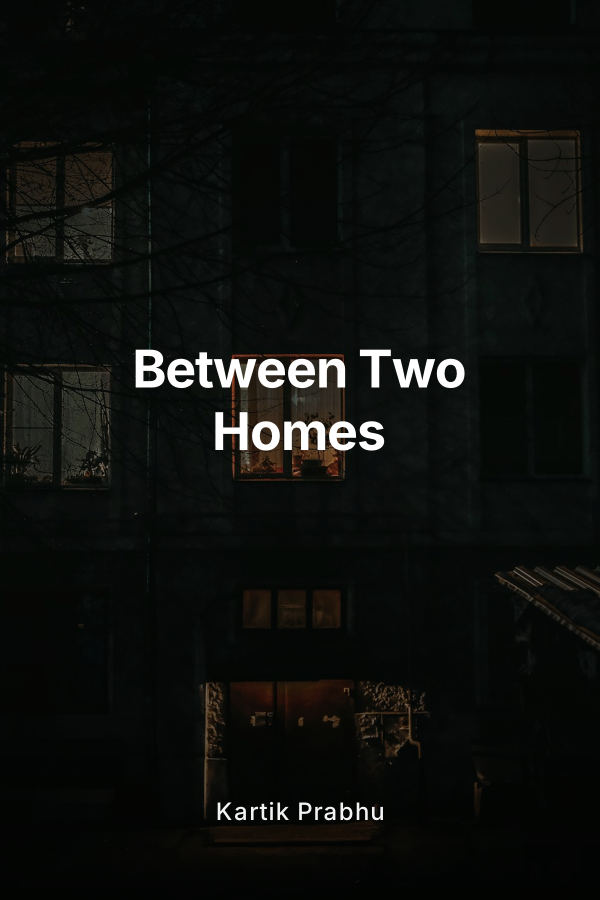
Summary:
When Ananya Rao leaves the crowded streets of Mumbai for the damp skies of Leeds, she carries more than suitcases. She brings three hard-earned years of building a fledgling occupational therapy practice from scratch, of listening to frail voices in cramped apartments, of turning tiny spaces into worlds of possibility. In Mumbai, she learned how to see the person before the diagnosis. In Leeds, she must prove that this quiet way of seeing can transform lives in a care system that is polite on the surface, yet quietly suspicious of a young Indian woman leading from the front.
“Between Two Homes” follows Ananya at thirty five, an occupational therapist and new owner of a small nursing home on the outskirts of Leeds. To some commissioners she is too young to be trusted with frail, confused residents. To others she is simply “the Indian lady,” greeted with professional smiles that never quite reach their eyes. Inside the home, a different set of battles waits: chronic understaffing, exhausted carers, families worn thin by years of loving someone who no longer remembers their name, and residents who carry their own private wars within their fading minds.
Ananya’s work is rooted in one radical question: “What would this person be doing if they were still at home?” That question becomes the heartbeat of the nursing home as she reshapes routines, corners, and conversations around it. Where others see “wandering,” she sees a retired postman searching for his morning route. Where some see “aggression,” she sees a proud woman fighting against yet another small theft of dignity.
The story centers on a small group of residents who come to define Ananya’s days and nights:
• Margaret, who has been moved through fifteen different homes in Leeds, leaving behind a trail of incident reports and staff relieved to see her go. Her agitation seems impossible until Ananya, drawing on years of pattern-spotting work in Mumbai, notices the same flicker of panic in Margaret’s eyes at certain times of day and begins to unpick the hidden story behind her “challenging behaviour.”
• Arthur, a gruff former engineer who distrusts care workers, therapists, and “soft ideas” in equal measure. He has decided that his walking days are over. Ananya, who has coaxed stubborn men through the chaos of Mumbai traffic, recognises his fear behind the sarcasm and begins a quiet campaign to get him standing again, one fiercely negotiated step at a time.
• Elsie, a once-vibrant teacher who has lost almost all spoken words. Where others see only blankness, Ananya is reminded of her nonverbal clients in Mumbai and sets out to build a new shared language through rhythm, touch, and music.
• Nora, whose entire life has been built on doing for others and who now finds herself watched, corrected, and “kept safe” at every turn. Stripped of purpose, she lashes out in anger. Ananya suspects that the real problem is not “behaviour” at all but a woman who has been silently told that she is no longer allowed to be herself.
Through these residents and many others, Ananya begins to reimagine what a British nursing home can feel like. Days gain shape through therapy led activities that mirror lost routines: a weekly baking group where someone still measures the sugar; a quiet corner turned into a “church pew” for hymn-singing; chair based exercises that echo old factory shifts and long walks; music and reminiscence sessions designed not for entertainment alone, but to anchor identity. Her small, dedicated staff learn to see early signs of agitation and step in with tailored approaches long before behaviour becomes a crisis.
Parallel to her clinical work runs the slow, relentless current of subtle discrimination. In meetings with NHS professionals Ananya’s suggestions are nodded at and then set aside, only to be praised later when echoed by an older, white colleague. Families sometimes speak to her as if she is an assistant rather than the person in charge. A single money focused family pushes back at every turn, demanding cheaper options, fewer staff interactions, more control, and less “indulgent” independence for their relative. Ananya recognises these patterns from Mumbai, where she had also stood between vulnerable elders and those who measured care in cost alone. Here, however, she must learn to respond in a different cultural language, turning microaggressions and quiet dismissals into opportunities for firm, composed leadership.
Outside the home, Ananya juggles the constant background guilt of being a working mother. Her eight year old son, Aarav, is growing up between continents: grandparents on video calls from Mumbai, homework on the living room floor in Leeds, and a mother whose mind rarely leaves the nursing home. She worries about missed school events, skipped bedtimes, undone craft projects. Her husband, Rohan, a software engineer far from his own world of code when he listens to the complexities of dementia care, becomes her sounding board. His “outsider” questions often reveal assumptions in the system that she can quietly challenge.
The novella traces one transformative year in Ananya’s life. In Part One, she finds her footing in Leeds, confronting low expectations and learning to translate her Mumbai strengths into a wary, rules bound British environment. A first small success with a resident’s mobility and reduced agitation hints that her approach can work here too, even when colleagues are not yet fully convinced.
In Part Two, the story deepens within the walls of the nursing home. Ananya and her team face a serious crisis when a resident’s escalating distress risks pushing the home onto the same path that failed Margaret fifteen times before: incident forms, emergency reviews, talk of moves and restrictions. Drawing on her experience of tracking behaviour patterns in crowded Mumbai households, Ananya builds simple, research informed tools to map triggers, adjust routines, and involve families as partners instead of bystanders. Her calm refusal to resort to restraints or “chemical solutions” brings her into quiet conflict with those who see risk management as the highest good. It is here that her identity as a young Indian woman in charge becomes most visible, and her insistence on person centred care most tested.
Part Three widens the lens. The home’s slow transformation attracts the attention of local researchers and inspectors who are curious about her dependency tools and personalised care plans that have reduced falls, agitation, and staff burnout. Ananya begins to share her methods in small forums, carefully navigating systems that are not built to notice people like her. Inside the home, the impact of her work is measured not in charts alone but in everyday scenes: Arthur taking careful steps with a walking frame and a crooked grin; Elsie humming along to an old song, eyes bright; Nora leading a tiny “tea round” that restores a sense of purpose; staff members anticipating agitation and gently redirecting it before it explodes.
The emotional heart of the final chapters lies not in awards or headlines, but in relationships. A letter from a once sceptical family arrives, expressing unexpected gratitude that their mother’s final months were filled with small freedoms instead of restraints. Care assistants, once cautious of “all this therapy talk,” find words to thank Ananya for guiding them rather than judging them, and for trusting that they could grow into a more skilled, confident team. Aarav, visiting the home one afternoon to read to residents and play music on his small keyboard, surprises his mother by telling her he is proud of what she does, repositioning her working mum guilt into something quieter and more forgiving.
“Between Two Homes” is a gentle but unflinching portrait of dementia care in modern Britain, seen through the eyes of a woman who has already learned to make change happen in a very different city. It invites readers to step beyond stereotypes of Indian women as quiet followers and shows instead the quiet strength of a leader who refuses to choose between cultural identity and professional excellence. Rooted in realistic daily challenges and illuminated by small, hard won victories, the novella reveals how independence for older adults is not a luxury but a form of respect, and how one therapist’s journey between Mumbai and Leeds becomes a bridge between two ways of seeing, two systems of care, and two homes that both, in the end, belong to her.