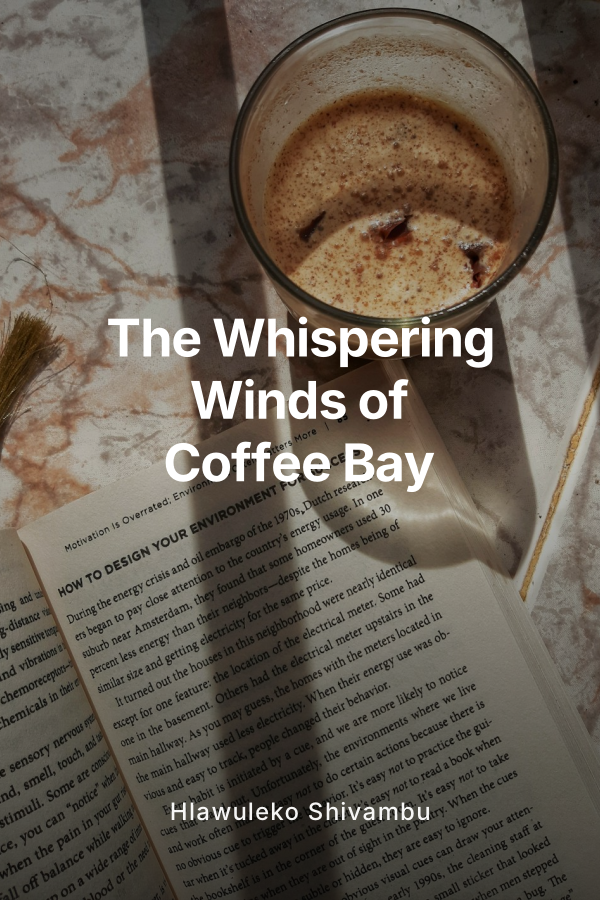
In the coastal village of Coffee Bay, where cliffs plunge into restless seas and the air hums with ancestral songs, the destinies of three generations of women are braided together by an invisible thread. The land itself seems to breathe and remember, its winds restless with the stories of those who came before. It is here that Aisha, a gifted but disillusioned artist, returns after a devastating heartbreak and a creative silence that has stolen her sense of self. Hoping only for a brief escape, she instead walks straight into the heart of a family legacy she never knew she had the courage to face.
The Whispering Winds of Coffee Bay is an epic romance and multigenerational family saga with a gentle touch of magical realism. At its core stands Aisha, modern, curious, and quietly wounded, who has grown up at a distance from her ancestral roots. When a sudden storm reveals a hidden alcove in the old cliffside house, she discovers a worn leather journal tucked behind crumbling stone. Its pages belong to her great-grandmother Liyana, a fierce young woman who lived in Coffee Bay decades earlier and whose life was shaped by forbidden love, defiant choices, and a mysterious coastal legend spoken about only in hushed tones.
Through the fragile ink of Liyana’s words, Aisha is drawn into a world where the tides speak in riddles, certain birds appear as omens, and the wind carries the sighs of the departed. Liyana’s entries peel back the carefully hidden secrets of the family: a love that defied social expectations, a betrayal that split sisters apart, and a haunting curse that seems to echo through the women of the bloodline. As Aisha follows the trail of memories between the journal and the land around her, she begins to feel a presence at her side, a guidance that is tender yet relentless, insisting that she look beyond what she thinks she knows about love, loyalty, and herself.
The story unfolds across two braided timelines. In the past, young Liyana navigates the complexity of loving a man from a world that disapproves of their union, while also confronting the cost of claiming her own desires in a community shaped by rigid traditions, colonial legacies, and the silent power of rumor. Her choices ignite a family rift and, beneath the surface, call down a strange and unspoken consequence. The winds shift, the sea grows uneasy, and a prophecy begins to cling to her name. In the present, Aisha must piece together not only what truly happened to her great-grandmother, but also why the women of her family have so often found love shadowed by grief.
As Aisha paints again for the first time in years, Coffee Bay seems to respond. Colors in her canvases appear before she has mixed them, echoes of faces she has never seen emerge from her brush, and dreams leave the taste of salt and wildflowers on her tongue. The winds, unpredictable yet intimate, arrive at key moments in her search. They carry fragments of voices, tug at her steps toward secluded rock pools and ancient fig trees, and wrap around her whenever she hesitates. While the magic never fully abandons its mystery, it becomes clear that the land itself wants Aisha to remember something her family spent generations trying to bury.
Her quiet retreat becomes even less simple when a brooding stranger, Kael, appears in Coffee Bay. Drawn to the same landscapes that inspire Aisha, he seems both foreign and familiar, as if he belongs to a story she has only half read. Their connection is immediate and unnerving. Kael carries secrets of his own, bound to the history of the coast and to a line of men who once walked beside Liyana. As Aisha affirms her growing feelings for him, unsettling coincidences emerge between Kael’s lineage and the fragments of Liyana’s past. Old photographs, whispered names, and a recurring symbol carved into stone all begin to align. It becomes impossible to ignore the suggestion that their meeting is no accident, but rather part of the very prophecy that Coffee Bay’s winds have guarded for decades.
The novel travels through moments of intense tenderness and piercing ache as each generation’s story unfolds. Liyana’s defiance and the heavy price she pays ripple forward into Aisha’s mother’s life, shaping her distance and quiet bitterness, then continue into Aisha’s own fractured sense of worth. The ancestral home, once a place of laughter and song, has been clouded by unspoken grief and unexamined resentment. Aisha’s investigation into the journal peels apart these layers, forcing her to confront not only the courage of her foremothers, but also the harm that silence and fear have carried through the years.
Magical realism serves as both backdrop and catalyst. The appearance of unusual tides on significant dates, the recurring flight patterns of a particular bird, and strange marks that appear in Aisha’s paintings all hint at an older rhythm guiding the family’s destiny. At key moments, the veil between worlds thins. Aisha hears Liyana’s voice in the ocean’s roar, finds messages in patterns of shells washed ashore, and sees a flicker in the mirror that is not her own reflection. The supernatural never overwhelms the human drama, instead it amplifies each emotional beat: loneliness sharpened by a whisper from beyond, joy brightened by a gentle breeze that feels like an embrace, decisions magnified by subtle signs that the ancestors are watching.
As the connection between Liyana’s forbidden love and Aisha’s unfolding relationship with Kael becomes undeniable, the ancient curse reveals itself not as a monstrous spell, but as an inherited pattern of choices shaped by pain and fear. The so called curse is embedded in the family’s stories about what women are allowed to hope for, how they are supposed to love, and what sacrifices they owe to others. The true magic of Coffee Bay lies in the possibility that these stories can be rewritten. Guided by her great-grandmother’s spirit and the murmurs of the wind, Aisha refuses to allow the past to dictate her future.
The climax builds to a stormy night when sea and sky rage together and the boundaries between then and now collapse. Aisha must make a decision that mirrors Liyana’s fateful choice, but with one crucial difference. Where Liyana stood alone, Aisha is supported by the knowledge of what came before, by her love for Kael, and by a renewed bond with her mother and the remaining women of her family. Under a sky crackling with lightning and a wind that speaks in many voices, she confronts the lingering shadows of shame, forgives the failures that shaped her bloodline, and claims a vision of love that does not require erasing any part of herself.
By the final pages, Coffee Bay has shifted from a place of escape to a true homecoming. The cliffs and waves stand as witnesses to a lineage no longer defined by secrecy. Aisha’s art blossoms into something entirely new, infused with the colors and textures of the Wild Coast, as well as the faces of the women who walked before her. Her studio becomes a kind of shrine and a promise, where past and present coexist, and where the quiet magic of the land continues to move through her hands.
The Whispering Winds of Coffee Bay offers readers a deeply emotional journey through love, loss, and the work of healing that stretches far beyond a single lifetime. It invites them into a world where the wild beauty of the South African coast is inseparable from the people who belong to it, where ancestors linger in the elements, and where the courage to listen to the wind can change the course of a family’s story. It is a tale of women who dared to want more, of a love that returns across generations in different forms, and of the quiet realization that, in honoring where we come from, we finally learn how to choose where we are going.