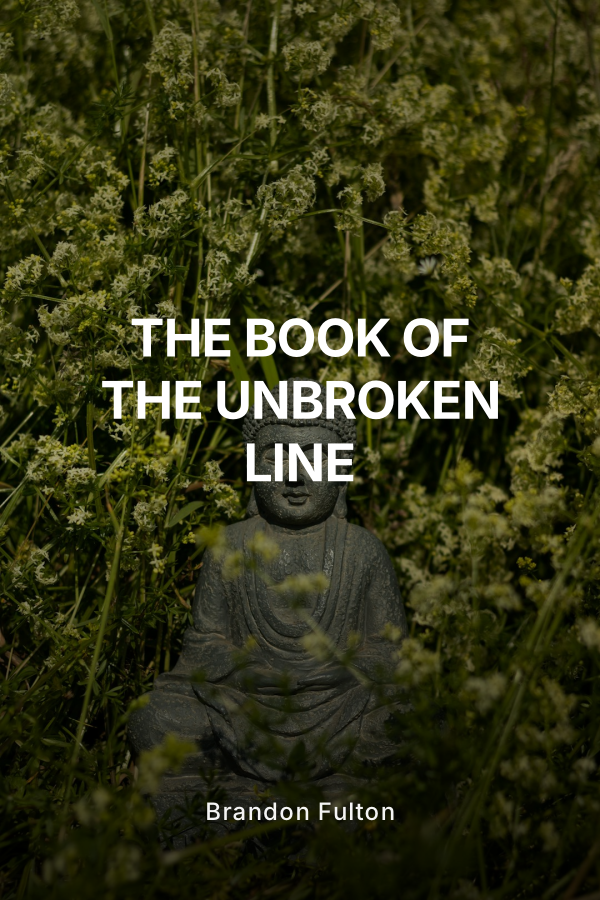
Only the first page of this book is left. We lost the rest in October 2026.
We lost access to the service that stored them, and no other copy exists. We're sorry.
THE BOOK OF THE UNBROKEN LINE
A Multigenerational Guidebook for Fathers, Sons, and the Lineage Yet Unborn
Subtitle:
How One Man Becomes the First Father, Ends the Chaos, and Begins a Dynasty
Book Summary:
This book is a manual for the man who refuses to pass his wounds forward. It is written for the First Father: the one who stands at the crossroads, looks at the chaos he inherited, and decides it ends with him. He is not content to “wing it” through fatherhood. He wants a system. A code. A living tradition his sons can inherit instead of confusion and pain.
The Book of the Unbroken Line gives him that system.
It combines two essential forces in one volume:
- The mythic: identity, story, prayer, oath, and symbol that make a boy feel he stands inside something ancient and sacred.
- The practical: daily rites, age-based ceremonies, wealth principles, emotional tools, and clear behavioral laws he can use today.
Spanning roughly 10,000 words in five core chapters (with two substantial subchapters each), this book functions as a compact but complete generational blueprint. It is designed to be read, spoken aloud, lived, and handed down.
The structure:
Prologue – Installing a Living Scripture in a Bloodline
The book opens with a direct address to the reader as a man at the hinge of his lineage. It explains the purpose of the book as a generational tool, not mere self-help. The Prologue teaches three modes of use: individual practice, father–son tradition, and family lineage manual. It introduces simple instructions for ritual reading, yearly revisiting, and how to physically keep this book in the home as a visible symbol of the Line.
The Prologue also contains the Invocation of the Line: a liturgical, carved-in-stone prayer that calls upon the ancestors behind, the unborn ahead, and names the reader as the bridge. This invocation becomes one of the fixed, immutable elements of the lineage, spoken at rites and annual gatherings.
The Prologue closes with guidance on how to “install” the book in a family: creating a rites calendar, a yearly reading tradition, and a simple method for passing annotations and stories to future generations.
Chapter 1 – You Are the Bridge
Subchapter 1.1 – The Man Between Two Infinities
This chapter reframes the reader’s identity. He is not just one individual trying to survive his own life. He is the hinge between all that came before and all that will come after. The text explores the idea of “the man between two infinities”: the infinite past of his ancestors and the infinite future of his descendants. It defines the cosmic contract of manhood as accepting that his choices ripple through time.
Subchapter 1.2 – The Responsibility of Continuity
Here, the reader is shown what it truly means to be the First Father. The book confronts the father-wound and the absence of rites without dwelling in self-pity. It names the pain once, then pivots into responsibility. He learns that continuity is not automatic: it is forged. This section introduces the core narrative of the Line: “You are the bridge. You are the vessel. You are the Unbroken Line.” It closes with a clear weekly action: a short reflection and a simple written entrance vow that marks the moment his bloodline begins to turn upward.
Chapter 2 – The Birthright of Fire
Subchapter 2.1 – What Is the Fire?
This section defines “the Fire” as the living force a man carries: his capacity to create, to order, and to protect. It is not mystical in a vague sense; it is grounded as creative drive, disciplined energy, and the will to shield what matters. The text explains fire as birthright, burden, and blessing: something he receives, must refine, and must pass forward without letting it burn his lineage.
Subchapter 2.2 – The Three Flames of a Man
Here, Fire is divided into three practical flames:
- Creation: the energy to build, learn, make, initiate.
- Order: the power to structure chaos into stability.
- Protection: the instinct and capacity to guard family, resources, and values.
Each flame is described both mythically and practically. The reader is given simple father–son exercises: building something together, implementing one new household system, and practicing a small protection drill. The subchapter ends with a weekly “Fire check”: a quick self-audit of whether he created, ordered, and protected in the past seven days.
Chapter 3 – The Five Bodies of Man
Subchapter 3.1 – The Bodies and the Man Who Rules Them
This subchapter introduces a clear model: a man is not only a physical body. He is a stack of five bodies that must be aligned if he is to stand as a pillar in his line:
- Physical Body: strength and stamina
- Emotional Body: regulation and resilience
- Mental Body: focus and clarity
- Energetic Body: presence and calm command
- Ancestral Body: identity and purpose as part of a lineage
Each body is explained plainly, with no mystical fog. The reader sees how neglecting any body leads to instability in his family. A brief self-rating exercise lets him scan his current state in minutes.
Subchapter 3.2 – Alignment & Sovereignty
With the five bodies mapped, the text explains sovereignty as a man’s ability to be internally unified. No body is at war with the others. The reader is given a short daily micro-practice that aligns breath, posture, thought, and identity. This becomes a precursor to the Dawn Rite. The section closes with a simple challenge: choose one body to strengthen this month and commit to one small, repeatable action for it.
Chapter 4 – The 33 Decrees of Ascent
Subchapter 4.1 – The Nature of Decrees & the Three Arcs
This chapter introduces the 33 Decrees as the canonical laws of the lineage: short, first-person vows that a boy can speak and a man can live. They are organized into three arcs:
- Arc I: Ember – Foundations of self-mastery and control
- Arc II: Flame – Order, purpose, courage, and ancestry
- Arc III: Ascent – Service, wealth, legacy, love, and transformation
The reader is taught how to use the Decrees: weekly repetition, father–son discussions, and simple “tests” in daily life. He is shown the two Gates:
- The Ember Gate: Awakening, Stillness, Honesty
- The Flame Gate: Integrity, Order, Responsibility
Each gate marks a stage: from boy to young man, from young man to pillar.
Subchapter 4.2 – The Canon Tablets
This subchapter lays out all 33 Decrees in their final, tablet-like form. Each Decree appears as:
- Name
- One carved canon line (short, “I…” statement)
Only the laws themselves appear here, no explanation. The Decrees are presented as something to be spoken, written, and memorized. The reader is instructed to select one Decree each week to focus on, and to record one story from his life that proves or challenges that Decree. This quietly begins his Family Scrolls.
Chapter 5 – The Daily Rites: Dawn and Nightfall
Subchapter 5.1 – The Dawn Rite: Beginning the Day as a Man of the Line
This is the operational core of the book. The Dawn Rite is given as a one-page, father-ready script and structure. It always includes:
-
Posture: standing tall, spine set, as the living pillar.
-
Breath: one slow, deliberate breath to reset.
-
Dominion Declaration: three fixed canon lines spoken in order:
- “Today, I choose the man I am becoming.”
- “My inner world builds my outer world today.”
- “Today, I aim my attention with intent.”
-
Act of Order: naming one concrete act of order he will perform that day.
The page is divided into:
- “Father, read this first” – a brief note that reminds him presence matters more than perfection, and that missing a day simply means returning tomorrow.
- Man’s Dawn Rite – a concise, spoken sequence with bracketed cues.
- Boy’s Dawn Rite – a 10–15 second version for young sons: stand tall, breathe once, say “I am a boy of the Unbroken Line,” then perform one small act of order.
The subchapter ends by instructing the reader to begin this practice the next morning and to treat it as the true start of each day, before screens or noise.
Subchapter 5.2 – The Nightfall Rite: Closing the Day in Truth
If Dawn is command, Nightfall is accounting. This section introduces a simple evening ritual:
- One breath
- One question of honesty: “Did I live as the man I chose this morning?”
- One short confession and correction plan if he fell
- One line of identity: a quiet affirmation that he is still the bridge and can return tomorrow.
The Nightfall Rite is given in father-ready wording, with a simplified version for boys. The Restoration Protocol (confess, correct, continue) is integrated, ensuring that the lineage is built on return, not perfection.
Across these five chapters, the reader moves from shock and recognition (“I am the hinge of my line”) into structure and daily practice. He receives:
- A new identity: First Father, bridge between ancestors and unborn.
- A spine of law: 33 Decrees that define his behavior and his son’s education.
- Two daily rites: Dawn and Nightfall as the bookends of his day and the nervous system of his lineage.
- A model of the five bodies: a practical map of his own development.
- A living relationship with Fire: creation, order, and protection as his operating flames.
By the end of this condensed but potent volume, he no longer sees himself as a man “trying to figure life out.” He sees himself as the architect of a dynasty. He holds a repeatable way to stand each morning, to close each night, to speak law into his own chest, and to initiate his son into a structure that will outlive them both.
He becomes the First Father.
The chaos stops with him.
The Line runs forward, unbroken.