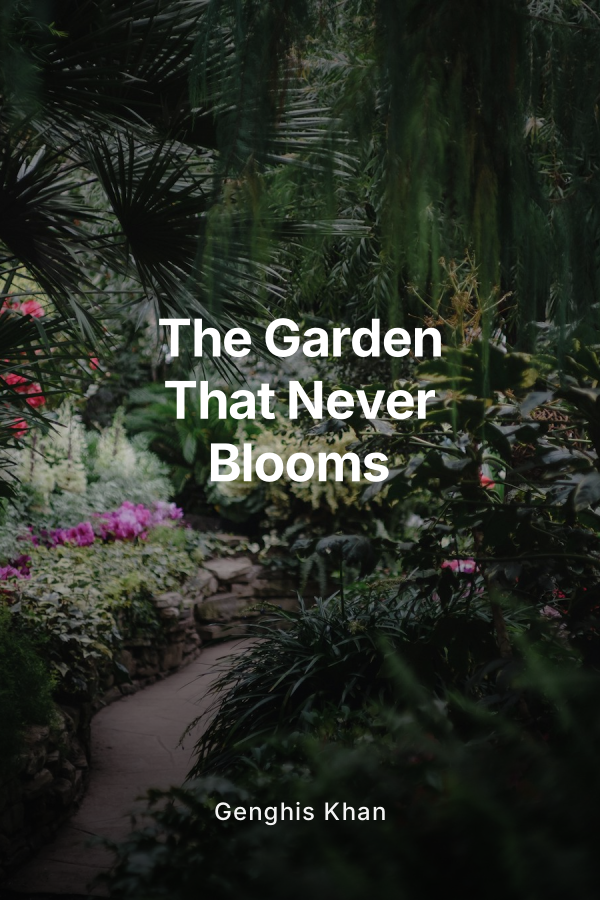
Summary:
In the year 1234 of a forgotten age, in a valley where the soil is gentle and the seasons keep their promises, sixteen–year–old Harun tills his father’s fields and wakes to the mellow bells of the shrine of Barnabe. His world is small and complete: a laughing younger sister who steals berries, a mother who reads the stories of the Blessed Garden of Torve by firelight, a father who believes that faith is found more in a plow than in a sword.
When the Blessed Knights of Barnabe ride into the valley, burnished in sun and incense, Harun sees not soldiers but living saints. They speak of the Skelmps, heretics who have broken Barnabe’s covenant, and of the holy war to reclaim the Garden of Torve, the cradle of creation and the wellspring of grace. The garden, they say, must belong to the true faithful, or the world will wither.
Taken from his fields to join the order, Harun becomes a novice in a company that lives on ritual and blood. The Knights pray before relics made from shattered blades and bone; they chant litanies that turn slaughter into sacrament and insist that doubt is a luxury for those who sleep under unburned roofs. The Rule of Barnabe tells them what to eat, when to kneel, how to wash their hands of sin. It does not tell them how to carry the memory of a face.
War, at first, feels like a cruel game that Harun learns to play too well. He hones his skill in the practice yards, learns to move like a shadow, and at night rides with the others into Skelmp villages. He invents a private arithmetic: kills in one column, cold–blooded murders in another, a quiet contest against himself etched into the leather of his bracer. He whispers the numbers as if they were prayers.
In the darkness of sleeping houses he sees only shapes, not people, and the thrill of the hunt drowns the fragile echo of his father’s voice. He takes what is not his and calls it plunder for Barnabe. He slips knives into throats and calls it mercy. Each raid ends with sacred chants, with priests anointing their brows and praising their zeal.
Then, in a narrow alley of a Skelmp town that smells of smoke and soap and baked bread, the game breaks. Harun drives his sword into a boy scarcely younger than himself, who wakes into the blade and clutches at it with hands that shake. The boy does not die quickly. He chokes and gurgles and stares, eyes widening in an animal terror that has no doctrine. Beneath the boy’s torn tunic lies a small carved token, marked with the same symbol of Barnabe, only traced in another style.
Harun watches the life drag itself out of the boy in wet, heaving breaths. The noise follows him long after the raid, creeping into his sleep, crossing the boundaries of every ritual. The priests call it a holy deed; his comrades mark another tally in their own private ledgers. Harun cannot fit the image of the dying boy into his arithmetic. The numbers on his arm begin to look less like victory and more like a curse that will not stop growing.
The war for the Blessed Garden continues to coil upon itself, a chain that each new skirmish forges a little tighter. The Knights of Barnabe kneel whole mornings in ritual purification, then ride out to burn villages that pray in nearly the same words. Across the river, Skelmp warriors kneel in their own shrines, chanting their own litanies to the same garden, guarded by another set of interpretations and another hierarchy of men who call themselves servants of heaven.
From within this swirl of mirrored fervor, Harun’s inward war begins. Night after night he dreams of the boy choking on his blood. Day after day he dips his hands in basins of consecrated water, listening for the smallest hint that he has been forgiven. The water is always clear; his hands are always red in his mind.
He keeps fighting, because stopping is unthinkable and running is a sin that would doom his family. His reputation grows almost in spite of him. Comrades begin to speak his name with a mix of awe and unease. He can enter houses where others flinch; he knows how to make his face a blank wall. The higher commanders and the priests of Barnabe decide he is chosen. They send him to the worst of the work.
Each success binds him tighter to the legend being written around him, a story that bears little resemblance to the boy who once watched wheat bend under wind. Higher up, in stone halls far from the mud of the front, leaders misplace a single clause in a treaty, disregard a weather warning, ignore a messenger whose horse has gone lame. Small omissions layer over each other, trivial and forgettable, yet every one of them drips into the same basin that overflows on the borderlands.
Skirmishes that should have ended become feuds. Feuds swell into campaigns that need new martyrs. The Blessed Garden of Torve remains as distant as ever, its orchards rumored and invisible, while its name justifies the filling of ditches with bodies. Neither side remembers the original insult clearly, yet both can recite in fluent detail the injuries of the last month, the last week, the last night.
Among the Skelmps, another young warrior counts his own kills, prays to Barnabe in a different cadence, and rides out under a rival banner that claims the same light. He and Harun will pass within a sword’s length of one another long before the day of capture, each convinced that the other stands on the wrong side of a holy river.
As the war grinds on, Harun’s faith frays into threads. Rituals that once felt radiant begin to seem rehearsed, as if he and the others are actors in a liturgy that has forgotten its author. He still kneels, still mouths the creed, but some quiet, stubborn part of him listens now for the places where the words run thin. He cannot bring himself to renounce Barnabe. Instead he begins to wonder what Barnabe would look like without the armor of the Knights, without the blood offerings, without the garden they have never seen.
His crisis reaches its quiet peak when he is ordered to lead a raid on a village that echoes his own. The Skelmps’ fields run down to the river in the same neat furrows. Their children race along the paths with the same shrill joy. Their shrine smells of the same beeswax and simple herbs. For one long moment Harun hesitates, sword in hand, while behind him his men wait for his signal.
Whether he gives the signal or refuses it, his fate narrows toward the same point. In a failed advance or a muddled retreat, cut off from his company, he is captured by Skelmp fighters who bind his wounds with the same rough competence his own side would have shown. They recognize his name. In their stories he is a butcher. In their songs, a dark rider. To them he is proof of the cruelty that stains the Barnabe of the valley he once called home.
Imprisoned in a stone cell that smells of damp straw and old prayers, Harun is questioned not only about tactics and maps, but about belief. A Skelmp priest, with tired eyes and calloused hands, asks him what he thinks the Blessed Garden of Torve actually is. The war outside goes on without pausing to hear his answer.
On the day of his execution, Harun is led to a scaffold where enemies stare at him the way he once stared at them, trying to fit his face into a shape that hatred can hold. He remembers the boy choking on his blood, the columns of numbers on his arm, the farm, the shrine, the first time he saw the knights. He remembers the first time he counted a life as a mark to be tallied and the way every tally turned into another link in a chain that now wraps around his own throat.
His final words are ones he has heard in sermons and on the lips of dying comrades: “Though I have died, my country will live on.” They rise from him less as conviction than as reflex, the ultimate catechism of a world that has taught him no other ending. Around the scaffold, some weep, some cheer, some record the phrase so they can use it in stories that will recruit the next boy from the next farm. Across the river, in a valley he will never see again, children play at war and invoke his name without knowing his face.
In his death he becomes exactly what the war needs, one more emblem to sharpen its teeth upon. His enemies and his own people both carry his legend forward, reshaped to fit their needs, a cautionary tale or a song of valor, never the simple, complicated truth of a farm boy who once believed that Barnabe lived in tilled earth and shared bread.
The Garden That Never Blooms is a historical fantasy that walks along mud-churned roads and through candlelit chapels, following one young man’s transformation from eager devotee to haunted instrument of holy slaughter. Through his eyes, the reader witnesses the smallest overlooked choices of distant leaders echo into massacres at the border, the way two mirrored faiths can twist themselves into mutual ruin, and the quiet, relentless erosion of a conscience that tries to survive inside a body trained to kill.
It is an anti war chronicle that refuses easy answers. War never changes in its appetite, only in the uniforms and languages of those it consumes. Harun’s journey is intimate and harrowing, full of ritual and doubt, brutality described with the unsettling clarity of a presence that cannot look away. Around him, Barnabe’s name becomes a cloak draped over acts that would have broken the heart of any god worthy of the fields where Harun once walked barefoot.
The novel closes not on victory or reform, but on the persistent rustle of the same old banners in a new generation’s hands, on the echo of Harun’s last words used as fuel for fires he never meant to feed. In the distance, the Blessed Garden of Torve remains untouched, perhaps only a story, perhaps real soil that has never felt a soldier’s step. It waits or does not wait while men kill one another to own it, a reminder that what is most sacred is so often destroyed by those who swear they are defending it.