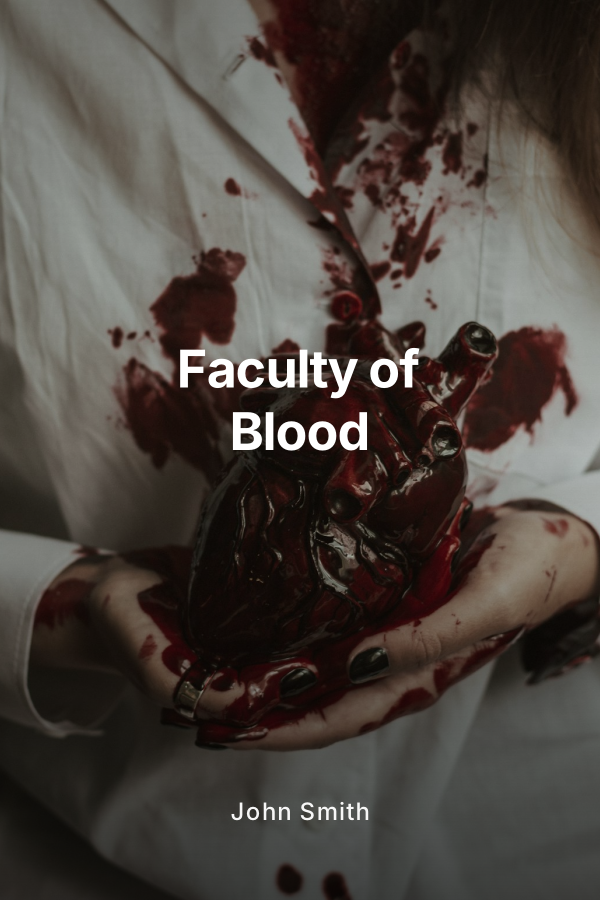
Summary:
Liam O’Connell is the kind of lecturer parents are proud to send their children to. Polished. Articulate. Tenured at one of the city’s most respected universities. He owns a sleek apartment, drives a quiet luxury car, and holds office hours with a warm, practiced smile. Colleagues praise his research. Students call him “inspiring.”
None of them know what he does at night.
Forty two, bitterly single, and rotting with a private fury he refuses to name, Liam lives with one poisoned belief: the world owes him intimacy, adoration, surrender. When he does not get it, he takes it. He tells himself it is just release. A way to vent the pressure that builds under the calm surface of his success. A dark correction to a life that never gave him the love he thinks he deserves.
He does not hunt on his own campus. That would be stupid. Predictable. Instead, Liam feeds his hunger across the river, at a neighboring university where no one recognizes him, where names and addresses fall neatly into his lap.
His brother, Aaron, teaches there.
With Aaron’s login codes and quiet cooperation, Liam slips through the other university’s systems. He stalks victims through admin databases. Timetables. ID photos. Records that were never meant to leave locked servers. Each line of data becomes a map to another life he will dominate, defile, erase. Male students are experiments in control and death. Female students are targets for the twisted blend of lust and rage that has taken root in his mind.
He thinks it is perfect. A clean double life. A safe system.
Then Duran sees him.
Duran Malik is a commerce student at Liam’s university. Second year. Top of his cohort. Quiet in class, loud on the field. He is the kind of young man coaches fight over and professors remember: observant, disciplined, unnervingly aware. He notices everything. The numbers on a spreadsheet in a single glance. The angle of a player’s shoulders before a tackle. The way a lecturer’s eyes linger on a screen a fraction too long.
Sitting at the back of Liam’s lecture one rainy afternoon, Duran spots something that does not fit. An unfamiliar logo in the corner of a projected document. A list of student details from another institution. Not a casual example. Not anonymized. Real names. Real addresses. All from the neighboring university where a string of disappearances has been hushed into rumor and late night whispers.
Everyone else sees a normal lecture.
Duran sees a crack in the mask.
While Liam fine tunes his next kill and basks in the high of his hidden life, Duran starts to dig. Quietly. Methodically. He cross checks faces, course codes, vanished students. He listens to dorm gossip about girls who never came back after a night out. Boys who “must have dropped out” without warning. The pattern sharpens. The timeframes line up with Liam’s late drives across the river.
What begins as a strange curiosity turns into a crushing suspicion. A spreadsheet on Duran’s laptop slowly fills with names that should never have belonged together. At the center of it all sits one man: the charming lecturer with perfect slides and a talent for remembering his students’ names.
As Duran edges closer to the truth, Liam senses the shift. A different look in the back row. An email that feels a shade too careful. A question asked not for knowledge, but for confirmation. The predator feels eyes on him.
And he does not like being watched.
Faculty of Blood plunges inside Liam’s fractured psyche, exposing the bitter narratives he clings to. He blames women for ignoring him. He blames men for having what he never had. He blames the world for daring to live freely while he stews alone. His violence is not random. It is calculated ritual, fueled by humiliation, entitlement, and a craving for power that no lecture hall can ever satisfy.
In parallel, the novel traces Duran’s transformation from reserved high achiever to reluctant whistleblower. Speaking up means challenging a respected academic. It means risking grades, reputation, and the quiet life he has built. It means accepting that the institution he trusts has blind spots large enough to swallow entire futures. As he pushes his suspicions up the chain, administrators flinch. Some dismiss him. Some stall for “procedure.” A few look at Liam and see only a colleague, not a monster.
But the pattern of missing students is impossible to ignore forever.
When the police finally move to detain Liam, it should end quietly. A planned arrest. A controlled operation. They underestimate him. Used to outsmarting young victims and absent systems, Liam refuses to go down as a quiet footnote. He slips the net, vanishing into the city with a fresh, wild anger burning through him.
Cornered and enraged, he plans one last performance.
He selects a bright young woman from his own lectures and traces her life to a modest suburban home. A mother. A daughter. Two generations to brutalize in one night of escalating cruelty. For Liam, it is a twisted answer to the humiliation he feels as the investigation closes in. For the city, it is the crime that finally rips his mask off in public.
What follows is a frantic, suffocating race: police combing through years of failures, Duran chasing digital trails and personal guilt, Liam spiraling into more reckless violence as his two worlds crash together. Campuses lock down. Media vans choke university gates. Students who once worshipped their lecturers now look at every closed office door with suspicion.
The final confrontation erupts not in some alley or anonymous motel, but in the heart of the academic world that sheltered him. Lecture theatres become war zones. Offices turn into hunting grounds. Liam drags his darkness across the very corridors where he once held court, taking down colleagues who try to intervene, spilling blood across the polished floors of a place built for knowledge, not horror.
Faculty of Blood does not stop at Liam’s arrest. It follows him into the courtroom, where he tries to twist his narrative one last time. He blames loneliness. He blames stress. He blames everyone but himself. Evidence piles up: digital logs from his brother’s university, cross matched timetables, forensic traces from vanished students, testimony that corrodes what little is left of his respectable image.
The public listens. Then recoils.
The brutality of his crimes, the years of evasion, the final atrocity against mother and daughter, ignite a nationwide fury. Talk shows dissect “the lecturer killer.” Students organize vigils. Survivors of institutional negligence speak out. The question drifts through every debate: how could someone like him hide in plain sight for so long?
The answer comes not from policy papers or solemn speeches, but from the shadow of a gallows.
When the verdict lands, mercy finds no foothold. The court sentences Liam to death by hanging. His execution becomes a symbolic purge, a violent attempt to balance scales that can never truly be level again. Some call it justice. Others call it revenge. For Duran, watching from the margins, it is a grim end that does not silence the echoes of the victims he never knew but tried to avenge.
The novel closes on a world forever altered. The university rewrites its safeguards, too late for the dead. Aaron faces his own reckoning for the access he granted and the signs he ignored. Duran stands at a crossroads, carrying the knowledge that one quiet student can topple a monster, but not without scarring himself in the process.
Faculty of Blood is a fast paced, relentless thriller that cuts into the soft underbelly of institutional trust. It lives inside the tension between public respectability and private depravity, between the safety we assume and the danger we fail to see. Through Liam’s diseased logic and Duran’s stubborn pursuit of the truth, the story asks a single, haunting question:
How many monsters look exactly like the people we are taught to admire?