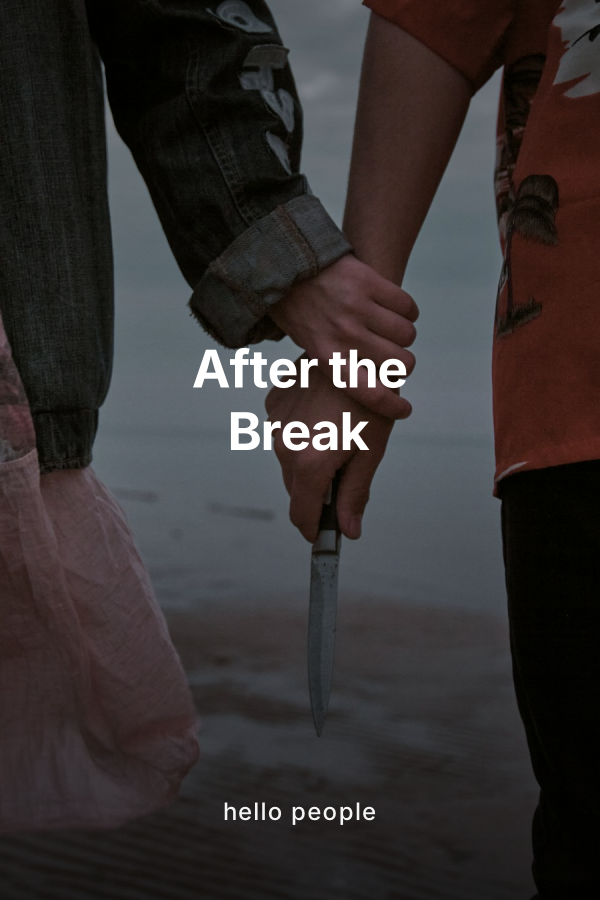
Summary:
Shane Hollander and Ilya Rozanov are twenty‑one, the brightest young stars in professional hockey and the league’s fiercest, flashiest rivals. On the ice, they trade hits and highlight‑reel goals. Behind closed doors, they trade kisses, secrets, and whispered promises neither of them dares share with the world. Shane is light in motion, all laughter, freckles, and impossible optimism, the one person who can steady Ilya’s stormed‑out heart. Ilya would do anything to keep that light burning. He just never imagined anyone could be cruel enough to try to rip it out of Shane by force.
Snatched off the street by a group of obsessed men who see them as trophies instead of human beings, Shane and Ilya are dragged into a nightmare basement where their names, faces, and fame become twisted excuses for possession and punishment. The kidnappers only truly want Shane. They want to own his body, his pain, and the bright spark that made millions fall in love with him from afar. Ilya is chained nearby, forced to watch as Shane is starved, beaten, humiliated, and violated, his captors using drugs and calculated cruelty to shatter him from the inside out. When they decide to break Shane completely, they put a knife to Ilya’s devotion and force him to become part of the torture.
Days blur into an ugly smear of terror, withdrawal, and the cold stink of the single thin mattress they are given to share. Shane’s body turns against him under chemical manipulation, leaving him trapped in a storm of blackout gaps, involuntary arousal, and cravings that rip through him long after the hands are gone. The basement becomes a world with only two anchors: the people who hurt him for their own twisted pleasure, and Ilya, who clings to Shane’s hand, kisses sweat‑slick hair, and silently promises he will not let him die here, no matter what he has to become.
Rescue, when it finally comes, does not feel like salvation. It feels like floodlights on a ruined stage. The kidnappers are dragged away toward cages of their own, but their damage is already etched into Shane’s nerves and bones. In the hospital, praise and pity close in from every side while he shakes through withdrawal and wakes screaming from memories he cannot escape. Hockey agents, media representatives, and law enforcement want interviews and statements. The league wants to know when its golden boy will be able to skate again. None of them see the way he eyes every locked door as if wondering if there is a basement behind it.
Ilya stays. He stays through the vomiting, the endless nights where Shane stares at the wall and refuses to be touched, the mornings when the drugs still call to him and his hands tremble for something that once came in a syringe. He stays when Shane spits that it would have been better if he had died, when the boy who once lit up every arena now walks like a shadow at his own shoulder. For the first time, Ilya’s love is not enough to pull Shane back simply by existing. He has to watch as the man he adores reaches a point where even surviving feels like another form of torture.
When Shane finally slips away to end it himself, the silence he leaves behind is worse than any scream. Ilya finds him motionless, colorless, utterly gone, and for a jagged, endless moment he breaks alongside him. If Shane dies, Ilya’s world ends. With shaking hands and lungs that will not fill, Ilya drags him back to the surface through stubbornness and desperation until sirens wail and strangers take over. They restart Shane’s heart, but they cannot promise Ilya that the boy he knew will return with it.
After the attempt, recovery becomes something harsher and more fragile than any inspirational story. Addiction still whispers in Shane’s ear. Shame and self‑loathing coil around his ribs. He cannot step onto the ice without feeling ghost hands on his body, cannot tolerate loud arenas without flinching at every roar that sounds too much like laughter in the dark. He pulls away from Ilya even as he cannot stand to be alone, caught between wanting to be held and wanting to erase every trace of touch.
The kidnappers are locked away, their sentences and fates turned into sensational headlines, but justice feels hollow when the damage cannot be undone. The world debates whether Shane will ever be the same player again. They do not understand that he will never be the same person. The only real question is whether there is any version of Shane left who still wants to live.
After the Break follows Ilya’s ferocious, terrified love for a boy who no longer believes he deserves it, and Shane’s painful crawl back from the brink as he learns to breathe in a body hijacked by trauma and need. It is a story of graphic violence and the silent debris it leaves, of addiction formed in captivity and carried into freedom, of suicide and the cruel mercy of survival. At its center sits a single, stubborn bond: one man who will not walk away, and one who cannot quite extinguish the tiny, traitorous part of himself that still reaches for light.
In the final pages, the healing is not complete. No tidy closure redeems what was done or smooths the scars. Yet within the quiet of a shared room, in a world still too bright and too loud, Shane manages a small, ruined, almost‑smile for Ilya. It is a fragile thing, nothing like the brilliant grin that once lit up packed arenas, but it is honest and earned. It tells Ilya that Shane is not fully back and may never be. It tells him that, for now, Shane is still here. For a love that has endured basements, needles, and the stillness of a stopped heart, that broken smile is enough reason to keep fighting tomorrow.