Summary
Hana Lee Nakamura thought the hardest part of becoming an idol would be the training, the cameras, and the crowds. It was not walking back into the same Halifax school hall she left at fourteen, with a global boy group behind her, an entire year group in front of her, and the boy she once almost loved sitting three rows from the front pretending not to stare.
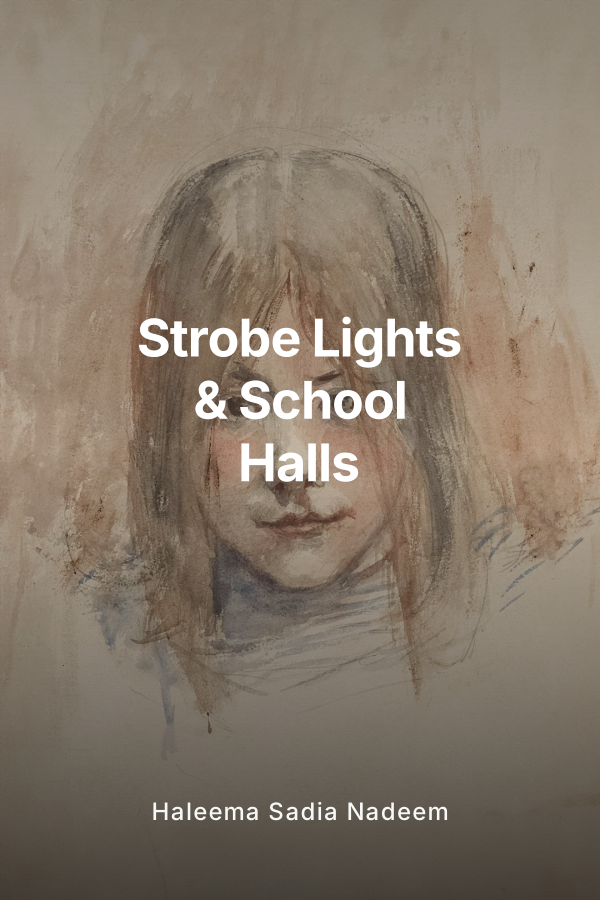
“Strobe Lights & School Halls” is a contemporary, character driven YA / New Adult novel that blends the intensity of K‑pop fame with the raw chaos of British sixth form reality. It follows Hana, a British Japanese Korean girl who grew up in Halifax, West Yorkshire, and traded her familiar life at The Halifax Academy for a survival show, a debut, and a new world as the youngest member of Enhypen.
Two years later, in August 2025, she returns. Not quietly, not on a random half term visit, but in the most exposed way possible: a surprise two hour assembly, cameras off but every pair of teenage eyes watching, as she and the boys are invited to “inspire” the Year 13s she used to sit with in M1.
Most of them do not care about K‑pop. They care about A‑levels, UCAS, part time jobs, and who is moving to who after school. To them, Hana was the smart, small STEM girl who dipped at fourteen and never properly explained why. Now she is back in joggers and a hoodie, hair done, makeup sharp, standing on a stage she used to cross to get certificates, trying to explain how she went from Halifax corridors to world tours.
The book unfolds over four chapters that move between present day and the past she left behind:
• Chapter One sets up Hana’s world before everything changed: her tight knit, chaotic South Asian heavy year group; her place in the top sets without being a “nerd”; and the fake “family tree” joke that binds her girls together. We see her bond with her dad, clashes with her mum, weekends at her grandma’s, and her early love of dance, soundtracked by R&B and sitcom reruns. Woven through are flickers of the boy who will later sit in that hall again: Umair H, tall, clever when he tries, messy when he does not, the situationship that almost became something more.
• Chapter Two drags us into the moment everything twisted: fourteen year old Hana walking away from Halifax Academy, through the brutal intensity of the I‑Land experience, and into debut. It traces her evolution from “girl who can really dance in the back of M1” to main dancer on global stages, the youngest in a group of older boys she learns to trust like family. The chapter shows the cost: missed GCSEs, lost weekends, messages left on read, and friends who stopped asking where she went because it hurt too much.
• Chapter Three anchors the entire novel in a single, charged day: the August 2025 assembly. The teacher emails, the travel back to Halifax with the members, the first shock of seeing the building again. Then the doors of the great hall open. Her friends Husna, Ambar, Hafsah, Omaimah, Arzo, Samrah, Asheeyana, Safa, Khadija, and Hajra realise who is on stage, scream the hall down, and rush her long before any speech can start. The rest of the year sits half curious, half unimpressed. Teachers recognise her and double take. Clips of Enhypen performances flicker on the projector while the year mutters “nah this is actually mad” under their breath.
The Q&A that follows is brutal in how honest and unfiltered it is. People who never cared about K‑pop ask the kind of questions no magazine ever would:
Are you actually rich or is that all cap?
Do you man even sleep?
You ever thought “this idol ting is long, I wanna quit”?
Who’s beefed who so bad you man did not speak for days?
Do you miss just being in M1 and chatting rubbish at the back?
Teachers step in when it goes too far, but not before the boys are pushed to answer about arguments, pressure, money, and what it feels like to live your entire adolescence on camera. We see each member’s personality through the rawness: the jokers who overshare, the quiet ones who drop one heavy sentence and leave the room stunned, and Hana trying to steer it all without losing herself. All the while, her eyes keep catching on Umair in the crowd, hand half raised to ask something about regret and normal life, then dropping again as his friends shove his shoulder.
• Chapter Four carries the story out of the hall and into the cramped corridors and side rooms where real conversations happen. Hana gives the boys a tour of the school, pointing out the science labs where she used to breeze through chemistry, the staircase she once tripped down in front of everyone, the corner where she and Umair used to argue about everything and nothing. Her friends drag her into a side corridor and explode: half screaming about how peng some of the members are, half dissecting every glance between her and Umair, swearing they could feel the tension from the back row.
Hana is forced to confront everything she has been avoiding: the guilt of leaving without real closure, the way success can make people assume you are fine, and the ache of knowing there was a version of her life where she stayed, did her A‑levels, and maybe actually tried with the boy who now acts like a stranger.
The book explores, in a grounded, emotionally charged style, questions that sit behind the glitter of any dream:
What do you owe the people you left behind to chase the life you wanted?
Can you ever fully go back to who you were before everyone knew your face?
And what happens when your old world and new one collide under fluorescent school lights, in front of people who will talk about it for years?
“Strobe Lights & School Halls” speaks to readers who love messy, layered characters, slow burn tension, found family, and the fierce loyalty of girl friendships. It blends the romance, banter, and internal conflict of dark, emotional new adult romance with the sharp, observational tone of UK sixth form life.
At its core, it is about a girl who learns that success does not erase where you came from, first love does not always get neat endings, and sometimes the bravest thing you can do is stand on a stage in your old school uniform hall and tell the truth about who you really are now.