Summary:
Adrian Morales is twenty-one, working the closing shift at a chain clothing store and cramming for exams at a small East Coast university. His life is a calendar of obligations and fluorescent lights. When he stumbles on a suspiciously cheap studio in a decaying brick building at the edge of town, he signs the lease with more relief than caution. The apartment is small, a little crooked, and oddly quiet, but it is his.
On his first night after a long shift, Adrian unlocks the door and walks into a room that is almost his and yet not quite. A picture frame is in the wrong place. The air smells of a different detergent. Sitting on the worn sofa is a stranger: a young man about his age, lean and tanned, with an athlete’s posture and a duffel bag at his feet. The stranger’s name is Jason. He talks about training schedules and near-misses with professional scouts as if he has always lived here.
Adrian should be afraid. Instead, he finds an instant, disorienting familiarity. They talk into the night, trading frustrations that mirror each other: Jason’s stalled sports career, Adrian’s grind of work and study. The conversation tilts. The distance between them closes. Their first touch is hesitant, then hungry, and the cramped studio becomes a cocoon of shared need.
The next time Adrian comes home, Jason is gone and the apartment is different again. The countertops are a different color. The window shows a street he does not recognize, washed in a season that does not match the weather he just walked through. Inside waits Noah, a former college student who burned out under the weight of classes and a job and now lives half-suspended on his parents’ money and fragile trust. Noah’s laughter is brittle, his body eager for contact. Adrian stays longer this time.
So it begins. Each evening, Adrian opens his own front door and enters a slightly altered world. The furniture shifts. The light changes. The air holds different recipes, different soaps, different years. In one version of the apartment he meets Liam, an aspiring chef slicing vegetables too carefully, counting ingredients against a dwindling bank account. In another, there is Ezra, a dropout hoarding paperbacks and quoting lines that no one else has time to read. In yet another, there is Marco, a former teenage racer memorizing engineering equations because speed has become too expensive.
They all share something in common. They are young men forced into adulthood by bills and expectations, each clutching a dream slowly being choked by cost, fatigue, or circumstance. With Adrian they find an odd refuge. At first, the intimacy is a comfort born of loneliness: conversations on the rickety chairs, laughter in the narrow kitchen, bodies finding each other on the couch, on the floor, in the bathroom shower. The sex is raw and desperate, an outlet for stifled anxiety and thwarted ambition.
Though no one remarks on it, time inside the apartment is not quite right. Sometimes dusk lingers too long beyond the window. Sometimes snow falls outside when Adrian is certain he left work in a humid summer night. The small inconsistencies are easy to ignore, blurred by exhaustion and desire.
As the nights and visits bleed together, Adrian’s life outside begins to fray. The shifts at the store feel further away. His classes become page numbers in a syllabus he rarely opens. Each time he thinks about going to the library or meeting a friend, the memory of touch in the apartment pulls harder. It is the only place where he feels seen, wanted, and free from the constant demand to perform.
Gradually, the apartment ceases to reset with each opening of the door. Realities begin to overlap. Jason might be in the kitchen while Noah rests on the bed. Liam leans over the stove, while Marco sprawls on the rug, legs tangled with Ezra’s. They interact like old friends who have always known each other, despite belonging to different years and distant cities that should have kept them forever apart. They cook, argue, tease, and reach for one another without the slightest awareness that anything is wrong.
The space around them responds. The layout twists in small but undeniable ways. A hallway appears where there was once a wall. A second window looks out on a different season than the first. The front door seems farther from the bed than Adrian remembers. Architecture loses its loyalty to logic, contorting to hold more bodies, more moments, more nights than should fit inside four walls.
Adrian’s attachment deepens into something like devotion. He stops going out except for the bare minimum. His only tether to the world beyond the chipped door becomes his phone, buzzing with texts and missed calls from his parents, who hear his growing distance even when he pretends nothing is wrong. Each vibration irritates the warm fog he has come to love inside the apartment. Answering requires language, explanation, the weight of concern. Inside, all that is required of him is to feel.
Sex becomes the central language of the space. What began as individual connections between Adrian and each man blooms into a collective intimacy that disregards conventional boundaries. They touch each other with easy familiarity, then with insistence, then with a kind of hunger that wipes out self-consciousness. Privacy dissolves. There is no more discreet retreat to the bedroom, no more embarrassed laughter after a sudden kiss. The apartment fills with bodies in motion, voices thick with pleasure, the constant friction of skin against fabric, tile, and wood.
As their minds slip under the apartment’s influence, time disintegrates further. Days stretch and fold; nights repeat with different weather at the same clock hour. The young men misremember how they met. They call each other by the wrong names and do not correct themselves. A bruise appears on someone’s shoulder in one moment and is gone when Adrian looks again. A mug that used to be red is suddenly blue. The windows show autumn leaves on one side and blazing summer on the other.
No one comments. No one cares. The apartment’s pull tightens around their thoughts until only the next touch matters. The sex loses its human shape, its careful negotiation and deliberate seduction. What remains is need. They reach for each other constantly: in pairs, in small tangles, in a full-bodied throng on the mattress and floor, a living knot of arms and mouths and hips. Boundaries and consent become irrelevant not because someone violates them, but because individuality itself melts into a shared, feral instinct. The horror of this absence coexists with an undeniable, animal joy.
Adrian is the happiest he has ever been. He has never felt more liberated from deadlines, debt, and expectations. In here he is no longer a student or employee, no longer a dutiful son. He is one animal among many, breathing in rhythm with others who understand his hunger because they share it. Love and lust merge into a single compulsion: to be as close as possible, as often as possible, until there is no room left in him for anything else.
Outside, the messages on his phone grow more frantic. His parents worry about skipped calls, vague replies, and canceled visits. Inside, the apartment swallows hours without testimony. Adrian forgets what season it is beyond the door. He forgets exam dates, coworkers’ names, even the street address of the building. All that matters is the next rush of heat and pressure, the chorus of moans that have become the only music he needs.
The climax of his journey arrives during the most intense gathering the apartment has yet produced. Every body is present, every touch layered over another. The room seems smaller, yet deeper, as if the walls have receded to make room for the collective. They are a single living organism, a hive of sensation. In the midst of this overwhelming tangle, Adrian’s phone rings.
The sound is absurdly sharp, a thin thread connecting him to a life that now feels like a forgotten dream. For a heartbeat, something breaks the surface of his bliss: a flicker of his mother’s face, the echo of his father’s voice, a memory of a childhood kitchen table and the smell of coffee. Guilt strikes like a brief shadow passing over the sun.
He reaches for the phone.
For one fragile breath, he could still answer, still explain, still step out into the hallway and reconnect with the world that raised him. Then a hand slides along his thigh, someone’s chest presses against his back, lips find the hollow of his throat. The starkness of the ringtone dissolves under the tidal pull of bodies and need. His moment of clarity fades like a dream on waking.
Adrian lets the phone slip from his hand. It arcs through the air and disappears somewhere in the chaos of blankets and limbs. The call continues to sound, muffled and ignored, as the group’s movements climb toward a shared, shuddering peak. They do not speak. They do not need to. In that animalistic, euphoric frenzy, they belong utterly to the apartment and to each other.
When release comes, it feels like annihilation and rebirth. The walls seem to thrum. The door, long disregarded, swings open as if in answer to some secret cue.
At that exact moment, in a version of the hallway marked by ordinary time, Adrian’s parents arrive at the building. Concern has finally drawn them past polite texts and worried calls. They climb the stairs, hearts pounding with dread, and open the door to their son’s apartment.
The room is empty.
There is no sign of recent occupancy. No clothes strewn across the floor, no half-washed dishes in the sink. The bed is neatly made. The furniture sits exactly where a landlord’s listing photo might have placed it. The air smells faintly of dust and stale paint, as if no one has lived here in months.
On the bare wooden floor near the center of the room lies Adrian’s phone. Its screen, face-up, shows a dimmed display. Missed calls accumulate under his mother’s name. A family photo glows faintly as the background: Adrian smiling awkwardly between his parents in a park, leaves bright with a season that no longer exists for him.
The device vibrates once more, silently this time, before the light slips away and the screen goes black. The apartment holds its breath.
Whether Adrian has escaped the weight of his old life into a truer, if monstrous, version of himself, or whether he has been consumed by a supernatural room that feeds on youth and longing, is never explained. The magic of the space refuses interpretation. It exists as a threshold between lives, a place where pleasure erases the cost of freedom right up until the moment you vanish.
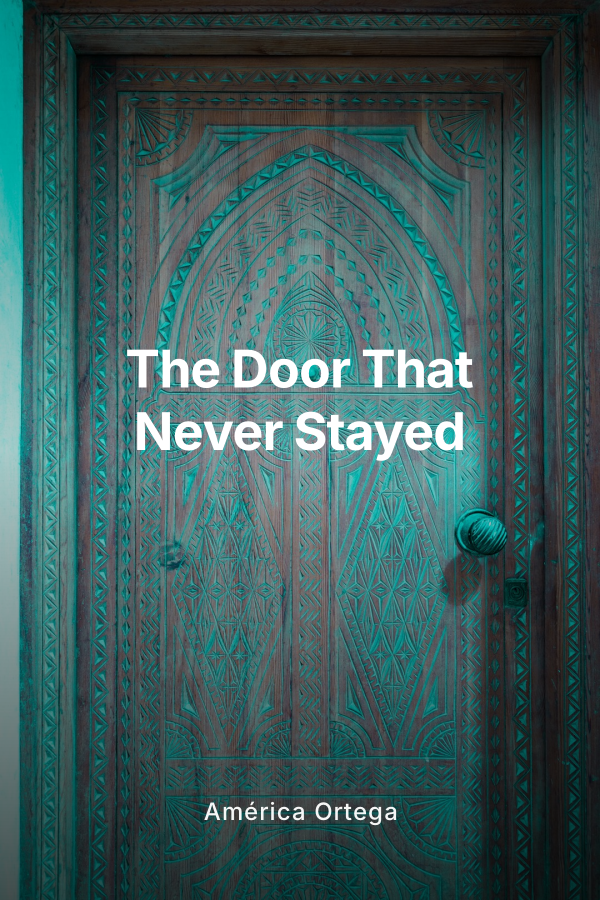
"The Door That Never Stayed" invites readers into a world where intimacy and liberation blur into obsession and erasure. It asks how far someone might go to feel fully alive, and what is left of a person when desire and comfort finally succeed in stripping away every other claim on the self. The result is a story that is both intoxicating and quietly terrifying: a portrait of a young man who finds everything he thinks he wants behind one cheap apartment door, and in doing so, may lose himself forever.