Summary
In the shadow of Nockmaar’s black citadel, a child is born with hair like living fire and hands that tremble at the thought of hurting even the smallest creature. Her name is Nova, second daughter of Queen Bavmorda and younger sister to Sorsha. Once, she is soft as morning light, a girl who sings to frightened horses and sneaks bread to condemned prisoners. Then Bavmorda discovers the truth: Nova carries her blood, her magic, and a shifter’s gift. To the Queen, she is no longer a child. She is raw material.
Systematically, cruelly, Bavmorda breaks her. She twists love into reward and pain into doctrine. A praise starved Nova learns to worship her mother as a god whose happiness is the only law that matters. Every success earns an embrace, a smile, a rare whisper of “my good girl.” Every mistake is carved into her skin, her bones, her mind. She learns to slip between forms, to hunt as a dire wolf and rain fire as a dragon. Nockmaar comes to fear her as “the Queen’s dog,” a beautiful monster at Bavmorda’s side. Only Sorsha remembers the girl Nova used to be and secretly vows to drag her sister back toward the light, even if it means shattering them both.
When prophecy names a child with a rune birthmark as Bavmorda’s doom, Nova becomes the blade that will cut the future apart. She hunts the pregnant women of the realm, her wolf form padding through snow and smoke. Yet even at her most obedient, one thing in her refuses to bend: she will not harm a child. To protect her power, Bavmorda lies to Nova about her own body, convincing her that every drop of blood is a lost child and that she is incapable of bearing life. It is another chain, another cage, and Nova never questions it. She believes she was born only to serve, to kill, to keep her mother’s throne safe.
But destiny intervenes in the smallest of ways. The prophesied baby, Elora Danan, slips through Nockmaar’s fingers and into the world of Nelwyn farmers and bumbling would‑be sorcerers. As Willow Ufgood and his companions struggle to protect the child, Nova stalks them through forests, mountains, and ruined keeps, a relentless hunter with golden predator eyes. At every turn, her path winds closer to a man who should have been nothing more than another corpse at her feet: a charming, half‑mad swordsman in battered armor, with the reckless heart of a golden retriever and the grin of a born troublemaker. His name is Madmartigan.
Their first encounters are built on steel and snarls. Nova mocks his bravado, tries to break his body and his spirit the way Bavmorda broke hers. Madmartigan, ever the shameless flirt even in mortal danger, answers her claws with a crooked smile and infuriating compliments. In stolen moments between battles, in cramped tents and snow‑bitten camps, they circle each other like predator and prey. She tells herself he is just another target, another distraction from the screaming in her own head. He is too foolish, too loud, too alive.
Yet his hands are gentle where her world has only known force. His eyes soften when he hears her cry as a beaten wolf. He treats her as a woman, not a weapon, and the fire in her that once burned only to kill begins, against her will, to warm. Their enemies‑to‑lovers journey tangles itself into the core of the original Willow tale: the chase through the crossroads, the snowbound flight down mountain slopes, the refuge in Tir Asleen’s haunted halls, the desperate stand at Nockmaar’s gates.
Madmartigan becomes her maddening equal, her rival and shield, a man whose desire is as unashamed as his tenderness. Nova, feral and terrified of her own feelings, meets him with claws, teeth, and a tsundere temper that masks a heart starving for any love that is not conditional. Between them, sexual tension aches like a pulled bowstring. Bound hand and foot, pinned against his chest on horseback, or facing him with steel bared on a frozen ridge, Nova learns to recognize the difference between domination and devotion, between being used and being cherished.
Without ever fully loosening from the film’s storyline, their relationship threads itself through familiar scenes. As Willow fumbles with spells and Raziel fights to reclaim her true form, Nova and Madmartigan are locked in their own war of touches and denials, kisses stolen in chaos, bodies pressed together under the noise of battle and storm. Nova thinks she cannot bear children, that her body is forever barren by divine decree. Madmartigan knows otherwise long before she does and treats the life growing between them as a miracle. To him, she is not Bavmorda’s dog but the center of a future he refuses to surrender.
The closer they come to Nockmaar, the more the old chains tighten. Nova stands in the heart of her mother’s fortress, Elora in reach, the ritual prepared, Bavmorda’s praise a poisonous promise in her ears. She is torn between the god‑mother who made her and the man and child who somehow, impossibly, make her feel human again. On the battlefield she unleashes her dragon form at Bavmorda’s command, raining terror upon her enemies, only to be forced back into her human skin by Raziel’s desperate magic. Stripped of her monstrous shell, she faces both armies as simply Nova, no longer able to hide what she has become.
The final clash at Nockmaar is not only a struggle for the fate of the world but for the remnant of Nova’s soul. As Raziel duels Bavmorda and Willow fights with wits instead of strength, Madmartigan battles his way to Nova not to save her from death but to save her from her own belief that she is nothing but a weapon. When he finally reaches her, it is not an order or a threat that breaks her, but a kiss that burns through the lies layered over her since childhood.
Bavmorda falls. The Queen‑god dies. Nova is left with a grief so raw it almost kills her. For all the horror, Bavmorda was her sun, her purpose, her entire sky. The victory feels like betrayal, and the freedom she is offered tastes at first like ash. In the uneasy peace that follows, the world expects a neat redemption: the monster becomes a hero, the Queen’s dog becomes the kingdom’s guardian. Reality is harsher. Nightmares linger. Guilt chokes. The dragon within does not die.
It is Raziel, patient and fierce, who steps into the role Bavmorda only pretended to fill, becoming a true mother to both Sorsha and Nova. Where Bavmorda demanded perfection, Raziel offers presence. Where Bavmorda punished weakness, Raziel tends it like a wound. Slowly, painstakingly, she helps Nova learn that love is not something earned by obedience, but something given and chosen.
At Nova’s side, Madmartigan remains as relentless in love as he once was in battle. He flirts, he teases, he worships every scar as proof that she survived. He smothers her in kisses, laughs through her snarls, and never once asks her to be the sweet child she used to be. He accepts the sharp edges, the dragon temper, the wolf wariness. To him, her danger is not a flaw to fix but a fire to guide, a warmth to share. Together with Elora, the child who once chose Nova as her mother before either of them knew it, they form a family forged not in perfection but in stubborn, scarred devotion.
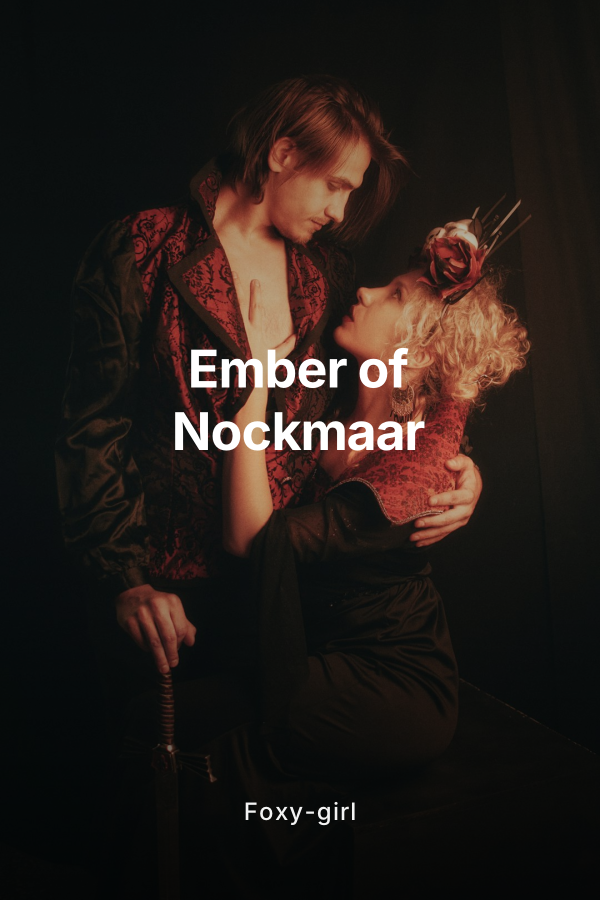
“Ember of Nockmaar” is a dark romantic retelling set within the events of the 1988 film Willow, interweaving canon adventure with an intense, enemies‑to‑lovers arc. It explores how a gentle soul can be broken into a weapon, how loyalty can be twisted into worship, and how love that is patient, persistent, and a little bit reckless can coax a monster back toward humanity.
Across twenty chapters of detailed scenes, intimate dialogue, and vivid sensory description, the story traces Nova’s journey from terrified child to Bavmorda’s feared enforcer, from merciless hunter to desperate protector, and finally from living blade to woman, partner, and mother. She never becomes that innocent little girl again. Instead, she becomes something entirely new: a soft‑edged storm, a dragon who would rather wrap herself around her family than burn worlds, a wolf who has finally chosen her own pack.