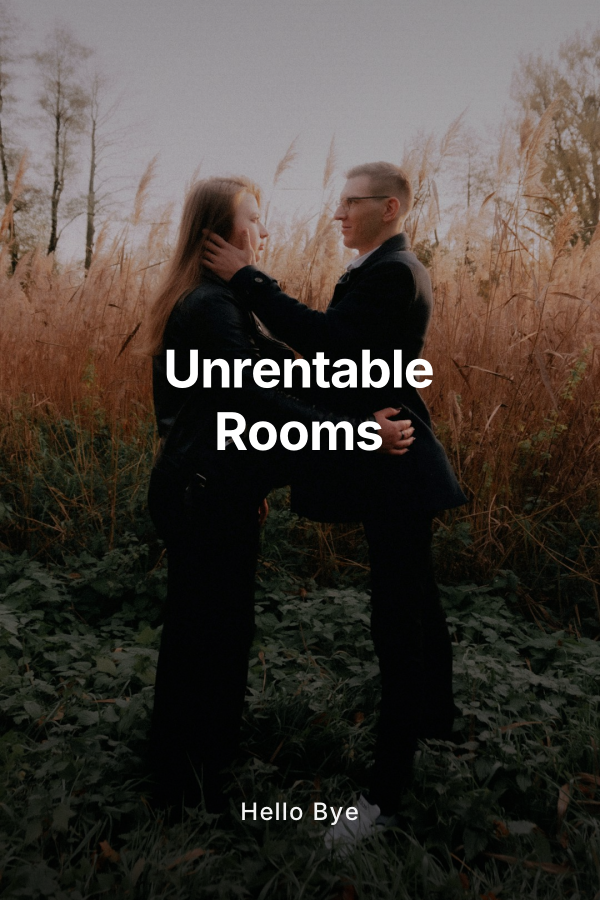
Summary:
Alec Rivera is twenty and exhausted. Between a full course load at a local college and endless shifts folding shirts at a retail chain in a fading East Coast mall, his life has shrunk to fluorescent lights, student debt, and apologetic texts to the friends and family he never sees. When he stumbles across an apartment listing that feels like a typo in the universe budget price, central location, suspiciously vague description he signs the lease without asking too many questions. It is small, old, a bit run-down, and perfect. It is also the place where his life quietly steps out of time.
The first change is almost nothing. One night after closing up at the store, Alec unlocks his door to find his apartment cleaner than he left it, his thrifted couch replaced by another model, and a stranger sitting amid the unfamiliar furniture as if he belongs there. The stranger, Blake, is Alec’s age, broad-shouldered and bruised from constant training. An athlete caught between minor leagues and a professional dream that keeps slipping away, Blake complains about his coach, laughs at Alec’s jokes, shares leftover takeout, and falls asleep on Alec’s shoulder halfway through a movie. In the morning, Alec leaves for class distracted but oddly light, as if he has finally made a friend who understands what it costs to never be enough.
The second change is larger. Another late return, another key in the same door, and Alec’s apartment is not his at all. Different layout, different city view, different year flickering at the edge of the news on a low television. This time the young man inside is Carter, a former college student who once tried to work and study at the same time, then broke under the weight. Now he lives on his parents’ money and their disappointment, oscillating between numbness and rage. He and Alec talk until dawn about exams, panic attacks, and what it feels like to keep breathing out of habit rather than hope. When they finally touch, their sex is not a distraction from pain but an admission of it. For one long night, their bodies offer each other the kindness neither knows how to extend to himself.
Every time Alec comes home, the apartment shifts. Sometimes the changes are subtle, sometimes complete. There is a new crack in the ceiling where he has never seen one, a different brand of cereal in the cupboard, unfamiliar shoes by the door. The man inside is always roughly his age, always a stranger, always on the run from a life that is crushing him. Diego, an aspiring chef, fights to buy ingredients and pay rent, turning thin grocery bags into feasts born of anxiety and obsession. Essay, a dropout starved on cheap paperbacks and online archives, speaks in tangled monologues about literature and walks around shirtless because he forgets to finish dressing. Finn, a former junior circuit racer who burned through his future in travel costs and spare parts, is now an engineering student convinced he traded a fast, bright life for a slow, respectable suffocation.
With each new arrival, Alec’s apartment becomes less an address and more a crossroads. Every lover offers him a different vision of what it means to fail, to pivot, to try again. At first, he treats each encounter as a fluke, a strange, vivid dream he cannot quite remember during the day. He heads to class, clocks in at work, answers his parents’ check-in calls with canned assurances. His real life happens under artificial light while his heart drifts toward the place that is never quite the same twice.
As weeks slide into a blurred season, the rules in the apartment begin to mutate. What seemed like clear boundaries one night, one man, one moment in time begins to fray. Alec comes home and finds two of his lovers cooking together in a kitchen that belongs to neither of them, moving around each other with the unstudied ease of old friends. Another time he wakes to find that the bedroom and the bathroom exist in different years, the hallway stretched between them like a seam where time has snagged. Outside the windows, cities flicker and rearrange. Sometimes the skyline is his own, sometimes a foreign one he cannot name, sometimes only mist and distant traffic that seems to echo from several eras at once.
No one, not even Alec, ever comments on these impossibilities. The men greet each other like housemates: pour coffee, borrow shirts, steal bites from one another’s plates, curl up together on the mismatched couches that phase in and out of existence. When they touch, it is with a natural, cumulative intimacy, as if they have been building this shared life for years. Alec’s relationships with them deepen in all directions: tender, needy, jealous, playful. Sex becomes the language through which they prove they are real, that their lives matter, that there is still warmth in bodies the world has deemed inefficient or not quite good enough.
The more Alec surrenders to the apartment’s strange rhythm, the more the outside world recedes. He starts skipping class, then entire days of work. His phone fills with unread messages and missed calls his mother’s worried voice, a manager’s ultimatums, automated warnings from financial aid. Inside the apartment, no one asks about due dates or shifts. No one tells him to hurry, to earn, to optimize. His only responsibilities are the shared groceries that restock themselves, the dishes that sometimes blink clean, the hearts and bodies tangled around his own.
As the boundaries between rooms and eras collapse, the apartment stops pretending to be a series of isolated moments and reveals itself as a continuous, shifting organism. Time loops back on itself in small glitches: a conversation Alec is certain he has already had, a bruise that appears on his hip before anyone touches him there, a half-open book in a language he does not know yet somehow remembers from another night. Lighting and weather defy logic. Rain lashes the living room windows while summer heat presses against the bedroom glass. Morning sunlight wedges itself into midnight.
The men, too, begin to blur. Traits echo from one body to another, as if the apartment is rearranging familiar elements into new configurations. A scar moves from Blake’s eyebrow to Finn’s jaw. Diego develops Essay’s habit of leaving sticky notes with half-finished thoughts all over the walls. Carter and Alec share the same childhood memory down to the smell of the detergent in their mothers’ laundry rooms. The differences between them remain, yet a strange recognition deepens: in each of these lovers, Alec glimpses a version of himself that could have been, or might still be in some other unchosen life.
By the time Alec realizes that he cannot remember the last time he stepped out into the street or felt weather directly on his skin, it may already be too late for common sense. His body lives in the apartment now. His schedule has inverted. Days and nights are marked not by clocks but by the rise and fall of voices and the slow unwinding of touch. The outside world filters in only as interruptions: the occasional ring of his phone, the flash of an email notification on a forgotten laptop, the folded envelope from his landlord that appears once in the stack of conjured mail and then vanishes before he opens it.
Still, beneath the warmth and pleasure, a faint unease hums. There are small prices that no one articulates. Sometimes after particularly intense nights, Alec wakes with an unfamiliar ache in his chest, as if he has cried in his sleep over something he cannot name. Sometimes one of the men will pause, hand on the doorknob, look back with a half-formed question in his eyes, then shake it off and rejoin the group. There are rooms in the apartment Alec never quite manages to enter, doors he always reaches just as someone else closes. The rules of the place exist, but only as a negative space shaped by instinct and avoidance.
The story moves toward its climax on a day that arrives like any other. The apartment is full, humming with low music and overlapping conversations. For once, everyone is there at the same time: Blake stretching sore muscles on the rug, Carter smoking out the kitchen window, Diego stirring something fragrant on the stove, Essay reading aloud from a dog-eared book, Finn sketching designs on scrap paper and laughing with his head thrown back. Alec moves among them like a planet in the center of a crowded solar system, drawn and held, his loneliness finally answered from all sides.
Desire swells, undramatic and inevitable. A teasing touch turns into a kiss, another set of hands, a body pressed against his. The lovers fold into one another on the living room floor, the couch, the hallway. It is not a chaotic pile but a slow, reverent choreography, years of shared comfort and fear distilled into a single act. They take their time. They learn each other’s rhythms all over again. Words and names blur into breath. In this suspended space, there is no debt, no expectation, no punishment for wanting too much.
In the middle of this, Alec’s phone rings. The sound is shrill and thin against the warm hush of bodies and whispered names. The caller ID flashes up like a relic from another life: “Mom.” He answers, hand shaking slightly, the distant sound of his parents’ anxious voices reaching through the speaker, asking where he is, begging for a sign that he has not disappeared. They have tried everything, they say. They are outside his building now, on the landing, at his door.
Alec hears them knock. The echo carries through his real front door and through the walls of whatever version of the apartment he currently inhabits, making all the lovers pause for one breath. The knock becomes a drumbeat timed to his heart. For a fragile instant, he stands on a private knife edge between lives: the one he was born into, with all its obligations and ordinary love, and the one he has crawled into, with all its impossible warmth and unpayable cost.
He chooses. Quietly, deliberately, he lifts the phone, listens to his parents call his name, and then, without answering, tosses the device away. It skids out of sight behind a stack of books or a different couch or into a decade he will never visit. He turns back to the men who have, in their own scattered, broken ways, made him feel fully seen. As he returns to them, the apartment seems to inhale. At the peak of pleasure, something tears and seals at once.
Outside, in the very ordinary hallway of a very old building on the American East Coast, Alec’s parents unlock his door with a spare key the landlord grudgingly provided. The room they enter is silent, empty, and perfectly still. Dust on the furniture, a thin ring of grime in the shower, clothes folded in drawers as if he meant to return yesterday. No sign of struggle, no forced entry, no son. It is as if he has stepped cleanly out of the world.
Unrentable Rooms is a queer, explicit, emotionally charged novella of magical realism about the temptation of escape and the price of belonging. Through Alec’s journey, the book explores how young men marked as failures by family, institutions, or economics seek solace in one another’s arms, and how love that feels like survival can also be a surrender. The apartment’s rules remain ultimately mysterious. Is it a refuge, a trap, a sentient witness to wasted potential, a convergence of parallel lives, or some tender catastrophe stitched into the fabric of time itself? The story refuses to settle on an answer.
What is clear is this: Alec gains a community that understands him in ways the outside world never tried to. He experiences a depth of intimacy and acceptance that makes the rigid structures of school, work, and familial expectation seem thin and unreal. He loses, perhaps forever, the chance to reconcile with those who loved him first, the possibility of growing older in the ordinary sense, the messy continuity of a life that unfolds in a single timeline.
By the final page, readers are left not with a moral but with a question that lingers long after the door closes on the empty room. In a world that demands constant sacrifice, what counts as running away, and what counts as finally coming home?