Summary:
Evelyn Mercer has always loved the kill.
In the stark light of the courtroom she shines as a weapon in designer heels, a corporate lawyer who strips old families of their land and leaves them with nothing but paper and rage. The Mercer name and the cold glass towers she serves are built on the humiliation of others, and Evelyn enjoys every controlled gasp, every broken expression on a defeated face. She likes being the workhorse no one can stop, the elegant predator in a tailored suit.
So when she wins the case that seizes the crumbling Voss estate for a hungry developer, it feels like just another victory. Mr. Voss is only an old man, thin as parchment and trembling, who clutches the edge of the plaintiff’s table while the judge reads the verdict. Evelyn meets his eyes and smiles as his legacy is torn away.
On his way out of the courtroom, he grips her hand in a chill that bites straight through her skin. In that touch the mask of senility crumbles, and something cruel and ancient looks back at her. In a voice that seems to echo with leaves and distant hooves, he curses her to be hunted and tormented, to know the life she has given others.
Evelyn laughs it off, the way she laughs off every threat of appeal.
That night, beneath city lights and carefully curated solitude, the curse wakes.
Her bones lengthen with an audible crack. Flesh twists. Her legs split, stretch, and grow into something powerful and fourfold. Her spine pulls like it is being hoisted on invisible hooks, dragging her screaming across the floor. Her clothing tears away as if the fabric itself recoils from what she is becoming. Skin turns to short, white hair. A blond tail unfurls and lashes in blind panic behind her. Her human sex melts and reforms into those of a mare while nerves burn like open wires.
She retains her face, her hair, her brown lawyer’s eyes, but her torso thickens with muscle and weight while her breasts swell monstrously heavy, straining at the shreds of her torn shirt. She is stretched and fused, human from the waist up, horse from the hips down, a grotesque centaur that should not exist.
In raw shock she drags herself to a mirror, desperate to see if this horror is real.
The glass flexes like liquid. A rift of absolute black opens in its surface. Tendrils of shadow, thick as ropes and soft as smoke, coil out and seize her limbs. Evelyn is hauled screaming through the mirror as her apartment vanishes. The portal slams shut behind her.
She awakens in the Feywild.
The forest that surrounds her is dark and wrong, a place of twisted trunks and whispering boughs where twilight never fully lifts. Here the curse takes on depth and teeth. Leaves rustle with a voice that calls her pale mare. Branches creak like the bending of necks. Hunger gnaws at her new body, and thirst scours her throat. She staggers on unfamiliar hooves, wrapped in the tattered scraps of her former life, refusing to believe that her human body is truly gone.
The Feywild does not care what she believes.
It watches.
Spriggans with bark-like flesh and ember eyes bind her in barbed vine ropes and taunt her like an animal that has somehow learned to speak. They take her last covering, leave her exposed and helpless, and joke in strange, ritualistic phrases about her strange double body. Evelyn learns how easily four strong legs can be tangled and rendered useless, how quickly her new strength turns to impotence when she is treated not as a person but as livestock.
When she escapes them, the forest takes her again in subtler ways. Cursed fruit and black water force feverish dreams of walking trees and hunting branches. A tree-creature stalks her, held back only by streams that burn her hide with acid pain yet leave no scars. She begins to suspect that this forest has chosen her, but not as a guest. As prey.
Then come the Hollow Sisters.
Three fey witches, scaled and lizardlike but with ragged white hair and voices like cracked bells, discover her half-conscious by a lonely pond. They have never seen a human. They have never seen a centaur. To them she is a curiosity, a specimen, an animal that speaks in nonsense about a world beyond the trees.
They tie her down and begin to explore.
Their cruelty is methodical. They probe every inch of her hybrid form, neither gentle nor overtly sadistic, only coldly fascinated. They discuss her body in chanting, ceremonial language, as if she is a sacred beast laid on an altar. Her breasts, now swollen and heavy, become the focus of their experiments. They mistake them for misplaced udders, marveling that her equine half bears none. They pull, squeeze, and inspect, ignoring her pleas, her shame, and her strangled moans of pain.
They pour foul potions down her throat, some slick and cold, others burning hot, just to see what changes. Time disintegrates into nausea, hallucination, and an unending parade of humiliations. The forest whispers the same title again and again.
Pale mare.
When, to the witches’ delight and Evelyn’s horror, her chest begins to ache and drip with milk, they escalate. They harvest her, hands and tools working her swollen flesh while they comment clinically on color, taste, and yield. They call it blessing, fertility, rare reagent. To Evelyn it is an ordeal that blurs pain and unwanted pleasure until she can barely separate the two. Her body responds, betraying her with shivering peaks that she tries to deny even inside her own mind.
Her milk goes into their cauldron.
Their spells deepen. Their voices rise.
Evelyn becomes both victim and resource, milked and used, reduced to a living vessel that strengthens their magic.
A moth-like fey creature finally comes in secret to cut her bonds. It whispers that the forest has claimed her for other purposes, that she must find the fox lord if she wants answers. Evelyn runs, hooves pounding, chest aching, half-lost in the aftershocks of too many enforced awakenings of her nerves.
She finds no safety.
Werewolves capture her next, drag her to their den, and argue in low, hungry tones about whether to sell her, sacrifice her, or breed her. Her legs are bound. Her human arms are tied in intricate knots behind her back. She lies on her side, helpless, while they speculate about her like men discussing cattle.
A crippled goblin slave offers her a bargain.
He cannot run. She cannot free herself. He will guide her through the forest to the fox lord if she agrees to be his mount and obey. Desperate, Evelyn accepts. She kicks a werewolf unconscious to seize the chance, and the goblin rides her into the night, reins of twisted vine tight against her throat.
What begins as pure exploitation soon shifts into something far more complicated.
The goblin is vicious with his tongue and casually cruel, calling her stupid mare, tugging her head where he wants it, refusing to free her arms because horses, as he insists, do not need hands. He keeps her alive, fed, and hidden from greater threats. He also enjoys her humiliation, mocks her sweating flanks and aching chest as they travel. Every day he uses her, every night he ties her.
Her breasts, altered by the witches’ potions and by the strange ecology of the Feywild, fill relentlessly.
When the pain of pressure grows unbearable, Evelyn does something she never imagined: she begs the goblin to help her milk herself.
The first time is a negotiation that tastes like ashes in her mouth. She offers obedience in daylight, meekness under reins, in exchange for his help draining the throbbing weight in her chest. He calls the request disgusting but agrees, more to maintain control than out of mercy.
He learns quickly how to work her. She gives him instructions through clenched teeth and bitten lips, trying to keep her voice flat as his rough hands discover the rhythm that forces milk to flow. Her body betrays her again. Waves of unwanted pleasure crash over her, and she fights to keep her noises soft, to pretend she is not shaking apart from the inside.
He pretends not to notice. Or perhaps he truly does not understand what is happening to her.
But her milk is not just milk.
Small accidents begin to happen. A stray droplet on his tongue. A taste taken in curiosity. Confessions slip out of the goblin that he did not mean to reveal, fears and old wounds spilling past his teeth while he stares in shocked horror at his own honesty. Evelyn is a lawyer at heart, even here, even now. She feels the pattern, weighs it, collects evidence in the quiet of her exhausted mind.
Every time someone takes her milk, their inhibitions drop. In larger, deliberate doses it does more. It drags truths out of them and lays them bare.
She is horrified.
She is fascinated.
She is tempted.
By the time she reaches the lair of the fox lord, a seven-tailed arch-fey who tests her with riddles and verbal snares, Evelyn has suffered enough to know that the forest will not heal her out of kindness. The fox lord is not a savior. He is balance in a cunning, dangerous shape. He cannot send her home. He cannot restore her human body. He tells her forest law, the old oaths the queen has broken, and hints at a path by which a pale mare might tip the scales.
If she is willing to use every tool the forest has given her.
That path runs straight through the heart of the unseelie court.
There she is captured again, collared and reined by a stag-lord who drags her before the dark queen. The collar drowns her thoughts in warm, soft fog. Her body moves at a signal she does not give, prancing and bowing like a show animal. The court watches, laughing and chanting ceremonial names for her: pale mare, milk-bride, forest’s vessel. She is led, displayed, handled, and finally milked as if she were nothing more than a prized animal.
Later, in the queen’s pasture, the stag-lord tries to breed her.
The collar strips her of dignity and thought, filling her with a sharp, instinctive heat that her mind can only scream against from a distance. At the last possible moment the fox lord intervenes, ripping the collar away and giving her a slender chance at revenge.
This time Evelyn does not merely run.
She stalks.
She returns to the stag-lord in his own hall, this time playing the role they have written for her. She lets him believe she is willing, that the pale mare’s heat has overpowered her human remnants. While he drinks from a cup she has laced with her own milk, she feels the echo of his arousal and fear ripple back through her, twisted and hot. It nearly makes her stop.
She does not.
The stag-lord spills everything: the queen’s hidden deals, the oaths she swore to the forest and then betrayed, the way she has taken and taken with no offering in return. Evelyn listens like a lawyer again, cataloguing every violation.
When she finally stands before the queen, surrounded by the court that once jeered at her, she does not come as a victim. She comes as a witness.
With the fox lord’s lore and the stag-lord’s milk-loosened confessions, she exposes the queen as an oath-breaker. In the Feywild, that sin is worse than cruelty. It is rot at the root. The court turns. The queen’s splendor unravels, revealing the small, vicious creature beneath. Evelyn watches without intervening as the same court that tormented her tears its own monarch apart.
In that moment Evelyn fully accepts what she has become.
She is not a human trapped in a nightmare. She is a centaur bound to a living forest, a guardian wielding the same humiliations once used to break her. Her milk remains a secret weapon, not a gift, a tool she chooses carefully, haunted by the memory of every involuntary shudder and helpless moan wrenched from her in chains. She has learned to dose it with deliberate intent, to feel the faint echo of others’ shame and desire, and to live with the knowledge that she is using bodies and secrets in ways that blur victim and predator.
The forest has changed her in ways she can never undo.
In a brief, final epilogue, a cruel fey intruder trespasses at the forest’s edge, wearing the same casual entitlement as those who once bound her. Evelyn confronts him not as a prisoner, but as the pale mare of the Feywild. She offers water. She offers a choice. When he mocks her, she lets him drink a measured sip of milk disguised in a cup of cool spring. She feels his mind soften, his arrogance tremble, his tongue betray him.
She takes what truths she needs, then stops.
She could break him. She could make him kneel in the mud and call it justice. Instead she marks the boundary and lets him leave, changed and shaken, carrying dreams of white hair and hot breath in the dark.
Evelyn watches him vanish between the trees, the ache in her chest familiar and heavy, and knows that if anyone ever comes to strip this forest as she once stripped others, she will be waiting.
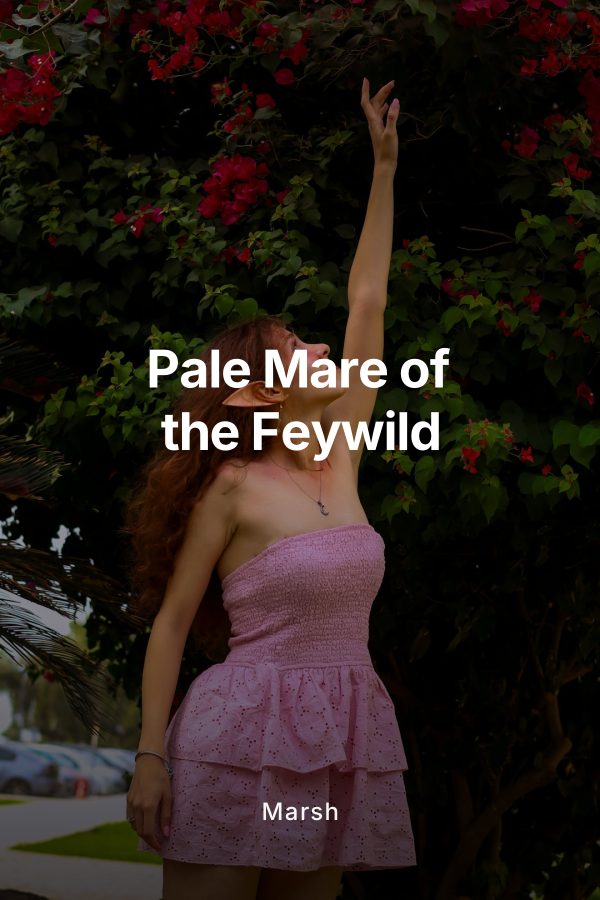
Pale Mare of the Feywild is a dark erotic horror novel that follows a ruthless human lawyer’s fall into a cursed wilderness where her body is reshaped into a centaur and her humanity is dismantled through captivity, milking, and ritual humiliation. Through witches, werewolves, goblins, and an unseelie court, Evelyn evolves from prey to ambiguous guardian, wielding the same tools of degradation that once shattered her while never fully escaping the arousing, unsettling power they hold over her own flesh and mind.