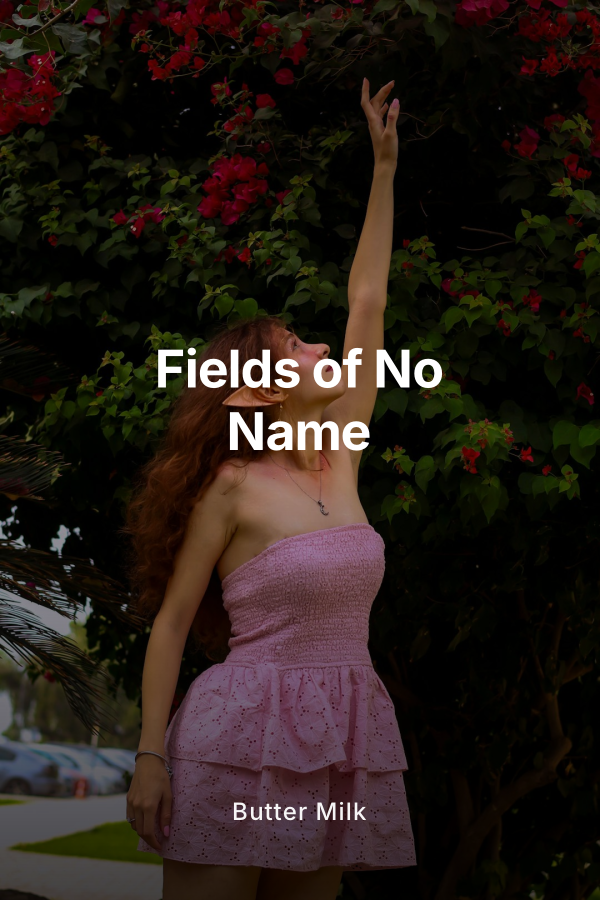
Summary:
The day Ivy opened the front door, she thought she was interrupting her comic book cataloging to deal with a delivery or a neighbor. Instead, she and six other girls from her town vanished into a system that pretended it no longer existed.
Drugged and transported in the dark belly of a cargo truck, Ivy wakes in a world that should belong to another century. Rows of failing cotton stretch to the horizon. A wooden longhouse serves as both barracks and cage. Overseers with whips and shotguns rule through hunger and terror. The girls are marched into an illegal forced-labor plantation that hides in plain sight behind fences, shell companies, and the complacent silence of those who profit from looking away.
Stripped of their hair, their names, and their clothes, they are told they are property. Their pasts do not matter. Their futures do not exist. The operation is meticulous: falsified paperwork and freight schedules, cash deliveries in unmarked envelopes, a network of “placement agencies” that supply expendable children. The compound itself is a closed ecosystem of cruelty: a barracks where exhausted kids collapse onto straw, a crude infirmary where infection is treated only if it threatens productivity, a “schoolroom” used not for education but for indoctrination and control, and a punishment shed whose door is the last threshold between innocence and permanent damage.
Yet in this manufactured nowhere, something the captors have not accounted for takes root.
Ivy, the quiet observer who once organized comic books by publication date, now begins to catalogue guards, shifts, perimeters, and weaknesses. London dissects the plantation as if it is a living organism, mapping routines, calculating probabilities, and noticing how supply trucks arrive and depart. Rochelle, whose courage costs her almost everything in the punishment shed, refuses to let her spirit go quietly. Aalyrah’s fury at injustice burns hot enough to scorch fear. Zoey, fragile and creative, finds ways to smuggle hope into the bleakest corners. Tender, anxious Laurie and small, terrified Harper draw everyone back to what is at stake whenever the desire for revenge threatens to eclipse the will to survive.
The plantation runs on an industrial logic: quotas measured in sacks of cotton, punishments calibrated to break without always killing, profit margins balanced against the cost of acquiring more children. There are older kids who have been here long enough to know when to look away, others who inform to secure scraps of privilege, and a system of colored tags and daily headcounts that turns human lives into inventory. Guards trade shifts like commodities, logging hours in a falsified ledger that keeps the whole operation synchronized with the world outside its fences.
Inside that brutal machinery, the seven girls carve out something fiercely human. At night, crammed together on scratchy mats, they whisper a new language of survival: a tap under the straw that means “I am still here,” a cough that signals a guard’s approach, a song hummed just below hearing that stitches them together when words are too dangerous. They share stolen bread and stolen minutes. They take turns absorbing punishments to spare one another. Slowly, their friendship becomes a parallel system, a quiet, subversive order that blunts the edge of the one imposed on them.
When Rochelle is dragged into the punishment shed and comes back hollow-eyed and broken, the fragile equilibrium shatters. It is no longer enough to endure. Ivy and London begin to treat the plantation like an enemy fortress, testing its perimeter through small acts of defiance: hidden notes passed beneath food bowls, paths traced in the dust near the wash barrels, careful timing of every bell and shouted order. They learn that this farm is not the only one, that there are “sister sites” fed by the same recruitment network and protected by the same corrupt intermediaries. What was once simply their personal nightmare reveals itself as part of a system larger, older, and more entrenched than any of them imagined.
As they dig deeper into the rhythms of the place, the operation’s world comes into sharper focus. Trucks arrive under cover of night, some loaded with fertilizer and feed, others with terrified cargo. A shabby office holds lists of coded shipments and falsified manifests. An aging foreman complains about costs, mentioning payments to a local official who is “keeping questions off our backs.” Ivy listens. London remembers. Together they convert overheard fragments into a map, not just of the compound, but of the pipeline that stole them from their lives.
The girls’ friendship evolves into something close to a resistance cell. Harper, who everyone thinks is too small to be useful, becomes the perfect lookout, slipping where adults cannot. Zoey, given extra time in the kitchen to scrub pots, smuggles information and small tools in dirty water buckets. Laurie, with her gift for easing tension, learns how to distract guards at crucial moments. Aalyrah and Rochelle practice moving silently with shovels and crowbars under the guise of night work. They begin to understand that escape will mean not only crossing the fence but also crippling the operation long enough to keep it from simply replacing them with new victims.
Their plan is brutal in its simplicity, anchored in the routines that once crushed them: Jed’s solitary midnight rounds, Silas’s nightly drunken stagger from the main house to his quarters, the feedings of the chained dogs, the blind corner near the rotted fence behind the old barn. When the night comes, friendship becomes a series of terrifying choices: who swings first, who distracts, who risks being seen, who stays calm enough to take keys from a fallen man who might not be dead. They learn in an instant that loving someone can mean striking hard enough to change a life forever, on both sides of the blow.
The escape through the forest is not a clean severing but a ragged tear. The girls carry with them rope burns, broken skin, empty stomachs, and memories that will not stay folded. Hunger and exposure batter them as surely as any overseer. Their friendship, however, has already been tempered in harsher fires. They divide what little food they find. They keep the weakest in the middle of the group. They argue about direction, about risk, about trust, and then keep walking anyway, because stopping is not an option.
When they finally reach a road and the door of an isolated farmhouse swings open on a horrified, compassionate stranger, the world outside the fences begins to move. Police raid the plantation. Reporters descend. Paper trails are uncovered, financial links traced, trucks impounded. Families are reunited in scenes that the news can frame but not fully comprehend. In the chaos, the girls discover that freedom is not the end of their story, only the beginning of a different kind of endurance.
Back in the world that forgot them, each girl’s path splits between healing and haunting. Ivy wrestles with guilt over every choice she made and did not make, even as she becomes a quiet leader in exposing the network that stole her. Rochelle transforms the worst thing done to her into a sharpened purpose, speaking publicly for those who never made it out. Aalyrah channels her fury into activism, refusing to let the story of the plantation be sanitized or simplified. Zoey paints the fields and the fences as blazing testaments rather than muted ghosts. London organizes survivors and allies, turning information into pressure that grinds at the gears of an industry too many still insist does not exist. Laurie and Harper build gentler lives that are no less brave, centering care, listening, and the small, persistent work of making sure no one in their orbit ever feels alone in the dark.
Fields of No Name is a harrowing, intimate novel of modern slavery, built for adult readers unafraid to look closely at how exploitation hides inside the everyday. It lingers inside the operation’s hidden world: its economics, its routines, its language of dehumanization, and the way whole communities can learn not to see. Yet at its core, this is a story about the power of friendship as a counterforce to industrial cruelty. Ivy and the others do not escape because they are uniquely strong or untouched by trauma, but because, together, they refuse to let the plantation’s logic define who they are or what they owe one another.
In a landscape of dust, quotas, and weaponized obedience, seven girls build their own invisible infrastructure: shared stories, silent promises, and an unspoken agreement that none of them will be left behind if there is any way to hold on. Their loyalty becomes the flaw in a carefully constructed system, the hairline crack that widens until the whole concealed world begins, finally, to break.