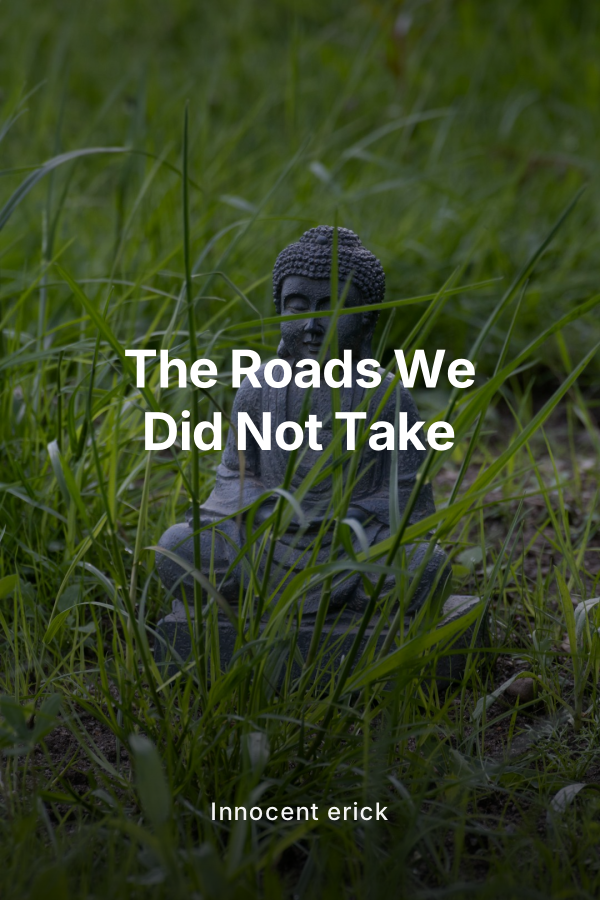
Only the first page of this book is left. We lost the rest in October 2026.
We lost access to the service that stored them, and no other copy exists. We're sorry.
Summary:
This book is an invitation to look steadily at the most unsettling questions a thoughtful person can ask: What should I have done differently? What else might have been possible? And, given all that did and did not happen, what can still make this one life worth living?
Written in an elegant yet approachable style, The Roads We Did Not Take moves between philosophy and ordinary experience, much as conversation after dinner may move from the tragic to the comic, from old grievances to new resolutions. It treats regret not as a private shame to be hidden, but as a universal evidence of our capacity for care, judgment, and hope. To regret is to concede that some things matter deeply. The problem is not that we regret, but that we rarely know what to do with regret once it arrives.
Across five chapters, the book traces a quiet progression. It begins where most of us live: in the restless habit of replaying scenes from our past and rehearsing dialogues that will never occur. It asks why imagined conversations can feel more vivid than the real ones we once had, and why the “better self” who speaks in hindsight so rarely existed at the time. Through clear analysis and wry observation, the reader is guided to see regret as a conversation between two versions of oneself: the person one was when acting, and the person one has become while judging.
The second part of the book lingers over the torment of possibility. The reader is invited to examine the strange arithmetic by which one life always seems insufficient when compared with the infinite catalogue of lives that might have been. Everyday examples from friendship, career, and love illustrate how the culture of “keeping options open” can leave a person sentimental about every path except the one actually taken. Against this restless ideal of infinite choice, the book offers a more modest vision of freedom: not the ability to be everything, but the willingness to be someone in particular.
From here, the narrative turns toward the present. If the past is closed and the future uncertain, what remains is the only tense in which we are permitted to act. The third chapter explores how attention, commitment, and ordinary decency can quietly transform a life that, on paper, looks unremarkable. Small scenes of daily courtesy, private loyalty, and dutiful persistence are treated with as much seriousness as grand achievements. With a tone of gentle irony, the book exposes how easily people dismiss their own real sources of meaning while envying more glamorous, but often more fragile, lives.
The fourth chapter concerns reconciliation: not a sentimental forgetting of injury, but a thoughtful arrangement with one’s own history. Here regret is reinterpreted as unfinished grief for the person one might have been. Through reflective questions and deftly drawn social situations, the reader is encouraged to sort regrets into three categories: what must be mourned, what can be repaired, and what must be forgiven without excuse. This process does not promise a spotless conscience, only an honest one, and suggests that such honesty may be the beginning of self-respect.
The final chapter asks, almost boldly, what makes a life worth living at all. Refusing both grandiose answers and fashionable despair, it argues that worth is found less in rare moments of triumph than in a pattern of choices that acknowledge the worth of others. The book considers love, friendship, work, and solitude as different ways of saying yes to the same question: whether another person’s good is something to which we are willing to be answerable. In this light, a worthwhile life is not a life without regret, but a life whose regrets have educated rather than embittered the heart.
Throughout, the prose maintains a lightness that prevents the subject from becoming oppressive. Ironic observations about social manners, romantic expectations, and the subtle competitions of everyday life keep the tone humane and recognisable. Philosophical ideas are introduced through simple narratives, conversational in style, so that a reader with no formal background in philosophy can follow without strain. Each chapter closes with a handful of questions, not as assignments, but as invitations to more candid reflection.
The Roads We Did Not Take does not offer a method for perfect happiness, nor a set of rules that will guarantee that one never feels regret again. Instead, it proposes something at once more modest and more demanding: a way of thinking that permits us to remain on speaking terms with our own past, to welcome possibility without worshipping it, and to find, in the limited and particular life actually lived, a ground for gratitude that does not insult our sorrows.