Summary:
Liam never wanted to be noticed.
Tall but breakable, with soft features and long sleeves that hide more than just skinny arms, he crosses campus like a ghost. His parents pretend he doesn’t exist now that they suspect he is gay, and the guys in his dorm make sure he remembers exactly how “wrong” he is. Bruises bloom where no one can see. Tears fall only when the door is locked and the lights are off. For Liam, survival means staying small, quiet, forgettable.
Then he gets a new roommate.
Micheal is everything Liam has learned to fear. Taller than anyone on campus, built like a weapon, with pitch black hair, a scar dragging across one ruthless eye, and tattoos that crawl up his arms like coiled dragons. No one knows much about him, except that people move out of his way without being told. Underneath his cold silence lies a secret that could get anyone near him killed.
He is the head of a Yakuza family.
Micheal hates weak men. He has spent his entire life breaking them, bleeding them, teaching them that the world chews softness apart. Violence is the only thing that ever made sense, the only place he feels anything at all. Until Liam.
Thrown together as roommates, they start off as strangers crossing the same narrow room. Liam tiptoes around Micheal’s presence, trying not to breathe too loudly. Micheal barely looks at him. But when Liam’s bullies go too far one night in the rain, Micheal sees the aftermath: the trembling hands clutching a soaked hoodie, the split lip hidden by a sleeve, the way Liam pretends he is fine even while he shakes.
Something in Micheal falters.
He does what he has always done with threats. He hunts the bullies down with quiet fury and leaves them broken on the pavement, yet when he turns back to Liam, his hands shift from brutal to gentle. He touches Liam like he might shatter him by accident. And that confuses him more than any knife ever has.
From there, their slow-burn connection unravels in stolen moments and unspoken tension. Liam starts bandaging Micheal’s bloody knuckles when he stumbles in at 3 a.m. smelling like rain and iron. Micheal starts coming back to the dorm more often without knowing why. They trade awkward small talk that accidentally turns honest. A brush of fingers passing a mug. An accidental shoulder touch that lingers a second too long. A night where they lie awake in parallel beds, breathing the same air, neither brave enough to cross the distance between them.
Their first kiss is not planned. It is quiet, confusing, and over too fast, leaving a silence heavier than any insult Liam has ever swallowed. They do not talk about it. Instead, they orbit each other, closer and closer, until every argument feels like foreplay and every touch feels dangerous.
But Micheal’s world is not the kind that lets softness live.
His Yakuza family has enemies, and at the center of that war is a brother full of poison. Micheal’s younger brother has always lived in his shadow, watching the title of boss land on Micheal’s shoulders instead of his own. Jealousy becomes ambition. Ambition turns into betrayal.
Behind Micheal’s back, his brother feeds information to a rival syndicate. Locations. Schedules. Weak spots. And the weakest spot of all: the quiet, pretty boy who lives in Micheal’s dorm room and still flinches when doors slam.
Liam senses something wrong before anyone else. Half-heard conversations, glances that last a second too long, tension humming under Micheal’s skin when his brother enters a room. Liam tries to warn him, stumbling over his own fear, but Micheal is too used to being untouchable. He dismisses it as paranoia, another sign of Liam’s fragility.
Until the night everything explodes.
Liam is taken.
The kidnapping is not cinematic or clean. It is rough, chaotic, full of hands that grab too hard and voices that spit slurs in his face. A gun goes off too close to his ear. A blast tears through the air. Pain hits, sharp and blinding, then fades into something worse.
Silence.
By the time Micheal finds him and drags him back to his family home, Liam believes it is temporary, just shock. Surrounded by unfamiliar walls and Micheal’s private doctor, Liam waits to hear the world come back. It never does.
His hearing is gone.
What follows is not just physical recovery. It is the disorienting, lonely horror of losing the sound of his own life. No more footsteps in the hallway. No more lectures humming in the background. No more whispered apologies from strangers passing by. No more voice from the other side of the room that Liam secretly found calming, even when it was clipped and cold.
The world goes quiet, and for a while, Liam does too.
He pulls away, wrapped in anger and grief. Not screaming, not blaming Micheal out loud, but retreating into a numb distance that hurts more than any slap. He convinces himself that Micheal is here only because he feels guilty, because he thinks he failed to protect what is “his.” Liam doesn’t want to be a symbol of regret. He doesn’t want to be a weakness weaponized against the man he is starting to love.
Micheal, who has never had to work for connection, finds himself on the outside of Liam’s silence. For the first time in his life, he is powerless in a way that violence cannot fix. He cannot kill the damage. He cannot slice the silence open with a knife and drag sound back out for Liam. All he can do is stay.
So he does.
He sits by Liam’s bed, motionless for hours, learning how to slow his world to match Liam’s. He starts tapping Liam’s shoulder instead of calling his name. He angers the family doctor with constant questions, demands to know every tiny detail about Liam’s condition, even when the answer never changes: permanent.
He learns sign language, badly at first, then with a kind of desperate precision that surprises everyone. He forces his massive, calloused hands to shape gentleness. He practices in the mirror at night, clumsy signs illuminated by dim hallway light. He repeats the words that matter most: stay, safe, sorry, please.
As Liam adjusts to a new way of living, their relationship transforms. Arguments no longer explode in shouted words, they crack in sharp gestures and stormy eye contact. Misunderstandings twist into silence that hurts, but they also push Liam to stand his ground. He refuses to be treated like glass forever. He refuses to let his deafness turn him into the “weak” thing Micheal claims to despise.
Micheal, slowly, is forced to admit that Liam is the strongest person he knows.
In the background, the war with the rival Yakuza group escalates. Micheal becomes more terrifying on the streets, more ruthless in meetings, more blood-soaked in alleyways. The same hands that sign gentle words to Liam choke the life out of enemies a few hours later. He no longer fights for control of territory only. He fights because someone touched what he cares about.
His brother uses that rage against him.
In a final, brutal clash, Micheal is lured into a trap where Liam becomes bait. The truth spills out under flickering warehouse lights: his brother’s jealousy, his calculated betrayal, his disgust at Micheal “lowering” himself for a fragile boy who cannot even hear. He mocks Liam to Micheal’s face, taunting him for falling for someone so “weak” that a single gunshot broke him.
Micheal’s control snaps.
He almost kills his brother right there, hands locked around his throat, vision tunneling into red. The world narrows to the urge to erase this betrayal permanently. To rip the problem out at the root. To prove that no one uses Liam against him and survives.
And then Liam touches his arm.
No long speech. No dramatic plea. Just a quiet, broken request spoken with his eyes, his shaking hands, and a few signs Micheal has taught him. Stop. Enough. Do not become the monster they already believe you are.
Micheal lets go.
His brother lives, but their bond is severed completely. The war does not end. The danger does not disappear. If anything, the line between Micheal’s world and Liam’s becomes sharper, harsher, edged with constant risk.
Yet in the middle of that chaos, Liam makes a choice. He stops seeing Micheal as a savior who failed him, and starts seeing him as he is: violent, scarred, complicated. A man who loves through protection and possessiveness instead of pretty words. A man who will never walk away from the Yakuza, because it is the only life he knows how to survive in.
Liam decides to stay anyway.
Their intimacy shifts from hesitant touches to something fierce and consuming. They do not magically become healthy or perfect. They use sex as apology, as comfort, as a way to say what both of them are still too afraid to confess out loud. They argue hard and make up harder. Micheal finds himself doing things for Liam he swore he would never do for anyone: slowing down, yielding control, learning how to listen without sound.
He never calls Liam his. He never claims him in pretty declarations. But he stands too close in crowded rooms. He shadows Liam’s steps when they are off campus. He threatens anyone who even looks at Liam the wrong way, always in secret, always from the shadows. When Liam finally confronts him about it, Micheal only looks at him with that sharp, unreadable gaze and refuses to deny it.
By the end, every secret is out in the open. Liam’s past with his homophobic parents. Micheal’s childhood twisted around violence and power. The rotten envy rotting his brother from the inside. The way Liam’s kidnapping was not random at all, but a direct hit on Micheal’s one soft spot.
Their world does not get safer. Micheal does not retire from the Yakuza to open a café. The streets still run with blood. Enemies still watch from the dark. Liam still wakes up to days where the silence feels too heavy, too absolute.
But in that silence, there is also something else.
A hand on his back, guiding him. A pair of dark eyes he can read better than any voice. Rough fingers forming clumsy signs that slowly become fluent. An unspoken promise that as long as they are both breathing, they will not let go.
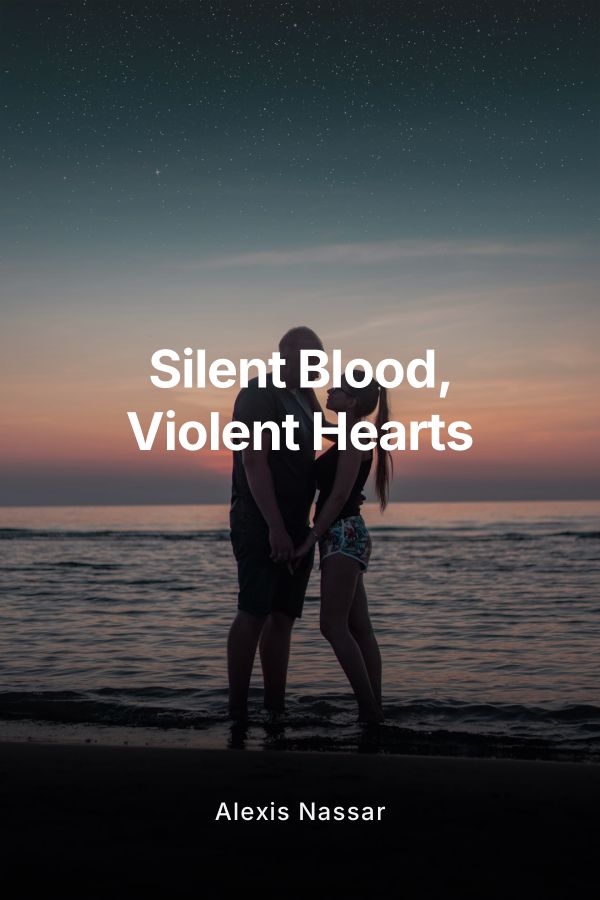
Silent Blood, Violent Hearts is a dark, emotionally charged romance about two broken men learning how to love in a world that keeps trying to tear them apart. It is about the weight of violence, the cost of survival, and the way intimacy can grow in the shadows of things that should have destroyed them. There is no tidy happily ever after, only this:
They are together. They are in love. The danger never leaves.
And for them, that is enough.