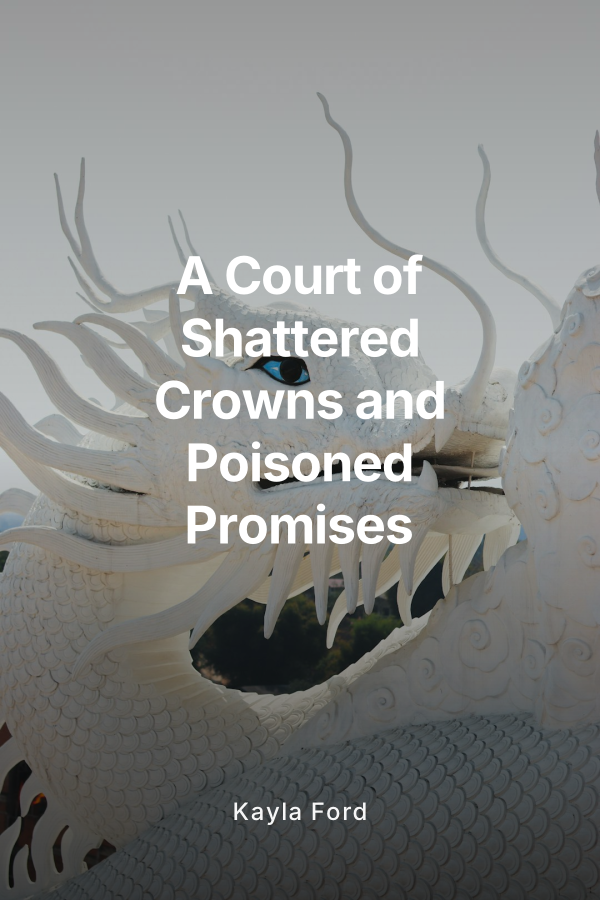
The Unseen Heir
Subtitle: A Court of Shattered Crowns and Poisoned Promises
In the glittering cruelty of the Seelie Court, power is performance and mercy is weakness.
Maeve is a half–fae outsider with nothing to her name but the memory of a mother who vanished in fire and silence, a faded lullaby of a court that should not exist, and a hatred for the nobles who sneer at her blood. Raised in the shadow of a splintered past and an adoptive father who speaks in careful omissions, Maeve has learned that survival in the palace of light requires sharper teeth than any monster of the dark.
The Tournament of Worth is meant to be a spectacle. Each generation, the nobles of the Seelie Court throw their heirs into a gauntlet of trials to prove who is worthy to stand closest to the throne and its heir, Prince Caelum. It is designed to parade loyalty, to terrify rivals, to polish the High King’s legend.
For Maeve, the Tournament is something else entirely.
Buried in the palace, locked behind shimmering wards and silenced oaths, lie the restricted archives. Within those forbidden vaults sleeps the secret of her mother’s past and the whispered ghost of an erased court whose name has been scoured from history. If Maeve can claw her way through the trials, she will win what she truly wants: a key to the truth, and a path to the power that was stolen from her bloodline.
Prince Caelum is the court’s perfect blade. Beautiful, distant, lethal, and bound to a crown that has carved whole pieces out of his soul. The nobles see a prince of light. Maeve sees a weapon honed to obedience. He does not remember the starless court whispered about in old songs. He remembers only a sister declared dead in a fire that never quite stopped burning at the edge of his dreams.
When Maeve storms into the Tournament, desperate, furious, and too clever to be dismissed, she becomes an irritation the court cannot ignore and Caelum cannot quite forget. Their first clash at a royal ball leaves glass shattered and reputations charred. Their second encounter, in the Moonspire Market beneath the palace, binds them both to a web of secrets neither understands.
There, amid stalls that trade in bound oaths and stolen memories, Maeve overhears the first true hint: a fragment of her mother’s name tied to a “starless line,” a bloodline that should have been dust. A line that once claimed a crown.
From that moment, the Tournament becomes more than a game of spectacle. Every trial drags Maeve closer to the truth and deeper into the court’s hidden rot.
In tests of illusion and diplomacy, she proves she is more than half–fae weakness. She bends glamour to her will, carves alliances from enemies, and learns to wear a smile as dangerous as any blade. In trials of subtlety and statecraft, she discovers that information is sharper than steel, and that the nobles would rather rewrite history than let it rise from the grave.
Her victories earn her a private audience with a reclusive fae scholar, who whispers forbidden words: starless, erased, betrayed. He hints at a court that vanished not by misfortune, but by design. He speaks of a bloodline cut out of memory with surgical precision, so thoroughly that only scraps remain in forgotten footnotes and dreams.
Maeve’s search for answers soon intersects with Caelum’s deepest wound. In illusions meant to break the mind, she sees her mother swallowed by fire and a faceless woman crowned in shadow, a young queen with eyes like Caelum’s. The court calls that woman a myth born of rebels’ stories. Maeve begins to suspect she is very real.
And very alive.
In the shadows that cluster beyond the reach of palace light, a cloaked figure begins to haunt Maeve’s steps. A presence in the Moonspire Market. A ghost at the edge of the Tournament grounds. When that figure finally steps from the dark, Maeve comes face to face with the impossibility that ties her fate to the prince she hates.
The woman beneath the hood is Caelum’s lost sister. The princess the court declared dead. The rightful heir the Seelie crown buried to preserve its own myth of unbroken power.
She is alive. She leads the rebellion.
She offers Maeve a choice: stand with the starless line and the forgotten, or kneel to the court that butchered history and calls it peace.
At the same time, by day, Maeve and Caelum are thrust into rivalry under a thousand watching eyes. He is the prince of a gilded court. She is the nobody who refuses to bow. Every trial pits them closer, every public barbed word draws blood. But beneath the choreographed hostility, something else grows in the cracks left by grief.
Caelum is not only the High King’s heir. He is a boy whose nightmares still end in his sister’s burning silhouette, whose most loyal guard raised him like a second father, whose every breath is a bargain with expectations he never agreed to. In rare, unguarded moments, he drops the mask the court loves and Maeve glimpses the scars beneath.
She also learns the most dangerous truth of all: they are not enemies by fate, but by design.
As Maeve unearths fragments of her mother’s place within the erased court, she discovers that her bloodline was not destroyed because it was weak. It was purged because it was a threat. Because it carried a claim to power that could rival the Seelie crown itself.
Maeve is not just a girl scraping for scraps of respect. She is heir to a court the world was ordered to forget.
When the rebellion stirs, it does so in silence at first. In the tight smiles of minor lords who remember too much. In the clipped conversations of guards who refuse to answer certain questions. In the odd way the High King’s gaze lingers too long on Maeve, as if recognizing something in the tilt of her chin and the fury of her defiance.
But secrets cannot remain buried forever.
Maeve makes her first true betrayal not with a blade, but with silence. She meets Caelum’s sister in the shadows and chooses not to tell him his blood still walks the world. In exchange, she is granted a fragment of her stolen legacy and the promise of more. For the first time, the path to power is not a dream or a threat. It is a hand extended from the dark.
She takes it.
Her silence buys her knowledge that could set the world on fire. It also becomes the first crack in whatever fragile bridge lies between her and the prince.
As the Tournament grinds toward its brutal conclusion, the trials sharpen into weapons. Test after test forces Maeve to choose between the girl who once wanted simply to belong and the woman who has begun to hunger for power that cannot be granted, only taken.
The final trial is an arena that reeks of blood and magic, a lethal game between the last two standing: Maeve and Caelum.
Capture the flag, the court calls it, as if war can be reduced to sport.
Flag against flag. Heir against heir. Every noble in the court is watching, every rebel hidden in the galleries counting breaths. If Maeve wins, she gains the victory and visibility she needs to pry open the last of the archives and stake her claim. If she loses, she returns to the shadows the court built for her kind.
Caelum is stronger. Trained from childhood. Built to break armies.
Maeve fights him anyway.
She pours every slight, every cruelty, every stolen piece of her history into each blow. For a moment, it seems as if fury can match strength. For a heartbeat, she almost reaches his banner. But the prince is a weapon for a reason. He breaks through her defenses, pins her beneath him on stone slick with sweat and dust, his breath harsh, his blade a whisper from her throat.
In that suspended instant, with the court roaring around them, she sees the truth as clearly as the edge of his sword.
She is not his equal. Not yet.
Fury claws up her throat, bitter and wild. Terror laces cold fingers through it. She has never been so exposed, so aware that someone else’s choice decides whether she lives or dies. Powerlessness is a collar around her neck. She hates him for it. She hates herself more.
“Go ahead,” she snarls. “Finish me.”
Caelum does not.
He spares her in front of the entire court. Not out of mercy, but out of something more dangerous. A feeling neither of them can name without setting everything they know on fire.
He wins the trial.
She loses.
Everyone sees a prince who triumphed and a girl who fell short. Only Maeve feels the raw wound of understanding that she is less, that strength and legacy are not the same as power. While the court cheers, a single vow crystallizes in her mind like ice.
I will never be powerless again.
That vow leads her straight into the arms of the rebellion.
In the wake of the arena, bruised in body and pride, Maeve makes her second unspoken choice. She binds herself to Caelum’s sister and the starless cause, not in a desperate outburst, but with clear, cutting intent. She will reclaim the erased court’s name. She will carve out a place where she is not lesser, not overlooked, not a weapon for someone else’s story.
Even if it means standing against the prince who spared her life.
Yet before the world fractures, before crowns are ripped from heads and blood stains the palace floors, something reckless and fragile blooms between them.
After the arena, Maeve confronts Caelum in a quiet corner of the palace, heat still thrumming under her skin, humiliation and fury knotting in her chest. She demands to know why he hates her, why he cannot leave her alone, why every glance between them feels like a blade and a promise.
He breaks.
He spits that he hates everything about her. Her eyes. Her defiant smile. The way she laughs with everyone but him. The way she makes him want things he was never meant to have. The way desire burns through his carefully built walls and leaves him bare.
Maeve laughs, not mocking, but disbelieving, ragged with something she refuses to name. It is a bitter, broken sound that drives him over the edge.
Their kiss is a collision, all sharp teeth and desperate hands, born from rivalry and resentment and a hunger they have both tried to deny. For a fleeting breath, the court fades. There is no Tournament, no rebellion, no erased court or crumbling crown. There is only the prince and the girl who should be his enemy, clinging to each other as if they can hold back the tide.
The moment shatters.
The world crashes in.
Rebellion erupts in steel and smoke. Noble houses break from their neat lines like shards of glass. The cloaked rebels step from shadow to fire, led by Caelum’s not-so-dead sister, who throws the truth of her existence into the High King’s face like a blade.
In the chaos, Maeve’s choices catch up with her.
The loyal guard who raised Caelum and stood at his side through every cruelty and triumph corners Maeve. He has seen too much. He knows she met the lost princess in the dark long before this night. He has begun to stitch her silences into a pattern that could unravel everything.
If he speaks, Caelum will know the depth of her betrayal. The court will see her not as a pawn, but as a traitor. The erased court’s fragile return will die stillborn.
In a frantic, breathless struggle, with rebels and loyalists tearing each other apart around them, Maeve crosses the line she once swore belonged only to monsters. She silences the guard to protect her secret. The death is not cold blood, not entirely. It is a blow thrown in fear and rage that she chooses, in the barest, ugliest moment after, not to undo.
The man who was a father to Caelum falls at her feet.
She feels the cost like a chain around her throat.
Still, she does not speak.
Amid the rebellion’s assault, the High King is struck down, his long, corrupted reign finally collapsing under the weight of its own lies. Some call it assassination. Some call it justice. It is, in truth, both. The court reeling, the nobles desperate to cling to any semblance of order, turn to the one person the old crown molded for this very purpose.
They force Caelum onto the throne.
He ascends in blood and smoke, his father’s body not yet cold. He wears a crown that feels more like shackles than ever, his sister alive and standing on the wrong side of the hall, his heart caught between the role he was carved to fill and the girl whose touch still burns his skin.
Then the final blow falls.
Caelum learns the truth. That Maeve met his sister in secret. That she knew the lost princess walked the world while he mourned a grave that never held a body. That she bound herself to the rebellion’s cause while he fought by her side, mistaking shared danger for trust.
That the only person he began to believe might see him as more than a weapon chose to keep him in the dark.
Personal betrayal and political treason entwine like thorns. The kiss they shared curdles into poison, every soft, desperate touch a reminder of how skillfully she kept her silence.
In the same breath, the court’s final, jealously guarded secret bursts into the open.
Maeve is revealed as heir of the erased, starless court.
Her bloodline, once wiped from books and ballads, claims its place in the center of the throne room. She stands exposed before nobles and rebels alike, marked not as a forgotten orphan but as a rival queen in the making, a living symbol of everything the Seelie crown tried to destroy.
Opposite her, Caelum sits crowned as the new High King, glittering with stolen authority, his knuckles white on the arms of his father’s throne.
King and unseen heir. Betrayer and betrayed. Two blades honed for different wars now pointed at each other.
Book 1 of The Unseen Heir closes with the court split open and the balance of power shattered. Caelum holds the throne, but not his trust. Maeve holds a legacy wrapped in blood and guilt. Their first kiss, born of fury and need, hangs between them like an open wound, fueling a slow, vicious, inevitable pull that neither crown nor rebellion can fully sever.
The war for the future of the fae courts has begun, and it will be written in the clash between a king who fears he was always a pawn, and an heir who has just proven she is willing to become exactly the kind of monster who once erased her own.