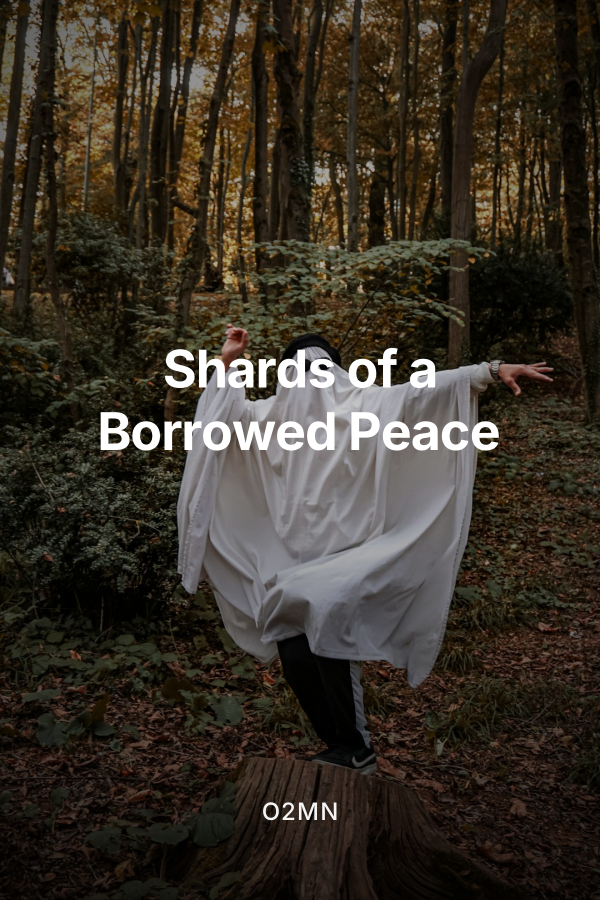
Shards of a Broken War:
A Vampire’s Quiet Apocalypse
Subtitle:
Two Siblings, One Peaceful World, and the Lies They Bleed to Protect It
Summary:
Valerie Tepes and her younger brother Issei are not supposed to exist in this world.
They come from a timeline that burned itself to ash, where gods broke, dragons screamed, and devils died in oceans of blood. In that dying world they were Lucifer’s children, weapons honed to end a Dimensional War that devoured everything they loved. They watched their mates, their comrades, their family fall. In the end, with reality itself collapsing, their father pushed them through a dimensional fissure with one last command: live.
They arrive in a strangely gentle parallel of their lost home.
Kuoh Town is quiet. Kuoh Academy is soft. The devils who rule this territory smile, play chess, worry about student council paperwork. The Fallen still scheme, Heaven still watches, Khaos Brigade is only beginning to stir in the shadows, but on the surface this world is almost peaceful.
Almost.
Valerie claws her way into that peace first. She wraps herself in suppression and illusion, buries the Sephiroth Graal and the fractured remnants of Albion and Ddraig inside her chest, and walks through Kuoh Academy’s gates as a foreign transfer student. She claims a cheap uniform instead of battle armor, a seat by the window instead of a command tent, homeroom roll call instead of casualty lists.
She tells herself she wants nothing but a quiet, human life.
Then she meets them.
Rias Gremory. Akeno Himejima. Murayama. Faces she buried in another universe, now alive and smiling, their memories scrubbed clean of war and grief and of her. They are not her lovers, not her comrades, not the women who died in her arms. They are strangers wearing familiar skin in a world before the fall.
Valerie knows that. She repeats it like a prayer.
They’re not mine.
Just a normal girl.
Just a student.
She eats lunch under trees with reincarnated devils who have no idea they once died screaming beside her. She fumbles idol talk, social media, and weekend plans, counting breaths and forcing smiles to pass as a teenager instead of a thousand‑year‑old weapon. She walks through hallways that feel too safe, where students leave bags unattended and windows unlocked because they genuinely do not expect death to walk through the door.
And always, she keeps her distance from Rias’s red hair in the sunlit courtyard and Akeno’s melodic laugh drifting down the hall, because she understands one brutal truth: if she lets herself love their echoes, she will watch them die again.
Issei chooses a different battlefield.
While Valerie memorizes class schedules and club flyers, he ghosts over rooftops and through alleys, building the only kind of peace he understands: peace with a knife behind its back. Suppressed so completely that even devils’ wards read him as human, he spends a month mapping Kuoh’s supernatural anatomy. Rias and Sona’s territories. Grigori cells. Khaos Brigade recruiters. The faint, repeating patterns of a war he thought he’d left behind.
He discovers that this world already had an Issei Hyoudou, an ordinary boy who died in a car crash months ago. The name is vacant. The life is gone. Issei takes it with clinical efficiency and a single sharp pang he refuses to indulge, because a dead boy’s paperwork makes the perfect mask.
While Valerie forces herself to laugh along with classmates who call her “like a grandma” about idols and apps, Issei sits in a quiet café, turning the whole town into a dossier. Rias Gremory. Sona Sitri. Fallen Angel cells under a new Raynare. Early Khaos movements. Every aura, every barrier, every potential ignition point of another Dimensional War goes into his files.
He promises Valerie peace. He promises himself he will not strike first.
He breaks that promise by inches.
Chapter by chapter, the siblings walk the same town along different fault lines.
Valerie’s days are a slow, aching attempt at normal. She endures homeroom questions about boyfriends and “Japanese boys” with polite deflections, dodges invitations without quite knowing how to accept them, and practices how to smile on cue. She counts out what “normal” laughter sounds like. She flinches internally at slammed lockers, then corrects herself, determined not to drop into a combat stance in a safe hallway.
She shares lunch on the grass with Katase and Murayama, listening to talk of clubs and tests while quietly tagging them as reincarnated devils, Rias’s Pawn and Sona’s Knight basking in sunlight like harmless girls. Albion mutters about devil pieces and how closely this world mirrors their own. Valerie changes the subject, asking which club she should join, because she will not let her mind wander back to a war that stole these faces already.
She hears other girls grumble about “those pervs” who spy while they change and files it away, dismissing the boys who catcall her on day one as pathetic, not dangerous. Later, naked in the locker room, she finds the peephole and the two idiots behind it. She opens the door calmly, water still dripping from her skin, and watches Matsuda’s phone hit the floor when her eyes meet theirs.
No power. No threats shouted. Just one step closer, one flat, dead stare, one whispered promise that predators like them do not die quickly if she chooses to act. The peeping stops. No one knows why. That night she lies awake watching the red digits of the motel clock crawl forward, sickened by how easily the war‑self rose in her throat.
Albion asks if she really believes she can stay out of conflict while carrying that darkness. Valerie does not have an answer. She only has her mantra and Issei’s voice echoing across timelines.
We can only pretend to be normal.
Issei’s chapters cut through the softness like a scalpel.
From the rooftop and the café corner, he watches Valerie’s fragile peace unfold and decides how much blood it is worth. He notes that her suppression has held for a month. No aura spikes. No incidents. No bodies. Good. His mind moves on to the question that burns under every line of intel:
How long until this world chooses the same path as theirs?
When a familiar Fallen signature in a human disguise appears at Kuoh’s gate, his hand twitches toward a weapon that is not there. Raynare. Still alive. Still hunting Sacred Gear bearers in devil territory. He could stop it now. Kill her before she raises a hand to anyone. Avoid the escalation he knows is coming.
He does nothing.
Because moving first will reveal him. Because it would drag the devils into alert mode. Because it risks Valerie’s cover. Because his promise says: no preemptive war.
He stands on the sidewalk while the woman wearing his dead mate’s face scans the students for prey and walks away, and tells himself this restraint is strength. In the back of his mind, Ddraig’s voice is a low, dry rumble that will not quite call it what it is.
When bare observation is no longer enough, Issei steps into the same school as his sister under a borrowed name. Class 2‑C. Average grades. Transfer from the countryside. A boy whose parents died in a car accident. Girls whisper that he is cute and offer to show him around. He smiles politely and declines, logging the details and discarding the rest as irrelevant.
From his new desk, he watches devils play at being teachers and students. He hears the perverted duo invite him to peep on the girls’ changing room, hear them warn him off “that scary foreign chick in 2‑B,” and realizes they are the same idiots Valerie already cowed. He eats alone on a bench, habitually choosing vantage points, and files their existence away as background noise.
By the time Chapter 5 closes, Issei has written the rules of his new private war in his head: the unspoken hierarchy that will define every choice he makes.
Primary comes first.
Secondary, when they overlap with primary.
Everyone else is acceptable losses.
He never attaches Valerie’s name to “primary” in his thoughts. He does not have to.
Chapter 6 widens the fracture.
Days of pretending to care about midterms and PE exercises grind against the patterns he sees in Kuoh’s underbelly. Small disappearances. Quiet meetings at the edge of town. Whispers of an organization that sounds exactly like the one that consumed his own world, only younger, cockier, and more careless.
Khaos Brigade is not here in force yet. It is still recruiting. Testing. Probing devils’ defenses with minor cells and third‑rate contractors. Issei reads the pattern and understands one devastating truth: if he waits until they are a visible threat, he will be too late.
So he does the one thing he swore to Valerie he would not do.
He starts the war first.
Not in the open, and never in school. He attends class, answers harmless questions about hobbies and favorite subjects, and takes careful notes alongside the human children. Then, when the bell rings and the sun sinks, he becomes the thing he was forged to be.
In back alleys and abandoned buildings, a nameless rogue Fallen finds himself strapped to a chair across from a boy with ordinary brown eyes and a voice as calm as still water. Ddraig is silent in the back of Issei’s mind, offering him nothing but quiet presence and a dragon’s pragmatic expectation that this will end in blood.
The questions are simple. Names. Locations. Chains of command. Who in Kuoh answers to Khaos, and how far the rot spreads. The methods are efficient. There is gore. There are screams that no one hears because Issei has already mapped out the sound wards and blind spots. When there is nothing left to learn, he kills the Fallen without anger, wipes his knife, and goes home.
In the morning, he adjusts his tie in the mirror beside Valerie and tells her she looks normal.
Between classes he begins to lace the town with invisible defenses: hidden seals under park benches and behind vending machines, emergency teleport anchors in forgotten shrines, dead drops filled with anti‑Fallen steel in hollow walls no one will think to check. Kuoh becomes a trapped board in an unseen game. The devils ruling the territory have no idea a second, bloodier Rating Game has already begun in their shadow.
Throughout it all, the mask never cracks.
His classmates see an orphan who works a little too hard. Teachers see a quiet boy with decent grades. The café owner sees a regular with good manners. Valerie sees only what she desperately needs to see: a little brother honoring her wish for peace.
Ddraig murmurs once, almost fond: a month of watching, hatchling. Obsessive as ever. He reminds Issei, gently, that no dragon fights a war alone. Issei nods to the voice in his soul and continues anyway, because there is no one in this world he trusts with the full weight of what he is willing to do.
By the time these opening acts close, the shape of the tragedy is clear.
Valerie is learning how to be a schoolgirl in a world built on the bones of her lost family, surrounding herself with people who look like her dead and choosing, every day, not to reach for them. Issei is quietly building a one‑man shadow war under the devils’ noses, carving Khaos roots out of Kuoh before they can bear fruit, and preparing to bathe this “peaceful” town in blood if that is what it takes to let his sister keep pretending to be normal.
They are both living a lie for the sake of the other.
And somewhere between the softness of Kuoh’s cherry‑blossom mornings and the dark alleys where monsters remember what they were made for, the first irrevocable choices are waiting: the moment when Valerie’s carefully constructed human life collides with a murder her brother committed in her name, the day Rias Gremory finally looks past the glamour and sees the weapon hiding behind kind eyes, the night a Fallen Angel invites Valerie out for a “girls’ day” that ends with a blade in her heart and an illusionary rook piece shining in Rias’s hand.
Shards of a Broken War is an AU High School DxD–inspired, yuri‑leaning, trauma‑soaked slow burn.
It is not about saving the world. It is about two war children trying to honor a dead father’s last command in a timeline that insists on repeating his mistakes. It is about the cost of peace purchased with denial, the cruelty of seeing your lost loves reborn as strangers, and the quiet, ruthless lengths a little brother will go to so his sister can finally sit in a classroom and worry about tests instead of gods.
They survived the end of one universe.
The real question is whether they can survive this one without destroying it.