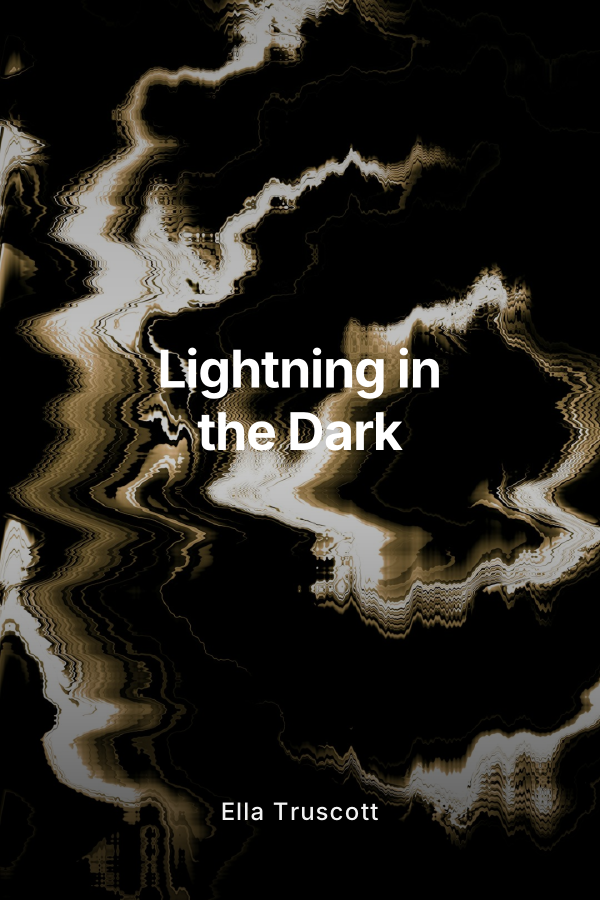
Book Summary:
In a twisted version of Swellview where capes do not save children on time, the city’s most notorious vigilante is a rumor in red.
They call him Volt.
He appears in storms of light and shattered glass, drops criminals at the feet of the police, then vanishes into shadow. No one has ever seen his face. No one knows his name. All they know is the mark he leaves behind: a spray‑painted lightning bolt, jagged and furious, on brick and concrete like a warning.
Captain Man and his young heroes in training at Swellview Academy for the Gifted have been hunting this vigilante for months. Volt is reckless, terrifyingly powerful, and completely unmanageable. Ray wants a weapon. Schwoz wants to know how a kid can bend electricity, shadows, and even their own body like that. The Danger Force want answers.
They think they are tracking a dangerous boy.
Instead, they find a girl who has learned to survive hell.
Hidden inside an abandoned amusement park, one of the dead castle rides has been gutted and rebuilt into a room. Red wires snake through broken plaster. Stolen blankets pad the floor. Spray‑paint art climbs the walls in angry color. There is a single photo tacked above the mattress: a school picture of a girl named Chapa.
To Captain Man and his trainees, it looks like Volt is obsessed with her.
They do not understand that Volt and Chapa are the same person.
Chapa is fifteen years old and already has more scars than most soldiers. Her body is a brutal map: thin white lines, ragged burns, infected wounds that never had proper care, and one lightning bolt striking through a sword tattooed on her ankle long before any adult bothered to ask why. She hides everything beneath long sleeves, baggy hoodies, thick makeup, and a red streak through her hair that says “angry” more loudly than it ever says “hurt.”
She cannot sleep. When she does, nightmares drag her backward through hands that used her, voices that sold her, and a world that taught her that her body is a battleground and her power is the only weapon she has. She has cut, burned, and experimented on herself to be stronger, harder to kill, less attractive prey. She has no memory of a birthday that meant anything, no possessions that were not stolen, and no working definition of love that is not followed by a price.
She also happens to be the most dangerous young metahuman in Swellview.
Chapa can split the sky with red electricity, disappear into shadows and come out somewhere else, turn invisible when shame strangles her, and ignite explosions from the salt on her own skin. Her agility borders on impossible. She moves like a knife. She fights like she is always outnumbered.
Voltage is her shield. Violence is her language. Survival is the only rule.
Across the city, Mika Macklin lives a completely different life. Mika, known in the field as ShoutOut, is the bright, relentless captain of Danger Force. Fifteen, brilliant, and honest to a fault, she leads her twin brother Miles, the vacantly sunny Bose, and their chaotic mentor into battle with a voice that can crack steel and a mind that is always five steps ahead.
Mika is the optimist. Miles is the calm prophet who sees pieces of the future. Bose is the telekinetic puppy who laughs his way through danger. Together they are supposed to be the answer to Swellview’s crime problem and the proof that kids with power can be safe in Captain Man’s hands.
Yet Volt keeps beating them to the punch. Stronger. Faster. Wilder.
Mika’s curiosity turns into obsession. She fills a folder with sightings, patterns, grainy photos, and any scrap about the red‑clad figure who keeps slipping out of her traps. Volt gets inside her head, under her skin, making her doubt whether she is actually the hero in this story or just one more hunter chasing a wounded animal into a corner.
When Danger Force finally follows a trail of electricity to the abandoned amusement park, they expect a terrorist’s lair.
They find a bedroom.
They find the Volt tag over a mattress, stolen food wrappers, scattered first aid supplies soaked in dried blood, and a single school photo of Chapa. To Mika, it looks like their masked rival has a crush. To Captain Man, it looks like leverage. To Miles and Bose, it is creepy and confusing and weirdly sad.
Nobody is prepared when the red‑eyed vigilante steps out of the shadows.
Nobody is prepared that Volt is short, sharp, and hoarse‑voiced behind the mask. Nobody is prepared for the moment Mika’s sonic scream hits the helmet, shatters it, and a girl with dyed red hair and haunted eyes stares right back.
It should end there. They should offer help and mean it.
Instead, this world is darker.
Captain Man drags Volt into the Man’s Nest in handcuffs. Schwoz hooks her to machines. The team crowd around with more questions than compassion. Under pressure and fear, Chapa’s powers flare. Invisible one second, blazing the next, she is as likely to hurt herself as anyone else.
They still think Volt is a boy.
They still treat her more like a weapon than a person.
In a brutal, invasive interrogation that crosses every line, Ray straps Chapa to a lie detector and tears through her privacy with a smile that pretends this is all training. Family. Age. Sexuality. Gender. Virginity. Consent. Each question is another blade. Each forced answer strips away one more layer of armor she spent years building over an open wound.
It is not heroic. It is not funny. It leaves her shaking.
The team see what Ray refuses to look at: the panic in her eyes, the way her fingers dig into her own skin, the static crawling off her like she might explode. Mika feels her certainty break. This is not a criminal mastermind. This is a kid whose voice trembles when she says she does not remember her last birthday and whose truths about sex and consent land like a punch in the gut.
Then comes one of Chapa’s many lowest points.
In the name of safety, the adults and kids together force her to strip so they can “check for injuries” and “find tech.” She thrashes. She begs. She loses. Shirts, hoodies, bandages, layers she has used as armor hit the floor. What they uncover is not tactical gear.
It is a horror story written on skin.
Razor scars, cigarette burns, jagged cuts that were never cleaned right, fresh wounds that might be infected, bruises the color of dead fruit. Bose almost vomits. Miles goes silent. Mika realizes that every laugh, every rumor about the terrifying vigilante boy, every joke about catching Volt, has been a joke about a girl who bled in the dark while nobody came.
Chapa’s reaction is nuclear.
Her sweat ignites into explosions. Her electricity blinds cameras, shatters glass, sets alarms screaming. Shadows swallow her and spit her out across the room. Power spirals out of control, wild and self‑destructive, until everyone finally understands that beneath the threat is a teenager who has never been safe a single day in her life.
The story that follows is not about a neat redemption arc or the easy warmth of found family.
It is about danger and damage and the excruciating work of trying to become human again.
Across twelve to twenty interconnected “episodes,” this book follows Chapa as she is dragged, coaxed, and sometimes genuinely invited into the chaotic orbit of Danger Force. At first she is an asset they want to recruit. Then a problem they need to control. Slowly, painfully, she becomes someone they care about, even when they have no idea how to show it without breaking her further.
Chapa remains aromantic and lesbian, and the world has never respected either truth. People took her body and called it affection. They sold her and called it survival. So when Mika, the very girl hunting Volt, accidentally crashes into her in a rigged Tunnel of Love and their mouths collide, tongue and shock and laughter from Bose and Miles close in like a trap. For everyone else it is an embarrassing mistake. For Chapa it feels like another moment where her body is not hers.
Mika cannot explain why her heart jolts at the contact or why she blushes every time Volt’s red eyes cut toward her. She does not know yet that the vigilante she has been chasing is the same girl in the school photo she once brushed past in the hall. She does not know that her bisexual confusion will crash headfirst into Chapa’s aromantic certainty.
They circle each other as enemies, rivals, and reluctant allies long before they ever admit to being anything softer.
Mika is the only one stubborn enough to keep trying once Chapa’s trust explodes. She is the first to call Volt “she” and mean it. The first to recognize that Chapa’s anger is not random but intelligent, a shield sharpened to a point. The first to see beauty in the girl who hates mirrors. She pores over her Volt file, tracks every pattern, and slowly realizes the vigilante never kills, only disables. Never hurts kids, only adults. Always chooses the most vulnerable targets to protect.
Miles offers quiet respect and a listening ear. Bose brings chaotic joy and a strange talent for accidental wisdom. Schwoz becomes an unnerving but valuable partner in engineering when he discovers that Chapa can build with the same ruthless precision she fights with. Together, they start to form a net that might one day catch her.
But healing here is not clean. For every step forward, there are nights where Chapa bleeds again just to feel something she can control. Missions where panic turns her electric and someone barely dodges the blast. Visions where Miles sees her dead and refuses to accept it. Arguments where Mika and Chapa’s explosive chemistry makes everyone else wonder if they are about to kill each other or pull each other closer.
The mystery of Volt’s identity collapses late, around episode ten, when the last lie falls and Mika finally pieces together that the scarred girl from the school photo and the storm in red are the same person. That revelation shatters the last comfortable distance between hunter and hunted, forcing Mika to confront her own obsession and every way she has helped violate Chapa’s boundaries.
Enemies become allies. Allies become something sharper and more fragile.
Across the book’s five chapters and ten major sub‑arcs, Lightning in the Dark will take readers through:
• The urban legend of Volt and the first chaotic confrontations between a traumatized vigilante and a polished hero team
• The discovery of Chapa’s lair, the misreading of her photo wall, and the humiliating first encounters in the Man’s Nest
• The invasive lie detector episode that lays bare her history of rape, self‑harm, and fragmented identity while everyone listens
• The forced undressing and scar reveal that detonates her trust, spirals her powers out of control, and nearly breaks the team
• Missions where Chapa and Mika are forced to fight side by side, sparks flying both literal and emotional, as they clash over what heroism even means in a world that failed Chapa so completely
• Moments of unintended tenderness, like late‑night engineering with Schwoz, skateboarding on the Nest’s roof, or quiet Spanish conversations when Chapa forgets to hide her fluency
• The agonizing crawl from obsession and suspicion toward understanding, as Mika digs through Volt’s past and realizes horror after horror that no one stopped
• The complicated exploration of identity as Chapa claims her aromantic lesbian truth on her own terms and Mika wrestles with bisexual desire that collides with guilt and respect
• The gradual reshaping of Danger Force from kids playing hero to a found family that must confront their complicity in Chapa’s pain and choose to become something safer
• A closing arc where healing is not a miracle but a series of choices: to stay, to sleep in a bed someone offered freely, to show a scar without being forced, to say “no” and be heard, to let someone hold your hand during a panic attack without expecting a bill afterward
This is not a lighthearted spin‑off.
Lightning in the Dark is a fanfic‑length, multi‑episode narrative that takes the world of Danger Force and plunges it into a full dark alternate universe where trauma has teeth and heroism is measured not in costume colors or catchphrases, but in how gently you can touch someone who has only known violence.
At its core, it is the story of one girl who thought she had to burn herself alive to be safe, and another girl who refuses to leave her alone in the dark.
Voltage meets voice. Rage meets relentless optimism. Wounds meet hands that are finally learning how not to hurt.
And in a ruined castle at the edge of an abandoned park, under strings of stolen lights, a girl who calls herself Volt will have to decide whether she can survive turning the power down enough to let anyone close.