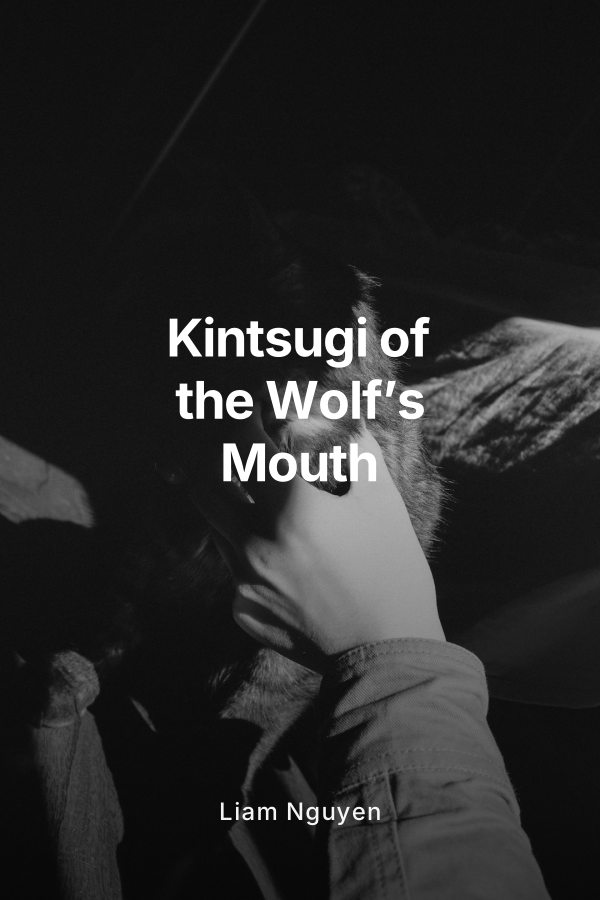
Kintsugi of the Wolf’s Mouth
Subtitle:
Love, Violence, and the Taxi that Haunts Buenos Aires
Summary:
Buenos Aires at night is a city of broken ceramics, glued together with cheap liquor, secret budgets, and unmarked graves. Its avenues glitter with theater marquees and political graffiti, while somewhere between Constitución and Once a yellow taxi circles like a patient predator.
Behind the wheel is a woman the public knows as Ximena Álvarez, a mute Italian‑Argentine cabbie who hides her mutilated lower face behind a canine mask and speaks only through Argentine sign language and scribbled notes. In the classified files of an unnamed state apparatus, however, her true identity appears in redacted fragments as D. Salazar: a government hitman, military police scout, investigator, and sanctioned executioner of the people official justice cannot, or will not, touch.
Her world collides with Sayuri Morita, a Japanese exchange student turned young literature and culture teacher in Buenos Aires. Sayuri comes from a tradition steeped in mono no aware, wabi‑sabi, and the quiet sorrow of impermanence. The city she lands in offers something else entirely: corrupt prosecutors, organ traffickers, vanishing girls, and the rumor of a monstrous vigilante who looks almost human, except for the wolf’s jaw beneath a taxi driver’s mask.
Their bond begins in the most mundane way possible. A foreign student, lost between bus lines and bureaucracy, finds stability in the routines of a particular cab: the same driver, the same dryly delivered notes about safe streets and dangerous corners, the same patient, opaque presence. Over the years, those rides become the spine of Sayuri’s Argentine life. The driver talks about tango and football, inflation and elections, theater and street art, the melancholy of a nation that dances at the edge of collapse. She never talks about herself.
That driver is Ximena. That shadow is D. Salazar. That woman becomes Sayuri’s lover.
The novel unfolds across interlocking layers of time and perspective, structured as a continuous noir tapestry rather than a clean episode‑by‑episode casebook. At its surface, it follows the present‑day rhythm of Sayuri’s existence: morning lectures on classical Japanese literature, delicate demonstrations of kintsugi with cracked tea bowls, students who half‑jokingly ask about her love life, and long evenings navigating a relationship with a partner who cannot speak and will not explain her scars.
In Chapter 1, Sayuri escorts Ximena to yet another hospital visit, acting as interpreter, buffer, and shield. Her Spanish carries a heavy Japanese accent; her handshapes in Argentine sign language are clumsy and imprecise. Nurses push, doctors prod, and each time someone asks why Ximena cannot speak for herself, Sayuri steps in with incomplete explanations and carefully selected half‑truths.
Behind a clinic door, while Sayuri waits in an anxious lobby, Ximena’s handler appears. He moves through the hospital with the casual authority of a man who knows no one will stop him. With the doctors dismissed, he presses his operative in private using a strange, ritualistic language that frames her upcoming assignments as a kind of modern Dionysian rite hidden beneath bureaucratic procedure. He evokes processions, masks, sacrifices made to appease a faceless public. Ximena’s response is silence. Her hands remain still. Her gaze dismisses him.
Soon after, the handler introduces himself to Sayuri, posing as an ordinary boss concerned about his driver’s welfare. Over coffee in the waiting area, his questions slide from polite to invasive: how much does she really know about “Ximena”? What habits has she noticed? Does Ximena vanish at night, come home injured, carry weapons, show a strange ease around violence? Cornered between loyalty and fear, Sayuri admits what she has seen and begs to know the truth. The handler reveals just enough: Ximena is employed by the government in a special capacity, authorized to do work that cannot be officially acknowledged. He omits details, speaks in controlled euphemisms, and quietly reinforces that Denise’s life is built on necessity, not choice.
Sayuri returns home with Ximena that night carrying a new weight: the knowledge that the woman who sleeps beside her is part of a vast, hidden machinery of sanctioned murder. Her attempts to investigate public records turn up redacted medical files and sealed legal documents. Ximena, aware of these futile searches, does nothing to stop them.
In Chapter 2, the façade cracks further when Sayuri and her friends are cornered by a pack of street thugs. Just as bravado turns to real danger, the familiar taxi appears. Ximena steps out in her canine mask, defenseless only in appearance, umbrella in hand. She writes on paper that she is just there for the girls, just a cabbie. The men laugh, draw knives, brass knuckles, makeshift clubs. Ximena moves first, low and efficient, fighting like someone who has been trained to end lives rather than win honor. The fight is vicious, intimate, and ugly, closer to a slaughterhouse floor than a choreographed brawl. When it is over, the surviving girls are bundled into the cab and driven to safety. Ximena returns quietly to the scene to finish what she started.
That evening, Sayuri’s friends demand an explanation. Sayuri lies, calling Ximena a famously tough neighborhood driver and nothing more. Their faces show gratitude, fear, and the recognition that they have glimpsed a predator disguised as a woman.
At home, Ximena offers no account of where she has been. She cooks an Argentine dinner with the ease of habit and fumbles a Japanese dish with endearing incompetence. Through strained, one‑sided dinner table conversation, Sayuri presses for answers about the fight, about the handler, about the true nature of her lover’s work. Ximena’s fingers describe only fragments in the air and on notepads, circling around what must remain classified. Sayuri’s frustration turns into a late‑night monologue whispered into Ximena’s sleeping form, in halting Spanish weighted with Japanese thought patterns. She wonders whether the woman beside her could ever retire, or if they are both trapped inside a life nothing in Tokyo’s quiet seasonal rhythms could have prepared her for.
Chapter 3 shifts fully to Ximena’s perspective. She tracks the thugs from that afternoon back to their hideout, a damp Buenos Aires underworld where cheap narcotics, illegal firearms, and human cargo flow together. The men tell stories about a masked executioner who prowls the city in a taxi, hunting rapists, traffickers, and corrupt politicians. They laugh at the myth even as their comrades limp in, broken by the woman they themselves mocked in the street. When Ximena steps into the light and removes her muzzle only for them, the rumor hardens into a new, more terrible reality. The ensuing massacre is methodical and brutal. Each weapon on her person and inside her guitar case has a role, and her pleasure in the work is as chilling as its efficiency. By the time she checks in with her handler, her report is just another line in the invisible ledger of extrajudicial “solutions.”
In Chapter 4, the narrative breathes and pulls back. Sayuri, alone after a lecture on Japanese aesthetics, recalls her first encounters with Ximena the taxi driver. Back then, Ximena spoke normally, voice flat and strangely uninflected. She drove Sayuri through Buenos Aires while describing not her own life but the city’s: its Peronist ghosts, its grimy love for football, its street murals and theaters, its literary history and political wounds. She never lied, but she always told only part of the truth. When Sayuri asked about childhood, she received sanitized vignettes: an orphanage, vague travels, hints of Europe and Latin America. When talk veered toward work, Ximena always steered it back to tango lyrics, cinema, or the economics of meat and soy.
These rides, repeated over months and years, form the quiet prelude to their romance. In the present, Ximena waits alone in their shared apartment, body always half‑tense for threats that may never come, while Sayuri finishes her day teaching concepts like mono no aware to students who giggle and crush on their professor without understanding that her entire life has become a case study in bittersweet impermanence.
Chapter 5 dives into Ximena’s fragmented memory, charting her path from orphan to soldier to government tool. It unspools a series of vignettes from years behind the wheel. Each passenger becomes a confession booth, a therapy session, or a missed opportunity for intervention. A shy student cries about friendship politics. A corrupt official pockets bribes while pretending to be late for a charity event. An old woman celebrates a birthday alone except for her dog. A priest wrestles with the sanctity of confession after hearing a killer’s secrets. A drunk prosecutor mumbles about cases she was ordered to drop. A teenage girl, exhausted and pregnant, explains how she was driven into sex work to support a sick family. A doctor, hollow‑eyed, speaks softly about an emergency abortion to save a child and the pregnant sister waiting for him at home. Human traffickers brag about their “merchandise,” unaware of the predator behind the wheel. A furious man outlines how he will shoot his unfaithful wife in the most humiliating way he can imagine.
All the while, classified pickups and drop‑offs thread through the same routes: operatives, informants, handlers who treat Ximena both as a peer and as equipment. Her childhood experiments, military training, and the slow erosion of a normal life blur until what remains is mostly muscle memory and a false name.
Among these memories, the mission that destroyed her voice and reshaped her jaw rises to the surface. It took place after she had already grown close to Sayuri, after the notion of an ordinary relationship had begun to seem less like a fantasy. Sent to neutralize a deranged scientist running private experiments, Ximena underestimated him, was captured, and became his subject. He sought to understand what had been done to her as a child by others, and in doing so carved further into her body and self. One of his cruelest alterations replaced parts of her mouth, jaw, and throat with living canine tissue. Her escape was a frantic, bloody improvisation that ended with the scientist dead and Ximena stumbling to Sayuri’s door, bleeding, mask torn, secret life exposed in the worst possible way.
Sayuri’s horror, panic, and unwavering commitment as she rushed her lover to the hospital and then sat through years of surgeries and speech failures become the quiet counterweight to the violence. She never demanded a full accounting. Ximena never offered one. They lived together in the aftermath, one woman unable to ask, the other unable to answer.
By the time the flashback returns to the present, Ximena’s reflections on Sayuri’s first confession of love are painted against the backdrop of the people she kills and the institutions she serves. The doorbell rings, and when she opens it with her muzzle in place, she finds not an enemy but Sayuri’s parents, fresh off a plane from Japan and confronted with a silent, masked stranger in their daughter’s home. They speak no Spanish. Ximena knows no Japanese. Only awkward gestures and written notes stand between them and mutual incomprehension. The chapter ends as Sayuri receives a call and learns that her parents are already in her apartment, alone with the woman she has never fully explained.
Chapter 6 begins in the classroom. Sayuri lectures on mono no aware, kokugaku and rangaku, the Heian court, Shinto and Buddhist notions of transience, the Tale of Genji as an early map of sensitivity to passing beauty. Students tease, flirt, and ask if their admired teacher has anyone special. Sayuri deflects with layered advice about communication and the fragility of love that doubles as a coded reflection on her own relationship with a woman who might not survive another mission. She introduces the philosophy of wabi‑sabi and illustrates it through her own repaired tea set, gold seams shining where it once shattered. The brokenness of the object becomes an unspoken analogy for the body sleeping beside her each night, and for the city that has patched itself with blood and silence.
Two detectives slip into this world: Martina Corbalán and León D’Alessandro. They watch the lecture, then approach Sayuri afterward. Their questions are at first disarming: more about aesthetics and kintsugi than crime. Slowly, they reveal their purpose. They are tracing a pattern: a steep drop in certain types of violent crime, sudden disappearances of gang leaders, unprosecuted but unmistakable massacres in the underworld. Sayuri and her mysterious partner appear at the edges of too many reports.
The detectives insist they do not want to arrest Sayuri or her lover. They claim to be after the truth: what network is using this masked killer, what lines of accountability exist in a city that pretends such things do not happen. Sayuri offers them polite half‑truths about Ximena Álvarez, the taxi driver, the woman with medical issues. Martina and León leave her with a business card and one final detail: the official name on some fragments of old files is not Ximena, but D. Salazar.
The chapter ends with Sayuri holding that name in her hand and her mind, feeling the ground tilt beneath her. Before she can process what it means, her phone rings. Her parents have arrived early and are already at her apartment. With Ximena. Sayuri races home, the narrative poised at the intersection of family, love, state violence, and the simple, impossible question at the heart of the book:
How do you love someone whose mouth was rebuilt to kill and whose life belongs, officially and secretly, to a city that never stops asking for more blood?
“Kintsugi of the Wolf’s Mouth” is a longform noir novel that fuses the psychological density of a damaged operative’s inner life with the cultural textures of Argentina and Japan. It explores how two people from different aesthetic worlds try to build a shared existence from secrecy, trauma, and partial truths. Through bilingual dialogue, vivid street‑level detail, graphic violence, and philosophical reflection, the book treats love and violence as two methods of repair in a city and a pair of bodies that can never return to what they were.
The ending remains deliberately open. Detectives circle. Handlers tighten their grip. Parents stand on a foreign threshold. Sayuri teaches her students to mend broken pottery with gold while sleeping beside a woman who may be beyond mending in any conventional sense. Whether their story moves toward redemption, collapse, or an uneasy equilibrium is left hanging, like a half‑finished kintsugi repair, the last seam waiting for the reader’s own gold.