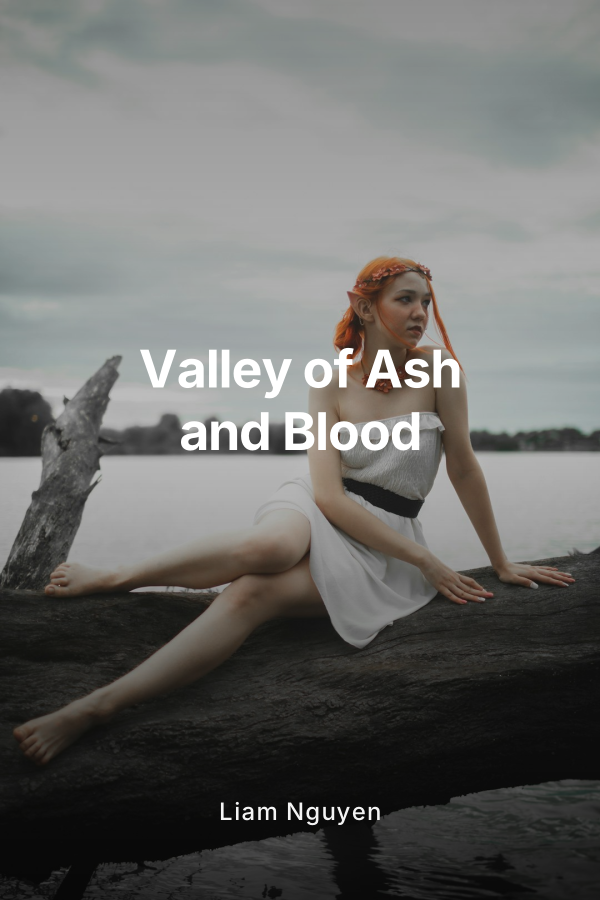
In the shadowed marches of late 8th and early 9th century Eastern Europe, there is a valley that should not exist as it does. Caught between the Bulgar khans and the Frankish heirs of Charlemagne, ringed by Slavic forests and raider-haunted rivers, it has become an unlikely refuge where the living and the not-quite-living bargain for survival.
Here Romani caravans share market squares with Slavic peasants and Bulgar horsemen. Here Finno-Ugric trappers trade furs beside Baltic fishermen, while Turkic mercenaries drink with Greek-speaking scribes. Beneath the noise of barter and song, another commerce pulses: blood for protection, flesh for peace, secrecy for safety.
At the heart of this fragile experiment stand three unlikely kin.
Mira, a sharp-tongued Romani woman with a trader’s brain and a healer’s stubborn conscience, has carved out a place for her wandering people in a land that would rather forget them. She knows every road, every superstition, every rumor. She also knows that the valley’s precarious safety rests on rules no outsider must ever see broken.
Volha, a Belarusian dhampir born of the oldest upyr and wolf-curse stories, lives always on the edge of losing herself. Unlike the vampires of legend, her hunger is not for a sip of blood but for the whole body, bone and gristle and soul-deep satisfaction. She can silence that craving only with smoke and snus that scorch her throat, or with sex that pulls her back from the brink. Volha belongs to no coven and no clan. Her body heals those she feeds from, her strange dhampir nature blurring the line between predator and guardian. She claims no masters, yet her only true anchors are the humans who chose her before the night did.
Zoran, her older adoptive brother, is a man who carries the legends of Polish werewolves in his bones but not in his blood. He has no supernatural hunger, no curse to manage, only an iron loyalty forged by grief. Orphaned young, he raised Volha from a frightened creature into a woman who can stand in both worlds. To the valley he is a mediator, a scout, and an unassuming lynchpin: the one who understands both teeth and plow, both priest and witch.
Their quiet, hard-won balance is broken when outsiders begin to take notice.
The story opens with a local Polish lord escorting an Italian merchant through the rural borders of the Bulgarian Empire. The lord speaks of trade and tolls, honey and salt, horses and silver. He also speaks, more quietly, of other things: of upyr that walk in daylight wrapped in shawls, of volkolak and strzyga and volkodlak who serve as hidden wardens of the forest tracks, of mages who distill strange fire in clay retorts, and of alchemists who sell tinctures to both priest and pagan. He paints a portrait of a valley that has learned to live with its monsters instead of burning them, and of a delicate pact that keeps peace at a price.
He warns the Italian: the Church tolerates what it does not fully see. A splinter of fanatical men, hungry for glory and purity, circle the region like wolves. Foreign factions taste the valley’s wealth and its secrets on the wind. Any careless move might turn legends into targets, neighbors into prey.
Far away, a young foreign page named Spero copies these whispers into his heart.
Sent from more distant courts with quills, questions, and a boy’s eagerness to matter, Spero sets out for the valley after hearing rumors of vampires and werewolves living not in crypts but in cottages and caravans. What begins as an investigation for Church and noble patrons becomes a pilgrimage into a world where borders of faith, blood, and species are not where he thought they were.
On his journey he shares fires and bread with merchants, soldiers, and peasants. In a bustling tavern near the valley’s edge, Spero watches a band of foreign knights boast and drink, brushing shoulders with Romani traders, Slavic villagers, and wary locals. Stories spill like ale: of a lord who commands a hidden unit of vampiric soldiers; of a poor family adopted into a werewolf clan; of a merchant who owes his life to a reclusive alchemist; of marriages and affairs that bind humans to creatures whispered of in homilies and lullabies.
Boast turns to challenge when some knights, stung by tales of immortal lovers and monstrous protectors, declare their desire to prove themselves against a vampire, werewolf, or mage. The mood curdles. The locals remind them, gently and then firmly, of the valley’s unwritten rules. No one hunts what guards their children. No one breaks the old bargains without paying in blood.
An elder, hoping to cool the room, tells instead of love: of an unnamed female vampire and the human man she chose rather than devour. From there the stories narrow, spiraling closer to truth. A dhampir woman who walks as wolf and shadow. A Romani healer who feeds her, loves her, and keeps her human. An orphaned man who stands between beast and world.
Spero listens as the first threads of Mira and Volha’s tale are woven aloud.
Before the night ends, Mira herself arrives to bargain for goods and favors. The knights meet her, questioning and half mocking. She answers with measured dignity, more concerned with prices than pride. When she slips out into the dark and calls softly to the forest, the knights follow with their eyes and see what she already knows.
A white wolf steps from the trees, muzzle bloody from a freshly killed stag it carries with almost ceremonial care. At her side walks Zoran, human and warm and very much at ease with both beast and men. He greets the company, that ordinary man amid unsettling marvels. The wolf drops the game at Mira’s feet, then rises, body twisting in a blur of fur and flesh until a pale woman stands where the animal stood.
Volha glances once at the knights, offers no explanation, and slips back into the tree line, wolf again before questions can become accusations. For the knights the sight is a shock to carry back to their lords. For Spero, it is an invitation he cannot ignore.
He stays.
As Spero enters the valley proper, he discovers a world more complex than any sermon. A local priest, hardened by winters and tempered by compromise, speaks with him in guarded trust. The priest knows the doctrines of Rome and the realities of the valley’s soil. He tells of nights when werewolves kept raiders from the church, of vampires who swore not to hunt within certain boundaries, of mages who warded wells against plague. He speaks of sin, yes, but also of stewardship.
Mira moves through her days as barterer and backbone of her Romani community. She bargains in half a dozen tongues, navigates slights from settled villagers, and trades charms with traveling mages and alchemists. Her people have learned to live alongside the valley’s other outsiders, both human and not, binding themselves into its life with marriages, debts, shared dangers, and stories.
Her intimacy with Volha is both a personal bond and a political one. Volha’s hunger is always near the surface, dangerous not only to strangers but to herself. The valley provides snus, smoke, and discreet partners to keep that hunger in check. Mira offers something rarer: steady affection, fierce boundaries, and flesh willingly given so that Volha need not take. Their sex and feeding are not mere indulgence but a negotiated ritual that keeps the dhampir anchored to human feeling.
Around them swirl the older powers: Rada, a vampiric lady whose bloodline threads through upyr, volkolak, and the oldest night tales; Marek, a human lord whose authority in the valley owes as much to his alliances with monsters as to his title; werewolf clans that claim certain hills and passes as their own; mage circles and itinerant alchemists who sell their services like mercenaries of knowledge. Together with local nobles, Romani elders, priests, and village heads, they meet in tense councils where politics are freighted not just with taxes and tithes but with what share of bloodshed each party is willing to bear.
Beyond the valley’s ridges, storms gather.
Norse longships probe river mouths and coasts. Magyar riders test the frontiers. Saracen raiders and southern pirates trouble the distant seas. The Carolingian Empire frays under succession disputes, and every crack in Christendom invites opportunists. The Vatican hears rumors of an eastern valley where the living consort openly with creatures the Church would rather see named demon than neighbor.
Spero, shuttling messages and impressions between valley and Church, finds himself ever more entwined in these currents. He debates visiting priests and arrogant foreign clerics who preach purges, argues that the valley’s fragile balance preserves more innocent lives than any crusade would. His words win him respect in some quarters and suspicion in others.
A single foolish moment almost ends everything. Spero stumbles upon Mira and Volha in what he takes for an assault near a hidden waterfall: Volha bloodied from a battle with bandits, Mira tending her, then guiding her toward feeding and rough intimacy that is both medicine and release. Misreading consent and context, Spero intervenes, shattering their trust and exposing what should have remained unseen. The incident humiliates Mira and Volha, shakes the valley’s faith in his discretion, and forces him to rebuild his standing from the ground up through labor, humility, and honest apology.
As seasons turn, everyday life in the valley continues. Fields are sown and reaped. Caravans arrive with spices, cloth, and rumors from as far as the Caucasus and the Mediterranean. Children grow up knowing that uncles and aunts may have fangs or fur or hands stained with strange alchemical dyes. The integration of humans, vampires, werewolves, mages, and hybrids deepens into something resembling a shared identity.
Yet cracks appear.
A foreign priest and his faction arrive, preaching holy fear. They attempt to rouse the valley against its own protectors. Their sermons kindle an echo of distant zeal in some hearts, but the valley has decades of coexistence to weigh against shouted promises. In a public confrontation, Spero and local voices strip the fanatics’ arguments bare before peasants and nobles alike. The result is humiliation for the zealots and, eventually, a public trial that brands them as threats to the valley’s peace rather than its saviors.
News of this defiance, and of Spero’s role in it, does not remain local. Reports reach bishops, cardinals, and distant courts. Debates ignite in cloistered chambers about how far the Church can bend to practical reality without breaking its own spine.
As the valley tightens its own pact in response, Rada and Marek struggle with their relationship to Volha and Zoran. They are not her parents, not exactly, and yet their investment in the siblings runs deep. To Rada, Volha represents both a dangerous deviation from traditional vampire society and a possible bridge to a future where her kind do not rely purely on fear. To Marek, Volha and Zoran are half wards, half allies, half instruments of policy. To both, Mira is an unpredictable but invaluable influence: a mortal who can reach into Volha’s darkest hunger and pull her back.
The climax comes when all distant threats converge.
A Vatican-backed inquisitorial envoy approaches the valley, armed not only with parchment and doctrine but with soldiers and the support of certain foreign lords who see profit in chaos. At the same time a coalition of raiders, mercenary bands, and adventurous nobles, emboldened by tales of supernatural wealth and power, move against the region. Inside the valley, old resentments and fears flare as some factions argue for submission, others for preemptive strikes, and a few for betrayal.
The resulting storm is brutal. Battles blaze in forests and fields, in village streets and along the riverbanks. Human warriors fight alongside werewolves and vampires, with mages and alchemists turning humble tools into weapons of fire and smoke. Zoran moves between lines, coordinating man and beast. Spero races between leaders, trying to keep panic and vengeance from shattering the alliance. Mira, caught between the need to protect her people and her devotion to Volha, becomes a linchpin in decisions that will shape the valley’s future.
Volha stands where the fighting is worst. She burns through snus and smoke, flings herself into combat, and skirts the edge of losing herself to ravenous joy. In the final confrontations she is grievously wounded while shielding Mira and others, a lasting scar that will mark her in body and reputation. Her injury underscores the cost of the valley’s survival and forces her to lean harder on the bond she once treated as a luxury.
The valley endures, but only just. The fanatical faction is broken locally, the immediate raiders are repulsed, the inquisitorial envoy is checked rather than welcomed. Yet victory feels more like a stay of execution than a triumph. The Vatican’s attention has sharpened, not faded. Foreign powers now know that the valley is defended by something more than rumor. Inside the valley, wounds and grievances will take time to heal.
In the wake of blood and fire, Mira and Volha’s relationship is brought into the open. Through a solemn, bittersweet rite that blends Romani, Slavic, vampiric, and werewolf traditions, their bond is acknowledged before leaders and common folk. Hands bound with woven cord, oaths spoken over fire and water, a shared cup that mingles food and a trace of blood, the exchange of talismans from each culture: all seal a partnership that is both private vow and public statement. They emerge not only as lovers but as a recognized unit in the valley’s fragile power structure.
Spero, having argued for the valley in public and lied by omission in private, finds himself a man balanced on two blades. The Church no longer fully trusts him. The valley does not entirely either. Yet both need him. By the end he stands as an unwilling mediator, too compromised to go back, too bound to abandon either side, his intercepted letters and overheard conversations having already pushed him near ruin.
“Valley of Ash and Blood” follows these intertwined lives through prologue and many chapters of journey, council, battle, and quiet domestic scenes. It weaves historical tensions of early medieval Eastern Europe with Eastern European folklore and myth, exploring a community that refuses to choose between burning its monsters and becoming them. Love, hunger, faith, and power collide in a world where a dhampir’s bite can heal as well as harm, where a Romani woman’s insistence on consent and dignity can anchor a creature of legend, and where a valley’s survival depends on its willingness to embrace the very beings others call abominations.
By the final pages, the valley is scarred but standing, its future uncertain, its enemies sharpening their plans. Mira and Volha are bound more deeply than ever, Zoran bears new responsibilities, Rada and Marek reckon with the consequences of backing such an unusual experiment, and Spero walks a dangerous road between loyalty and heresy.
The peace holds, for now, on the edge of Christendom. But the world beyond the mountains is closing in.