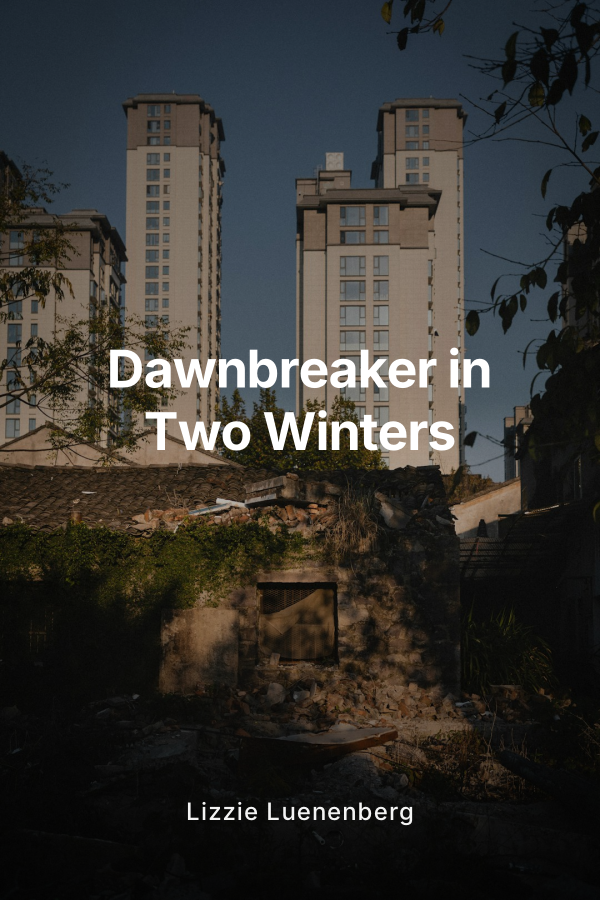
In a scarred, neon-lit Linkon City after the Chronorift Catastrophe, two versions of the same man move through two nearby winters, orbiting the same city square and the same empty bench.
In one timeline, he is Dawnbreaker: a Hunter and physician who freezes Wanderers with black ice that eats into his own nerves, a ghost in a ruined future who walks under Ever billboards and UNICORNS alerts that no longer matter to the civilians who are gone. His never-ending Christmas is not a simulation but the real central plaza, revisited night after night. The towering tree never comes down in his perception, because for him it is still the evening that a seventeen-year-old girl with purple hair chose a bench instead of a home and never stood up again. He was not there. He was with his family, pretending to be someone normal at a Christmas dinner he can no longer remember without nausea, until the message reached him too late. Since then, his life has become a closed temporal loop: patrol, cleanse, operate, and always return to that square, studying an absence that no amount of Evol control or medical brilliance can fill.
In the nearby, earlier timeline, he is simply Dr. Zayne: Akso Hospital’s youngest and most respected chief cardiac surgeon, a man with an ice Evol that is classified, contained, and eating quietly into his bones. He lives in a large, meticulously ordered house whose silence he has cultivated to survive long shifts and longer nightmares. Officially he treats congenital heart defects in newborns, attends Ever-funded conferences, and sits in closed rooms where Aether Core data scrolls across smart glass. Unofficially he comes home to a teenager who drops her schoolbag in his hallway and steals his bed. Lucca is not a Hunter, not modified, not part of any fleet. She is a chronically online high school girl with BPD, purple twintails, and a talent for turning her own pain into a joke before anyone else can weaponize it. Her mother runs a fake-punk, cigarette-yellow rock bar and spends her nights performing rebellion in front of regulars while privately shredding Lucca with accusations of ingratitude and failure. Her father lives with a new partner in another city and plans to leave altogether. Lucca takes none of it on as a duty. She simply retreats, one overnight bag at a time, to the only place that feels like a safe room.
By the time the reader meets them, Lucca and Zayne are already dating. The book does not waste time on their meet-cute. Instead it focuses on how a relationship survives the constant friction of their realities. Lucca is clingy whenever they have been apart: she crashes into his chest in hospital corridors, crawls into his lap under his own blankets, whispers sugar-laced insults to disguise “I missed you” in a language of teasing and brattiness. Zayne meets her with a quiet, practiced tenderness shaped by years of pediatric work and private vows he never speaks aloud. He peels her apples in a single spiraled strip, tolerates her glitter embedded in the seams of his expensive couch, pretends his AI assistant is the one reminding her to drink water. His house yields to her bit by bit: a toothbrush in his bathroom, a row of tenshi-kawaii outfits in his organized closet, the permanent indentation of her spot on his bed.
Sex is part of their intimacy, but never the cure. The book is explicit about how their negotiated kink becomes a controlled environment in which Lucca can redirect self-destruction into sensations she chooses, and Zayne can channel his dominance without sliding into savior fantasies. Safe words, aftercare, and clear boundaries are treated as technologies as vital as any Evol monitor. Outside those scenes, their life is quietly technical: smart thermostats compensating for his freezing Evol episodes, biometric locks that recognize her wrist tags, hospital teleconferences flashing Ever’s latest cardiac regeneration data while she does homework on his sofa and pretends not to listen.
World events remain peripheral. Hunters fight Wanderers somewhere beyond the skyline. Aether Core scandals and Chronorift thinkpieces scroll past on Lucca’s feeds, filed mentally beside fandom drama and meme wars. Farspace Fleet briefings exist for Zayne as calendar blocks he resents but attends. None of these arcs culminate in city-saving battles for Lucca. For her, the apocalypse is smaller than a universe and larger than her skin: it is Christmas season with a nameless mother getting drunk under neon while calling her a parasite; a father rehearsing departures; a mind that tells her, very convincingly, that she is too much for anyone to want long term.
Across five chapters, each divided into two subchapters, Dawnbreaker in Two Winters braids these realities without ever letting them collapse into each other.
In the Dawnbreaker chapters, the focus is on the aftermath of failure. We watch him cleanse streets where Wanderers roam instead of people, see him maintain a jasmine plant in a ruined apartment as if clinging to one of Zayne’s old, warmer habits, and track his descent into a form of professionalized mercy killing. His ice Evol freezes “Abominations” mid-transition to spare them the horror that his city fears more than death. He rationalizes it as kindness, but every Christmas cycle returns him to the knowledge that kindness would have been answering a message, boarding a train earlier, leaving the dinner and stepping into the cold. His guilt is an engineering problem he cannot solve: he tries temporal metaphors, multiverse excuses, even fantasies where he walks into the other Zayne’s dreams to shake him. The bench in the square becomes the fixed point his orbit cannot escape.
In the Dr. Zayne chapters, the narrative stays confined to a narrower domestic field. We see Lucca’s nameless mother at the loud, grimy bar with chipped guitars on the walls and fascist talking points slipped between rock lyrics. We witness Lucca arriving at Zayne’s house smelling of cigarette smoke and spilled beer, pretending it is all hilarious while hiding fresh marks on her arms. Zayne does not posture as a guardian. He is simply the boyfriend whose bed is big enough for two and whose standards of cleanliness bend whenever she tumbles through his door. His caretaking is technical and subtle: he monitors the chill in his own arm to make sure his Evol flare will not drop the bedroom temperature into hypothermic ranges while she sleeps beside him; he schedules operations so that the nights before her worst anniversaries he can be home. He loses occasionally, misses signals, says the wrong thing. When he does, he apologizes without drama, offers repair instead of grand gestures.
The structural heart of the book is Christmas. In one winter, Lucca dies on a bench, and Dawnbreaker learns what it is to be too late. In the other, December approaches with the same stacked pressures: family fissures, internalized hatred, her BPD spikes, his nightmares intensify. The central square hangs a new tree. The same bench waits. Zayne cannot articulate why the idea of her sitting there alone turns his bones to ice. He only knows that this time he refuses to let her walk home through cold streets unaccompanied. He nudges, invites, insists with the soft persistence of someone whose fear has no rational origin but all the force of remembered loss. She rolls her eyes, calls him an overprotective ancient man, then ends up pressed to his chest under his blanket anyway, grumbling as he tucks her icy feet between his calves.
The science fiction element lies not only in Evol and Aether, but in the way guilt behaves like a temporal field. Dawnbreaker’s world is a study in a man stuck at one time coordinate in his own history. Dr. Zayne’s reality explores whether small, repeated adjustments in the present can bend a trajectory before it reaches the same cliff. The dreams that connect them are kept minimal and canon-aligned: surreal flashes in which Dawnbreaker occasionally sees a brighter kitchen table cluttered with Lucca’s homework, and Zayne wakes with the taste of snow and the certainty of having held someone’s hand as it cooled.
Dawnbreaker in Two Winters is not about healing the Chronorift or unraveling Ever’s deepest secrets. It is a focused, emotionally raw exploration of what it means for a single human choice to fail once and succeed elsewhere. It treats Zayne not as a flawless savior but as a man who knows cardiac anatomy better than his own heart, and Lucca not as a tragic object but as a volatile, hilarious, stubborn teenager who loves hard even when she believes she is unlovable. The victory it offers is deliberately small and therefore enormous: in one universe, the bench remains a memorial. In another, on the same calendar date, Lucca wakes under heavy blankets that smell of detergent and cocoa, with a drop in temperature at her back where Zayne’s evolving arm rests, and a future that is still sharp, still unstable, but defiantly not over.