Summary:
On the cusp of a second winter, the year 2048 moves forward with the unstoppable, indifferent grace of time itself, yet somewhere just beside it, a different Christmas never ends.
In one world, Lucca is sixteen and trying very hard not to disappear. She dyes her hair a deep violent purple, collects frills and lace the way other people collect reasons to stay, and drapes herself in Jirai Kei and tenshi kawaii layers that insist on her existence even when she cannot. Her room is cluttered with cosplay wigs, game merch, and half-finished homework, her browser history drowned in timelines and timelines of other people’s lives, other people’s tragedies. Her own is quieter, made of neglected diagnoses and the slow erosion of trust.
Her parents live as parallel lines that no longer meet. A father who is gentle but absent, orbiting a multinational agronomy firm and a girlfriend in a distant city that shines like an unreachable capital. A mother who chose the warm neon of a bar over the dim lamp of their home, who punished Lucca’s quiet refusal by pushing her out just before the winter winds arrived. Her sister studies for a prestigious veterinary college near that same bright city, harboring private irritations and half-bitten resentments that slip out in sharp words. There is never a scene large enough to justify the ache. Just comments. Just looks. Just a sense that Lucca is an inconvenience lodged in everyone’s future plans.
Lucca is super intelligent, but only in ways that never glitter. She is good enough at everything to be told she could be anything, and yet she is failing classes, eternally catching up in summer school. Her mind is a tangle of patterns and catastrophes. Her body carries faint lines of self-inflicted pain, more scratched than cut, borne with a blank, cold face. She hides her meltdowns in locked bathrooms and the cocoon of her bedroom, biting down on her own wrists instead of screaming, because her greatest fear is to be a burden even in distress.
Then there is Zayne.
In the real year 2048, Zayne is older, composed, possessed of a difficult gentleness that feels, to Lucca, like a miracle that stumbled into her life by mistake. He is a man whose presence has the grounded warmth of a lamp left on for someone who might never come home. He meets Lucca somewhere between fandom and city lights, between her chronically online nights and the physical world they both nearly forget how to inhabit. He sees the purple hair, the sharp jokes, the bratty tilt of her chin, and he chooses to look past the curated chaos to the trembling silence underneath.
Their relationship is tender and complicated. Lucca spends more and more nights at Zayne’s place, not always with a reason that would satisfy any adult both of them know, but with a desperation that Zayne quickly recognizes as self-preservation. He makes space for her: on his couch, in his kitchen, tucked against him beneath unfamiliar blankets. He watches her move from frantic energy to hollow stares. He learns to sense when she has locked herself in the bathroom for too long, when the sleeves on her arms are not about fashion but about hiding. He is not a savior, and the story never lies about that. He is simply someone who refuses to look away.
What binds them is not only desire, though desire lives between them in all its messy, playful intensity. They dance around each other with a charged intimacy that blends kink with care. Lucca, shameless in some things and terrified in others, pushes and teases and brats her way into his arms; Zayne, a self-possessed gentleman, contains that chaos with steady hands and a quiet understanding: play is play, life is life. The rules of their bed never bleed into the world outside it. Within those closed doors, she can surrender control without losing herself. Outside those doors, he learns when to step back, when to hold her, and when to simply sit beside her on the floor until the storm in her head passes.
Yet the comfort of their shared 2048 is haunted by another December.
Somewhere else, Zayne is not the man she falls asleep beside, but Dawnbreaker, the one who came too late. In a parallel timeline that runs like a scar beneath the skin of the world, it is Christmas of 2047 forever. Lucca, abandoned by her mother, ashamed of her dependence on her father, exhausted by her sister’s sharpness, and convinced that her presence is a weight no one asked to carry, spends that holiday alone. No invitations, no shared meals, only the muted glitter of distant celebrations filtering in from other windows and other people's lives.
In that other winter, the pressure of small rejections crystallizes into one silent decision. The world remembers it as a suicide, a tragedy that happens once. Dawnbreaker-Zayne remembers it as something that never ends. His dreams are a looping corridor of Christmas lights and unanswered messages, of a purple-haired girl smiling in memories that dissolve into a final, unbearable stillness. Every time he closes his eyes, he relives the night of her death. Every time he wakes, he carries the echo of a confession that never had the chance to be spoken.
The story unfolds through alternating perspectives. In the Dawnbreaker timeline, Zayne is tormented, hollowed by the loss of the girl he loved but could not save. The VR cityscape and glowing interfaces of his world become mausoleums of their shared moments. Her laughter haunts loading screens. Her avatar waits in silent lobbies that no longer ping. He wanders familiar routes, chasing the ghost of a life that collapsed in one quiet December.
In the living timeline, he is simply Zayne, yet echoes of that other self bleed through in ways he cannot explain. Nightmares he cannot name leave him breathless, reaching for a girl who is very much alive and sleeping next to him. There are days when the sight of Christmas decorations makes his chest tighten, nights when he watches Lucca breathe as if afraid that the air itself might change its mind about granting her one more heartbeat. He does not know why he feels this dread; he only knows that he cannot bear the thought of losing her.
Lucca, attuned to every micro-shift in the people she loves, notices. She catches the way his hand sometimes trembles against her back when she curls up against him. She sees how his gaze lingers on her wrists. In these small, wordless exchanges, the book digs deep into the aching intimacy of two people who are equally fragile in utterly different ways. She clings to him not as a savior, but as proof that she can still be wanted, even when she fails at being the bright, easy version of herself everyone else seems to demand.
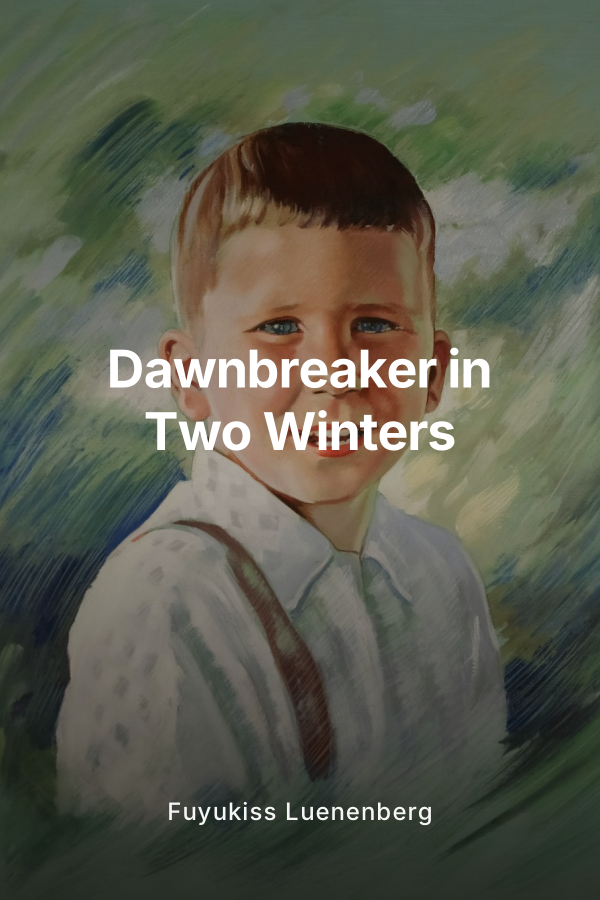
Dawnbreaker in Two Winters traces the quiet, brutal geography of a girl’s mind as she walks the thin edge between staying and slipping away, and the ways love can hold, but never fully anchor, someone who has spent her life feeling unwanted. It refuses to romanticize her pain, showing instead the repetitive, practical cruelty of neglect and the weight of being consistently almost seen. It refuses, also, to glorify a grieving hero, letting Dawnbreaker-Zayne’s torment remain jagged and unresolved.
At its heart, the book is about parallel possibilities.
In one timeline, love came too late, buried under one winter’s worth of isolation and a lifetime of accumulated hurts. In another, love arrives sooner, not as a cure, but as a quiet insistence that Lucca’s existence is not an intrusion. Zayne does not fix her. He provides a warm apartment, a patient ear, a steady touch, and a place where both her brightness and her darkness are allowed to exist without being punished. Their intimacy becomes another language through which they negotiate trust and consent, where pain is carefully transformed into sensation in a context that she controls, instead of the empty, self-inflicted harm she knew before.
As the story moves through five chapters, each divided into two interwoven lenses, the reader witnesses how the same girl and the same boy exist twice: as a memory that shatters a man’s sense of self and as a fragile present tense that might still be preserved. The Christmas of 2047 hangs over them both, a ghost-date that refuses to fade, a night already written in one universe and still unwritten in the other.
There is no miraculous convergence, no neat merging of worlds where everything is solved by revelation. Dawnbreaker’s grief remains real and incurable. The girl he lost remains gone. His timeline is the warning, the cost, the echo of what happens when every small hurt is allowed to grow in the dark without anyone reaching out with enough clarity, enough time.
In the living 2048, however, another ending is still possible. As December approaches and the city begins again to glow with cold lights, Zayne notices the subtle ways Lucca’s mood shifts, her posts grow sharper and more resigned, her sleeves a little longer. He cannot explain why Christmas terrifies him, only that it does. He will stand, in this world, exactly where he failed to stand in the other, and the story becomes a quiet question lodged in every scene: what difference can it make if one person chooses to stay, to listen, to make room?
Dawnbreaker in Two Winters is a hurt/comfort love story about a chronically online purple-haired girl who has never quite believed she deserves to be kept, and the man who loves her in two different worlds, once too late and once in time to try. It lingers in the small details of their lives: takeout containers, shared headphones, the hush of a late-night train, the cramped light of a bathroom where she no longer hides alone. It is intimate, explicit, and emotionally raw, honoring the complexities of mental illness, kink, and trauma without reducing any of them to aesthetic.
Most of all, it is a story about the fragile, stubborn hope that even when one version of a story ends in silence, another can still be written where a girl in purple twintails wakes up on Christmas morning, alive, loved, and not alone.