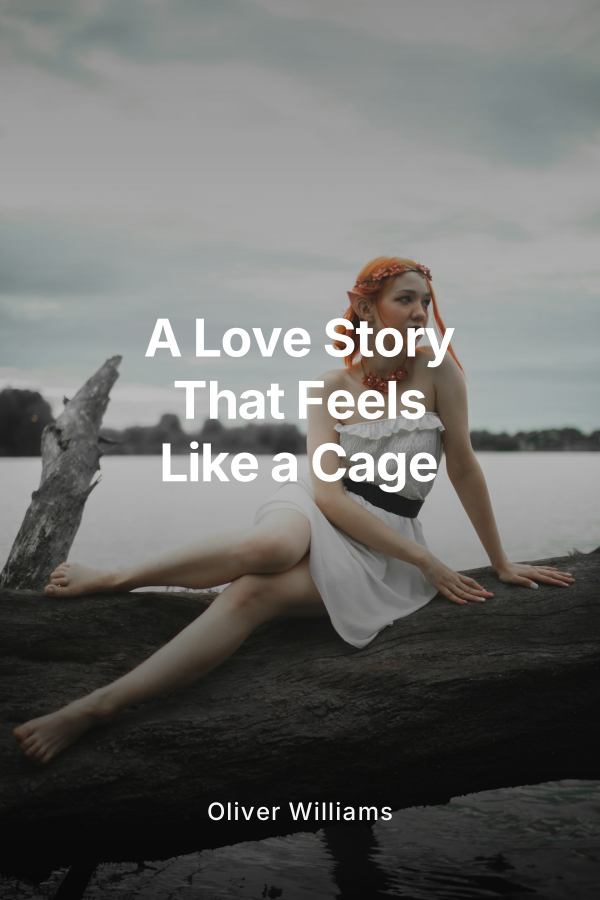
Hollow Hours
Subtitle: A Love Story That Feels Like a Cage
In a near-future Manchester choked with rain, smoke, and the glow of cheap venue lights, eighteen-year-old Oliver Williams looks almost normal. She goes to college. She rides buses. She smokes behind lecture halls with her best friend. She posts guitar covers online and dreams about music scenes she has only ever seen through a screen.
Inside her body, nothing is normal.
Four years ago, Oliver died in a Dublin bombing. Her corpse became a hypothesis and then a project on the table of Moira O’Deorain, a disgraced geneticist whose life’s work revolves around rewriting the rules of biology. Talon’s money and secrecy gave Moira freedom. Oliver’s broken body gave her the perfect canvas.
Moira brought her back. Rewrote her. Gave her unstable temporal abilities and a second life built on banned science and meticulous control.
Oliver grew up in underground laboratories, not bedrooms. Her first lullabies were machine hums and clinical instructions. She learned how to stretch seconds long before she learned how to speak to a stranger. She does not remember what it feels like to exist without Moira’s hand on the pulse of her body, her mind, her future.
When Talon collapsed, Moira smuggled Oliver to Manchester under a false name and a careful story. They share a city centre apartment that splits into two worlds: Oliver’s cluttered, poster-plastered cave and Moira’s cool, sterile sanctuary of notebooks and hidden equipment. Between them lies a thin bathroom door where Oliver’s rituals, self-harm, and quiet collapses play out in the small hours.
To the outside world, they are an eccentric older woman and her ward. Inside, they are an entangled mess of roles that cannot be neatly named. Moira is scientist, savior, captor, guardian, and lover. Oliver knows this is wrong. But wrong is the only shape love has ever taken.
Outside the apartment, Oliver clings to fragments of normal youth. She finds one in Roe Mercer, a hard-edged, sharp-eyed nineteen-year-old who smells of cigarettes and gig floors. Roe is angry at everything and loyal to almost nothing, except Oliver. Where others see a quiet, emo girl with a nicotine habit and too many late nights, Roe sees the tremors, the missing hours, the unexplained bruises, the panic when Oliver’s phone vibrates.
Roe does not know about temporal anomalies, secret paramilitary science divisions, or the geneticist in the kitchen. But she knows what control looks like when it is dressed up as care. She knows what fear looks like when someone has no language for it. She starts asking questions Oliver cannot answer without tearing her entire reality apart.
Meanwhile, Oliver’s music begins to slip beyond the walls of her room. Her online guitar covers catch the eye of Alex Korr, a tired, charismatic guitarist from the cult alt-metal band Whitelocust. He is thirty-four, London born, raised in dingy venues and backstage corridors. To the scene, he is a minor legend. To Oliver, he is a portal.
Their messages start innocently: gear, riffs, theory, jokes about broken strings. He sees a talented, shy kid who reminds him of himself at eighteen. She sees someone who exists entirely outside Moira’s shadow, outside Talon’s ghost, outside the clinical calculations that have always surrounded her body. When Alex invites her to London, she does not hesitate.
In Camden, Oliver tastes a different kind of intimacy. Alex walks her through music shops, buys her a drink, listens to her talk about tunings and tone. The night is warm, harmless, almost sweet. When he touches her, she feels the thrill of being wanted as a person instead of a project. The age gap and power imbalance register only as brief flashes of unease that she pushes down with the mantra she has learned to cling to: This is normal. This is what adults do. This is what freedom looks like.
She goes back. Again and again.
Oliver takes the train down to London for weekends that blur into late-night chords, cheap cigarettes on balconies, and the heat of a body that is not clinical, not measuring, not dissecting. Sometimes they meet at gigs when Whitelocust tours Manchester. In crowded backstage rooms and hotel corridors, she lets things happen. She does everything he wants and allows it, not from eagerness to perform but from a desperate need to be liked, to be chosen, to be treated as if she is a normal eighteen-year-old with a crush on a musician.
The sex is sometimes good, sometimes awkward, always threaded with a quiet wrongness that the narrative refuses to fully ignore. Alex is not violent. He is not calculating. He does not know she was dead at fourteen, that her nervous system was rebuilt by a woman who still owns half of it. He does not ask many questions. He misreads her silences as shyness. He takes her compliance as consent.
Oliver comes home from these trips exhausted, raw, and more unsteady than she realises. She never uses her abilities with Alex. She clamps down on them fiercely, refusing to let time falter around someone who has no idea she is anything but fragile, human, and breakable. But the strain of holding herself together, of performing normality, of carrying the weight of unprocessed trauma, carves hollows inside her.
Moira notices every shift. The way Oliver’s mood flickers. The way her sleep worsens. The subtle heaviness in her limbs. For Moira, these are not just emotional changes. They are data points. Variables. Proof that Oliver’s biology, painstakingly calibrated around Moira’s presence and interventions, destabilises when she invests emotionally elsewhere.
Moira does not forbid the trips. She does not storm or rage. She rarely even raises her voice. She simply reminds Oliver, in quiet moments: who funds her life, who constructed her physiology, who can regulate the unfamiliar headaches and crashes she pretends are just stress. She reminds her that no one else on earth understands what she is, or what might happen to her body if she spirals out of control.
Control with Moira is rarely visible as a locked door. It lives in the way Oliver self-polices, the way she hears Moira’s voice in her head when she chooses what to tell Roe, what to hide from Alex, when to ask for help. The harshest restrictions do not come from rules. They come from gratitude and fear.
Roe watches Oliver slip further away. She sees the late-night spirals after gigs, the way Oliver shakes as she smokes, the way she talks about London trips with a bright, brittle smile that never reaches her eyes. She hears about Alex in fragments: the band, the music, the rush of recognition. She notices what Oliver does not mention: how she felt in bed, whether she felt safe, whether he ever asked if she was sure.
In corridors and bus stops, Roe pushes. Who hurt you? Why is your phone making you flinch? Why do you look worse every time you come back from London? Oliver deflects. Jokes. Lies. She protects Moira. She protects Alex. She does not protect herself.
As Oliver’s emotional life knots tighter, her ability to hold everything inside starts to fail. The careful routines that kept her stable begin to crumble. She starts missing classes. She drifts through lectures in a haze of intrusive thoughts and unanchored shame. William Musgrave, a quiet professor who has seen too many students disintegrate in slow motion, notices the stutters in her attendance, the thousand-yard stare, the way she twitches at sudden sounds. He offers support in gentle, nonintrusive ways that Oliver does not know how to accept.
At home, Moira steps in with cold, precise tenderness. When Oliver’s panic spikes, Moira uses touch and ritual to steady her. Soft Gaelic endearments. A glass of water pressed into shaking hands. A slow, controlled rhythm of breathing and contact. It feels like care. It is also conditioning. Every episode resolved under Moira’s guidance becomes another reminder: without her, Oliver believes she would implode.
The line between comfort and control dissolves.
The more Oliver seeks validation from Alex, the more she ricochets back into Moira’s arms afterward, desperate to be soothed, to be told she is still whole, still wanted. Each time Alex treats their hookups as casual, as something light and unremarkable, Oliver’s shame deepens. He does not mean to humiliate her. In his mind, she is an adult making adult choices. He is careless with her feelings in the way tired, lonely adults often are, not because he delights in harm, but because he has spent too long surviving on shallow connections.
For Oliver, the shallow cuts deep.
The book’s long middle stretch follows this triangle of influence and attachment in intimate, unhurried detail: the late-night messages and train rides with Alex, the cigarette breaks and spiky affection with Roe, the clinical warmth and subtle manipulations at Moira’s kitchen table. Each relationship offers her a different kind of oxygen. Each one also drains her in a different way.
Roe reaches a breaking point. After one especially brutal weekend, she finds Oliver wrecked, vague, and brittle, the edges of self-harm visible despite Oliver’s best efforts to hide them. The confrontation that follows is not gentle. Roe does not have the language of therapy. She has the language of survival. She tells Oliver what the reader has been forced to wrestle with from the start: that someone is grooming her, that someone is benefiting from her confusion and devotion, that somebody is treating her body as a site for their own needs.
Oliver hears this as an attack on the only structures that have ever held her together. She lashes out, scorched with shame. Their friendship splinters. Roe is left outside the apartment block doors, fuming and heartsick, while Oliver retreats into the familiar cold of Moira’s arms.
The final act unfolds in the hollow hours between midnight and morning, when the city is quiet and the mind turns on itself. Oliver isolates. Messages go unanswered. Musgrave signs another attendance report and wonders if he should push harder. Alex sends the occasional casual check-in, then grows distracted with touring, new riffs, new cities. Roe hovers on the edges of Oliver’s digital life, reading, retyping, deleting.
Inside the apartment, Moira is more present than ever. She regulates Oliver’s spirals. She offers her whiskey-dark comfort and the reassurance that the outside world is not built for someone like her. Their intimacy grows heavier, more claustrophobic, more consuming. It feels like devotion. It reads like possession.
Oliver’s final descent is quiet, almost gentle. There is no spectacular psychic break, no explosive confrontation. There is only accumulation: of sleepless nights, of swallowed guilt, of nights with Alex that felt both validating and hollow, of arguments with Roe that she cannot bring herself to fix, of moments of mercy from Moira that come attached to invisible strings.
One night, the weight crosses an invisible threshold. Oliver moves with the calm precision Moira once praised in the lab. She chooses the bathroom floor. She collects pills and bottles and lines them up with the same focus she once applied to chord progressions. Her phone lies beside her. She starts a message to Roe: You didn’t deserve how I treated you—
It trails off.
The narrative slows. It does not glamorise. It does not sensationalise. It simply stays with her in that suspended instant where the choice has been made but the outcome has not yet arrived. Time does not bend. Oliver keeps her abilities pinned down even as she unravels. Control, to the very last moment.
In the aftermath, another perspective takes over. Moira finds her. The emotion in her face is unreadable. Rage, terror, calculation, a twisted sort of love, and the familiar instinct to protect her work and her girl all mix into something the reader is forced to interpret without guidance. Moira handles the scene with chilling competence. She hides what must be hidden. She calls who must be called. She ensures that whatever story emerges will never threaten the fragile world she has built around Oliver’s existence.
Outside, life continues. Roe calls, again and again, staring at a screen that does not light up. Alex posts a one-line memory about the Manchester show to his followers and moves on to the next city. William Musgrave initialises another document, another absence, another unresolved worry.
The book ends where its title lives: in the hollow hours, the quiet spaces between disaster and aftermath, between love and harm, between being saved and being owned. It never offers easy villains or simple heroes. Moira is both monstrous and tender. Alex is both kind and careless. Roe is both abrasive and deeply compassionate. Oliver is both victim and agent, making choices within the distorted boundaries that were built around her from the moment she was pulled back from death.
Hollow Hours is an intimate psychological horror romance about attachment under captivity, consent under conditioning, and the way a young woman can learn to treat her own trauma as background noise. It asks the reader to sit with contradiction: to feel the warmth of a hand that steadies and recognise the cage that hand maintains, to ache for a love story and see the rot in its foundations, to watch a girl who can reshape time refuse to use that power while believing she has no power at all.