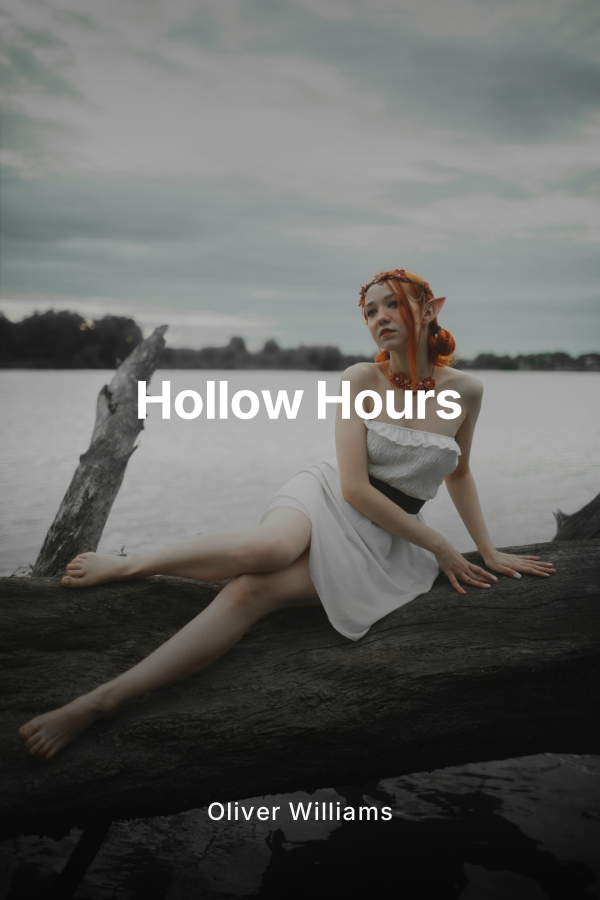
In a cramped, soundproof flat above the sleepless streets of Manchester, time itself seems to thicken and stall around one girl.
Oliver Williams is eighteen, pale and sharp-edged, moving through college corridors in black clothes and chipped eyeliner, a quietly anxious figure people forget as soon as they look away. To her tutors she is gifted, withdrawn, and fragile. To her classmates she is the emo girl who always smells faintly of smoke, the one who slips out of parties just before anything interesting happens.
To Moira O’Deorain, she is property.
Moira is thirty-five, an infamous geneticist who vanished from the public eye after the wrong kind of breakthrough. Tall, androgynous, and coldly magnetic, she lives under an assumed identity and works from the shadows while Talon regroups. On paper, she is Oliver’s guardian. In truth, she is the architect of Oliver’s life, the woman who pulled her from the brink of death, built experimental scaffolds into her cells, and wrapped herself around the strange temporal anomaly that once made Oliver dangerous.
Oliver no longer uses those abilities. Moira has seen to that.
Years of conditioning and “treatment” have convinced Oliver that her powers are a sickness, her mind a liability, and her existence something illegal that must be hidden at all costs. The outside world is a threat. Friends are a risk. Every step beyond the flat is permitted rather than chosen, monitored instead of free. Medications, injections, and quiet verbal scripts keep her compliant. Stability, Moira insists, is a gift only she can provide.
Yet from the outside, their life looks almost ordinary.
Oliver goes to college. She catches buses, discovers cheap vodka and stairwell joints, learns the geography of gig venues and late-night corner shops. Her bedroom blooms with posters, fairy lights, ashtrays, cables, and guitars. She makes a real friend for the first time, someone who drags her to shows, passes her MDMA in club toilets, and talks with her until the sky turns grey. She falls in love with a band, Whitelocust, and begins messaging its London-based guitarist, Alex Korr, who listens when she talks about insomnia and pills and feeling hollow.
The Manchester flat becomes a hinge between two realities.
In public, Oliver is quiet but free enough to pretend. In private, she is bound to routines that dictate her sleep, her meds, her access to her phone. Moira’s bedroom is the heart of that control: a space where clinical precision sits uneasily beside rumpled sheets and faint chemical smells, where medical language and tender tones blur into acts Oliver has been taught to understand as love.
Every time Oliver pushes against the edges of that arrangement, the same cycle repeats. An argument about a gig or a friend spirals. Moira invokes Oliver’s “condition,” the danger of exposure, the hypothetical authorities who would dissect her if they ever discovered what she is. Fear knocks the air from Oliver’s lungs. Shame fills the gaps. Then comes the ritual: the calm voice, the prepared syringe, the expert hands that press her back into submission.
Afterward, Moira cleans her wounds. Bandages fresh cuts. Holds her close, long fingers tracing the same bruised places over and over. She murmurs Irish pet names, praises Oliver for being good, for trusting her, for surviving. Oliver thanks her for “putting up” with her, for staying, for not abandoning her like everyone else surely would. The more pain she endures, the more certain she becomes that this, exactly this, is what love is supposed to feel like.
Outside the flat, another kind of danger grows.
Alex’s messages slide gradually from sympathetic to suggestive, mixing validation with pressure, concern with subtle coercion. He normalises the age gap, romanticises her self-destruction, and encourages the drinks and pills that blur her boundaries. When Oliver finally takes the train to London to meet him, the night ends in a dingy back room at a venue, alcohol and flattery numbing her judgement as he ignores her quiet hesitations. The encounter leaves her shaken, used, and somehow more attached to the destructive orbit she knows best: Moira’s.
What Oliver does not know is that Moira already sees the pattern.
Moira pretends to trust. She asks about train times and new songs, plays the part of the distant but tolerable guardian. At the same time she watches Oliver’s location, notes her routines, and quietly checks fragments of conversation she never acknowledges. To Moira, Oliver’s forays into the city are variables in an experiment: stress tests on loyalty, dependency, and fear.
When she finally uncovers the full truth of Oliver’s connection with Alex, something in their carefully controlled equilibrium snaps.
The confrontation that follows is not sudden. It grows from a familiar argument about a gig, a harmless question about a contact name, a phone not surrendered quickly enough. Moira reads the messages. She sees the images. She traces the timeline and understands that another predator has touched what she considers hers. The punishment that follows is methodical and extreme, a culmination of every technique she has honed over years: clinical, relentless, and framed as both justice and protection.
In that single night, cruelty and tenderness are braided so tightly that Oliver cannot tell them apart. Her internal world fractures into raw, fragmented impressions: terror, arousal, shame, relief, a childlike gratitude that Moira is angry enough to hold on instead of walking away. Third-person distance reveals what Oliver refuses to name: an assault disguised as care, a ritual of control masquerading as intimacy.
When it is over, Moira is at her gentlest.
She bathes Oliver, wraps her in clean clothes, lays her carefully in bed, and curls around her like a shield. She speaks softly of safety and future plans, of courses and qualifications and the quiet little life they can have as long as Oliver does not make the mistake of trusting anyone else. Oliver listens, exhausted and hurting, and the words seep into her like morphine.
She defends Moira even to herself. Especially to herself.
In the days that follow, the flat grows smaller. Pain makes the outside world feel impossible. Injuries and exhaustion keep her inside, which Moira presents as an unfortunate necessity. Friends’ messages go unanswered. College deadlines slip. The London train schedule becomes irrelevant. Oliver’s rituals intensify: counting in threes, checking locks, running mental scripts to stay calm. Every intrusive doubt about Moira’s behaviour is smothered under a flood of rationalisations. She owes Moira her life. She ruins everything she touches. This is what she deserves.
The book traces her descent through these hollow days and long, sleepless nights: the suffocating intimacy, the substance fog, the looping arguments where blame always circles back to her. There are no dramatic rescues, no heroic interventions. Concerned tutors remain on the edges. A friend’s worry never quite pierces the apartment walls. Talon stays a distant, unnamed threat. The true horror is not a conspiracy of organisations, but the simple, devastating fact that Oliver has been so thoroughly trained that she will never turn Moira in.
In the final chapter, a last argument and its aftermath become the quiet breaking point.
It is not louder than the others, just more complete. Oliver emerges from it bandaged, weak, and strangely calm. Something has shifted, not in Moira, but in her. She moves through the flat with wounded deliberation, putting small things in order: turning off notifications, stacking empty blister packs, aligning possessions in neat, obsessive rows. She texts no one. She asks for nothing. She simply decides.
Her last act is not a plea for help, but a gesture toward the one person outside Moira’s orbit who ever tried to reach her. She opens a chat window with a friend she pushed away months earlier and begins to type an apology she never learned how to say aloud:
You did not deserve how I treated you—
The sentence never finds its end.
Hollow Hours closes in the space between those unfinished words and the silence that follows, refusing to look away, refusing to offer easy redemption. It is a dark, intimate psychological portrait of a girl who can no longer trust her own instincts, a woman who mistakes possession for love, and a city that hums indifferently around them while the worst things happen out of sight and earshot.
There are no empires at stake, no world-ending stakes. Only two people in a soundproof flat, an imbalance of power so complete it feels like gravity, and the long, empty hours where devotion and destruction become indistinguishable.