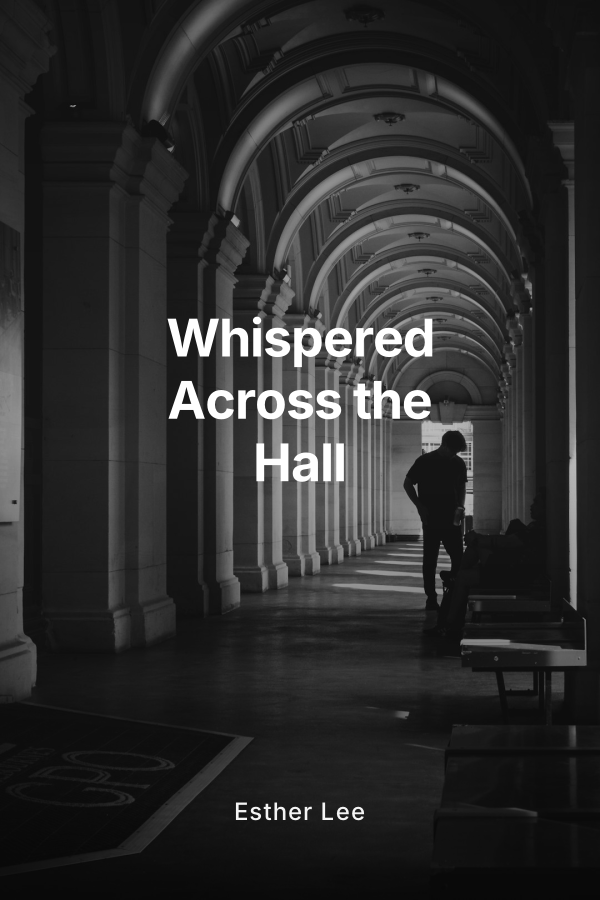
Lydia Carter has learned how to survive by staying quiet. At her private academy, she keeps her head down, protects the fragile peace of her life, and focuses on the things that matter most to her: good grades, helping her aunt, and remaining invisible to the kind of people who never bother looking twice. She is shy, guarded, and underestimated, though beneath her silence lives a sharp, observant mind and a heart that aches for something more.
That something more enters her life in the most unexpected way.
Jacob Hale is the school’s most impossible mystery, a cold and distant young man who moves through the halls like he belongs to a world far above everyone else. He is polite if spoken to, composed in every room he enters, and impossible to read. What Lydia does not know at first is that Jacob is the son of one of the most powerful men in the country, the heir to Hale Industries, and a billionaire whose life has been tightly controlled by wealth, expectation, and fear. Jacob wants freedom more than admiration, normality more than luxury, and someone who sees him as a person instead of a legacy.
Their story begins with coffee.
One careless accident, one spilled cup, one startled moment in the hallway changes everything. Jacob spills his coffee on Lydia, and in the awkward aftermath, something unspoken passes between them. It is not instant love, but it is the beginning of recognition. He sees her quiet strength. She sees his loneliness. From that day forward, they are drawn to each other in ways neither one can safely explain.
What starts as small glances becomes late night texts. What begins as brief conversations becomes secret notes passed when no one is watching. Hidden study sessions turn into private moments that feel more honest than anything either of them has known. Lydia, who has spent so long trying not to be noticed, finds herself opening up to the one person who seems to understand the weight of silence. Jacob, who has lived under his father’s control for so long, finds in Lydia a softness and sincerity that make him feel human again.
But a private academy is a dangerous place for a secret.
Jenny, the same age as Lydia and Jacob, is the kind of girl who thrives on status, attention, and control. She is popular, mean, clever, and sneaky, with an instinct for cruelty that makes her dangerous in ways that are hard to see at first. She notices the smallest changes, the missed glances, the hidden smiles, the distance that grows suspiciously close. What fuels her obsession is not just jealousy, but the thrill of exposing what she believes should never exist. To her, the idea of Jacob Hale, rich beyond imagination and destined for power, falling for a “low-born” girl like Lydia is scandalous enough to destroy both of them. So she watches, waits, and plots.
As Lydia and Jacob grow closer, Jenny begins to interfere in every possible way. She engineers moments that force them together, then twists them into evidence of wrongdoing. She creates accidents, spreads tension, and pushes Lydia into situations designed to make her look foolish or guilty. Each attempt to isolate Lydia only brings Lydia and Jacob closer in secret, but every stolen moment also deepens the danger. Their romance becomes a quiet rebellion against everything the school and Jacob’s family expect.
Then Jenny finds the proof she has been hunting for.
When Jacob puts his arms around Lydia’s waist, Jenny takes a photo and leaks it to the entire school. The image spreads like fire. Phone calls explode across the campus. Gossip races through hallways, classrooms, and dorm rooms with vicious speed. Before the day is over, more photos follow, one of Lydia and Jacob holding hands on another day, and then one of them kissing. With each leak, the scandal grows larger, crueler, and impossible to contain.
The exposure does not just humiliate them. It threatens to destroy everything.
Jacob’s father is furious. To him, the relationship is not love but disgrace, a danger to the family name and the carefully controlled future he has planned for his son. His anger is sharp, controlling, and merciless, and he threatens to take Jacob out of school before the scandal can spread further. Lydia’s aunt, devastated by the public humiliation and the emotional fallout, is heartbroken by the chaos now surrounding the girl she loves and has tried to protect. For Lydia, who has always tried to hide, the world suddenly feels too loud, too cruel, and too exposed.
At first, Lydia retreats into silence again. She hides, not because she has stopped loving Jacob, but because fear has once more convinced her that staying invisible might be the only way to survive. Yet hiding cannot last forever, especially when love has already changed her.
The turning point comes in a sharp, tense hallway confrontation that no one in the school will ever forget.
Jacob’s father confronts him publicly, expecting obedience, shame, and surrender. Instead, Jacob stands before him with a courage that he has been building for months. In front of the people who have always watched him bend, he refuses. He says the words that finally break the old order: he chooses Lydia, and his father does not get to control his life. He is done obeying. He is done living like a possession. He is done treating his heart like something that can be bought, edited, or erased.
Lydia, who has spent so long hiding from pain, does the one thing she once thought impossible. She stands by his side.
Their defiance does not end the storm, but it changes them. Jacob’s bold confrontation becomes an act of liberation, not just for himself but for Lydia as well. He defends her not as a secret to be protected, but as the woman he loves and the future he wants. For the first time, they are no longer whispering through the dark. They are choosing each other in the open, even if the world punishes them for it.
The final break from fear comes in the rain.
Soaked, shaken, and finally honest, Lydia and Jacob meet one last time with everything exposed. They kiss in the rain, refuse to let go of each other, and make the kind of promise that feels more powerful because it has survived betrayal, shame, and public ruin. When they leave together, it is not an escape born from weakness. It is a declaration that they will build a life that belongs to them alone.
The epilogue reveals what that promise becomes.
Years later, Lydia and Jacob are married and happy, no longer defined by scandal or fear, but by the peace they fought so hard to earn. They live a life filled with love, and their family has grown to include two daughters, Esther and Erin. In their home, there is no control like Jacob once knew, no hiding like Lydia once practiced, only the steady warmth of a marriage built on loyalty, trust, and the kind of devotion that survives every storm. Their story ends not with gossip or power, but with the quiet triumph of two people who chose each other and never let go.