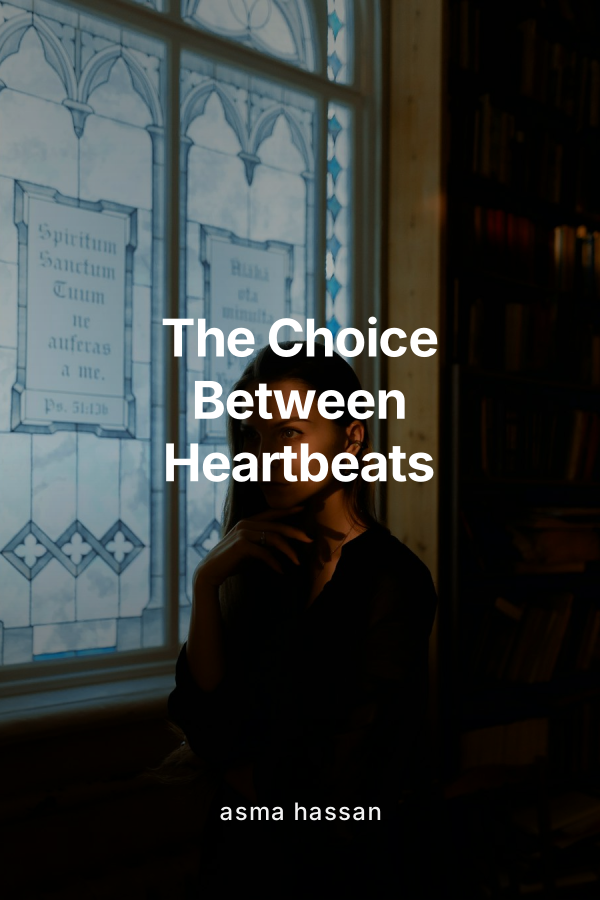
In a single charged night within a delivery room, The Choice Between Heartbeats follows a woman in labour as time narrows to the width of a breath and love is measured against life itself. Told in an intimate third person that never leaves her inner world, the story turns a medical emergency into a lyrical meditation on identity, desire, and the aching cost of bringing new life into the world.
The book opens with the woman already in the throes of labour, sweat mixing with the cold chemical scent of the hospital. Each contraction feels like a tide trying to tear her from herself, yet she clings to small, human details: the chipped edge of a clock on the wall, the sound of footsteps in the corridor, the way the fluorescent light makes the ceiling seem endlessly far away. The world around her appears both sharply real and strangely dreamlike, as if every sensation has been dipped in memory before it reaches her.
As the narrative moves through the stages of labour, the prose lingers on her thoughts rather than the machinery that surrounds her. The monitors, needles, and masked faces are present, but they appear almost blurred at the edges, like scenery glimpsed from a train. What remains in sharp focus is the inner landscape of a woman standing at the border between who she has been and who she might become. She remembers fragments of her life in flashes that echo the contractions: a childhood game in a summer field, a first kiss under indifferent stars, a quiet moment when she once believed her life could go untouched by such grand choices.
The baby inside her is more than a heartbeat on a screen. It is a presence she has already begun to know. She has whispered nameless endearments into the dark, traced circles on her own skin as if outlining a future face, and listened to the sea-like hush of her own blood carrying two lives at once. These quiet intimacies saturate the pages and tighten the emotional tension long before any explicit dilemma is spoken aloud.
The central turn of the story arrives when something in the room shifts: a look exchanged between the staff, a sudden stillness in their practiced movements, a subtle but unmistakable change in the rhythm of the beeping machines. The atmosphere thickens. Though the medical specifics are only lightly sketched, the reader understands that the familiar narrative of labour has stepped onto more precarious ground. She feels it before she is told, a primal knowledge blooming like frost across glass.
When the doctor finally speaks, the words enter the room with the weight of a verdict. There is no melodrama in his tone, only a quiet sorrow honed by repetition. He asks her to decide between her own life and the life of her child. This question, at once impossibly abstract and terribly concrete, becomes the book’s axis. The prose slows, expanding a single moment into something vast and echoing.
Within that suspended instant, the story turns fully inward. Her thoughts fracture and scatter, then gather themselves again in strange, luminous patterns. She imagines the world without her: a crib that will be filled but a bed that will be empty, a tiny hand gripping a stranger’s finger, a child raising questions about a face seen only in photographs. She also imagines the world without the child: mornings that feel unfinished, silence where a laugh should have been, the palpable shape of an absence at every dinner table and every passing year.
The book never lets the reader forget that she is not only a mother in potential but also a woman with her own history and unfinished story. She thinks of promises she has made to herself, of dreams that still lie unclaimed. Yet those personal visions collide with the new, fierce tenderness she already feels for the life inside her. The conflict is not presented as a simple equation of selflessness versus selfishness. Instead, it is rendered as an intricate tangle of love for herself, love for the child, and even love for the people who will have to live with the consequences of her choice.
Floating between pain and the numbing haze of medication, her perception becomes a shimmering mix of reality and reverie. The buzzing of fluorescent lights folds into the remembered sound of rain on an old window. The cool touch of a nurse’s hand on her arm blurs with the imagined warmth of the baby’s skin. She is at once firmly in the hospital bed and standing at a metaphysical threshold where every possible future stretches out like unchosen paths in a winter forest.
The tension of the narrative lies not in graphic description of medical crisis, but in the delicate balancing of images and questions. What does it mean to be a mother if the price is the erasure of the self who longed to be one? What does it mean to cling to life when that life has already begun to grow beyond one’s own body? The book does not offer answers through speeches or declarations. Instead, it lets meaning seep through repeated motifs: the ticking of the wall clock that seems to hesitate, the rise and fall of her breath that she begins to measure against the unseen breath she hopes to hear, the remembered feel of her own mother’s hand and the sudden awareness that she now occupies that same sacred, fragile role.
As the climax approaches, the prose sharpens to a fine point. We watch her weigh the lives in her mind, not as abstractions but as two distinct melodies that cannot both reach their final note. There is a hush in the room, a collected holding of breath from everyone present, yet the story stays almost entirely within the quiet storm of her consciousness. Her decision crystallises not in words, but in a subtle change in the way she sees the ceiling, the light, the figures around her. A private serenity, or perhaps a private resolve, settles over her.
The book ends on a carefully crafted cliff hanger. She parts her lips to answer the doctor’s question. In her eyes, there is the unmistakable glimmer of a chosen path. The reader feels the full force of that decision without ever being told what it is. The final sentences capture her inhale, the soft formation of the first syllable, the way her hand curls just slightly on the sheet, as if already reaching for the life she has decided to save or the life she is ready to surrender. Then the narrative closes, leaving the echo of that unspoken choice reverberating long after the last page.
The Choice Between Heartbeats offers a brief yet haunting exploration of motherhood, mortality, and identity, rendered in poetic language that blurs the line between the physical and the metaphysical. It does not resolve the impossible question at its core. Instead, it honors its magnitude, allowing the reader to stand beside the woman in that charged instant and feel, as she does, that love in its purest form is less an answer than a trembling, beautiful opening into the unknown.