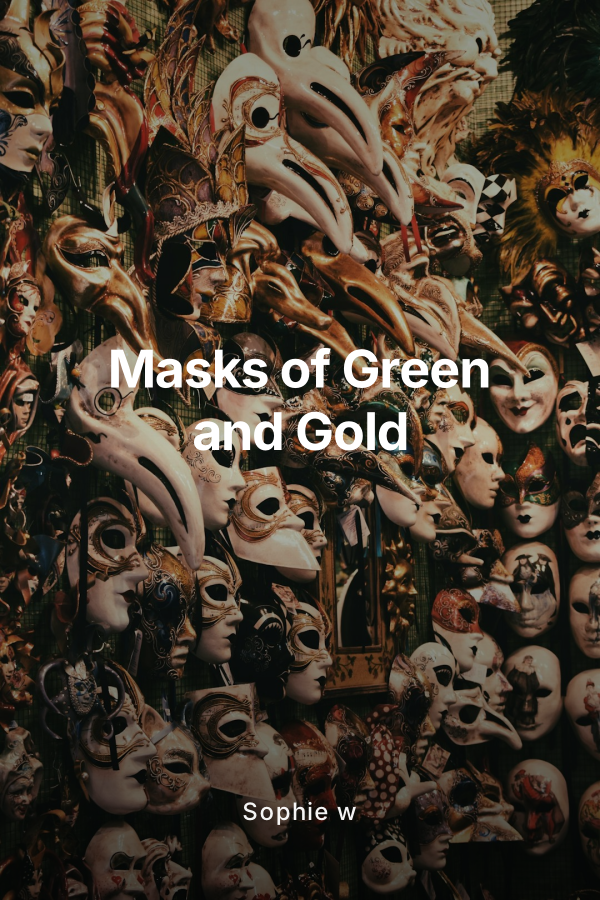
Emmeline Vale was raised to be flawless. In the hushed corridors of Hogwarts she is the girl in emerald robes and sharpened silences, a Slytherin of impeccable lineage, cold precision, and myths of dark magic that trail after her like smoke. Pureblood, powerful, untouchable, she is everything the Vale name demands. Behind the mask, however, lives a girl who flinches at the thought of going home, who memorises antidotes instead of curses, and who dreams of becoming a healer even though her parents have already arranged to trade her future for political gain.
Across the castle, in a world of laughter and mischief tinted Weasley red, George moves through life as half of a whole. To most of Hogwarts he and Fred are a matched set, a punchline in motion, impossible to separate in anyone’s mind. George hides his quieter doubts behind a grin, wonders who he might be if no one already knew the name on his jumper, and buries the deep, aching desire to be seen as more than the echo of his twin. He is everything Emmeline should avoid: loud, reckless, a pureblood without the arrogance her world worships.
Their worlds collide on a staircase. Draco Malfoy sneers about bloodlines and worth, nursing a bruised Charms record, while an entire cluster of Slytherins looks on. Emmy dismantles him with calm, surgical precision, pointing out that magical strength has nothing to do with family trees and everything to do with actual skill, which Draco notably lacks. She keeps her voice soft and her posture languid, terrifying in the way only Slytherin poise can be. When Fred and George drift over, ready to heckle Malfoy, Emmy slices them into the argument without even turning her head, quipping that not all purebloods are intelligent, as current company proves.
For a heartbeat George is disarmed, because the ice queen of Slytherin just defended Muggleborns and half‑bloods in front of Draco Malfoy. Then her insult lands, and the twins walk away with a new enemy. Emmy has earned their respect and their ire in the same breath.
What no one sees are the letters piling in Emmeline’s trunk, each one an invisible set of shackles. The Vale family is as old and polished as the Malfoys. Her father and mother have groomed her since childhood to be the perfect political bride. Prospects are laid out like a menu: Graham Montague in seventh year, handsome with a cruel glint that promises control; Theodore Nott, quieter, cleverer, someone who has been at her side for years and might at least be kind. Love is never mentioned. Expectation is. So is obedience.
Behind the rumours that she practices dark magic, Emmy spends late nights in the dungeons perfecting potions and memorising herbology texts. No one knows she is quietly training to become a specialised healer. No one is meant to. Vale daughters do not work, they marry. Vale daughters do not dream, they deliver alliances.
Her summer is a lesson in how thin the line between obedience and bruises can be. An argument with her father ends with his hands on her shoulders, slamming her back into a doorframe hard enough to flower blue marks along her skin and leave her wrist aching when she tries to lift her wand. She runs, not to St Mungo’s, but to Theo Nott’s house. He opens the door in the middle of the night, says nothing at the sight of her red eyes and trembling hands, just leads her upstairs and lets her curl against him while he strokes her hair until she falls asleep. They never mention it again. He understands her world too well to name the violence.
Charlene, her closest friend, comes from a similar pedigree and carries her own constellation of scars under flawless robes. Emmeline confides in her in pieces, both girls learning how to survive by not looking too closely at each other’s wounds.
Back at Hogwarts for sixth year, Emmy resumes her performance as the sharpest blade in Slytherin’s arsenal. Her cruelty is mostly theatre, calculated and glacial. She chooses her targets carefully, turns that poison tongue only on those who hurt others first. She quietly defends the vulnerable with backhanded compliments and icy warnings, never letting anyone see that the girl beneath the mask shakes with fear of her parents’ displeasure.
George notices her again by accident. First it is in a forgotten corridor, where the twins are planning to test a new product and nearly collide with her. Then at breakfast, when he sees owls deliver letters wrapped in expensive parchment to her plate and watches her slip them into her bag without breaking stride. The rest of Slytherin pretends not to see. George, who has spent his life in a family of letters and hand‑knitted jumpers, cannot look away from how deliberately she does not open them.
He decides she is hiding something and that it is his business. Fred calls it a bad idea and then dares him anyway.
Their forced proximity begins with mischief. A prank in the corridors goes wrong, Filch appears out of nowhere, and Emmy and George are shunted together through a side door as they both duck for cover. Trapped in a disused classroom that smells of old parchment and dust, they are forced into a brittle truce. The air between them crackles with disdain and curiosity. Emmy, pressed against a cabinet, is all composed lines and flat, disinterested replies. George, irritated and intrigued, tries to provoke her into a reaction, jabbing at the rumours about her, at her Slytherin friends, at the way she publicly humiliated him on the stairs.
The conversation turns heated, not just with barbs but with reluctant honesty. She calls him arrogant for assuming he understands her, he calls her a coward for hiding behind blood and reputation when she clearly does not believe in either. Somewhere between accusations she reveals, almost by accident, that she can tell the twins apart, that she can always tell when it is him. That tiny admission lands in George’s chest like a spell. Someone sees him, not the pair of them, not Weasley, not a joke, but George.
From there the ground shifts slowly. They run into each other in halls and on staircases with suspicious frequency. Sometimes with Fred, sometimes without. Every time Emmy’s eyes find George first. He notices that her wand hand twitches whenever someone raises their voice. He notices that she is softer with first years who look terrified in Slytherin green. He notices that Theo Nott is the only person she lets touch her casually in public, a hand on her elbow, a palm on her back guiding her through a crowd. Jealousy rises in George like a dragon. He stuffs it down, calls it irritation, mocks himself for caring.
In the library he sees her bent over cauldrons with a Ravenclaw seventh year, the one who challenges Professor Snape and always sits alone. They speak in low voices about counteragents and rare ingredients, their conversation a dance of intellect and private jokes. Rumours say Emmy used to sneak off to snog him. Now the touches are rare, the intimacy turned inward. George cannot resent the Ravenclaw’s mind, but he resents that Emmy’s eyes light up for someone else.
He pines from a distance, drowning his confusion in new pranks and bigger explosions. Fred, slower to trust Emmy, begins to notice that George’s laughter is forced whenever she walks into a room. He catches his twin watching the Slytherin table at meals, tracks how George’s good mood vanishes when Theo drops a casual arm around Emmy’s shoulders. Fred teases, because that is their language, but under the jokes lies a dawning understanding. George is not just annoyed by Emmeline Vale. He is orbiting her, and it is beginning to pull him off his axis.
Emmy’s life tightens around her. Her parents’ letters shift from implication to command. Her father formally announces that they have accepted a marriage contract: she is to marry Theodore Nott after Hogwarts. The letter is a masterpiece of politeness and property language, as if she were another ancient artefact being traded between old houses. There is no question of her consent. Theo, when he finds out, is gutted but composed. He has always known this was a possibility. He cares for her deeply, perhaps a little in love in his own restrained way, but he also sees the flicker in her eyes when George’s name is mentioned.
Theo becomes an almost lover and a staunch ally, the person who knows exactly how trapped she is yet is tethered by the same expectations. He holds her secrets, including the bruises from the summer, and in return she guards his. Their engagement is a safety net for them both and a cage.
As the year unravels, dark academia drapes itself over Hogwarts. Late‑night study sessions in empty classrooms blur into whispered arguments about free will and family duty. Emmy and the Ravenclaw boy push each other’s minds to the limit over potions theory, their rivalry blurring lines between past intimacy and present camaraderie. In green‑lit corridors, Theo and Emmy share quiet, heavy moments where he gently presses her to at least imagine a future that is hers, even if his name must be on the contract.
George is caught in the crossfire of all the men in her life. He sees Emmy laugh, truly laugh, for Ravenclaw boy over a spilled vial. He sees her lean her head against Theo’s shoulder when she is too tired to hold herself upright. Each glimpse becomes a needle under his skin. His jealousy is laced with self‑loathing. Who is he, a prankster from a famously poor pureblood family, to covet the icy princess of Slytherin? He is loud where she is lethal, sunlight where she is green‑tinted shadow. Yet he cannot stop watching.
The enemies‑to‑friends shift anchors itself in vulnerability. More shared detentions, more accidental alliances when teachers pair houses for group work, more stolen conversations behind tapestries where barbs gradually turn into confessions. Emmy learns to trust George with slivers of truth. She reveals her love of potions, her secret ambition to heal, the suffocating weight of the Vale name. George reveals his terror of being forgettable, of one day standing alone without Fred and not knowing who he is.
In the privacy of these moments the arrogant front cracks on both sides. Emmy still clings to control as if her life depends on it, because it always has. George, instinctively gentle despite his brash exterior, begins to show her what it might mean to let someone else carry a little of the weight.
Their path to lovers is not linear. The engagement announcement detonates between them like a curse. George hears about it secondhand and feels the floor vanish beneath his feet. He confronts her, furious that she did not tell him, accusing her of playing him, of treating him as a distraction when her future was already written. Emmy lashes back with equal fury, reminding him that not everyone gets the luxury of choice, that his family might be poor but at least they are kind, at least they do not bruise their children for talking back. She goes too far, weaponising her knowledge of his insecurities. He goes too far in turn, calling her a coward for submitting to a fate she does not want.
The fight leaves them both bleeding on the inside, and after it they retreat into their separate worlds. George throws himself into chaos, pranks growing more reckless. Emmy doubles down on her Slytherin mask, colder and crueller than ever. Theo and Charlene watch the implosion with weary resignation. The Ravenclaw boy questions whether Emmy is sabotaging herself out of fear.
The eventual breaking point will force Emmy to choose between obedience and the wild, terrifying promise of a life lived on her own terms. Her family’s power reaches for her too tightly, their threats no longer limited to bruises but extending to those she dares to care about. Hurting George by association is her worst fear, and as long as she remains Vale property, anyone near her is a potential target.
In seventh year, the price of love becomes impossible to ignore. Emmy’s decision to sever herself from her family is brutal and costly. In cutting off the Vales she loses her inheritance, her name, and any semblance of the security she was taught to worship. What she gains is fragile and new: a chance to build a self that belongs to her and not to the people who shaped her with fear.
George, who has spent so long being seen as the irresponsible twin, becomes the steady presence at her side. In stolen nights and secret rooms he teaches her how to relinquish control in ways that heal instead of harm. In their most intimate moments, the girl who has always braced for the next blow learns what it feels like to surrender by choice, to set boundaries and have them honoured, to be guided by firm hands that are incapable of cruelty. Their physical connection becomes an extension of her emotional journey from survival to trust, his dominance the opposite of her father’s violence, rooted in consent and care.
Around them, Hogwarts continues in its rhythm of classes and Quidditch and exams, unaware that in the green‑shadowed corners of the castle a new story is being written. Emmy, once feared as Slytherin’s cruelest daughter, begins to knit herself into a different family: a freckled, loud, infuriatingly warm clan of redheads who welcome her with suspicious glares that turn into genuine affection. Charlene learns that escape is possible. Theo grapples with losing an almost‑future and finds purpose in choosing his own path. The Ravenclaw boy watches Emmy step into a life where her mind and heart are finally allowed to be as bright as her magic.
Masks of Green and Gold is a slow‑burn, enemies‑to‑friends‑to‑lovers romance set in a Hogwarts untouched by war yet saturated with pureblood politics and dark academia moods. It traces two people who were never meant to touch finding their way toward each other through pining, jealousy, sharp‑edged banter, and aching vulnerability. At its core, it is the story of a girl who was trained to be a weapon and a boy who was treated as a joke, and how they learn to rewrite their fates together.
The ending is bittersweet. Emmeline Vale loses the family that raised her but gains a new one that chooses her. George Weasley, forever overshadowed, finally stands in a light that is his alone, reflected in the eyes of the woman who sees him better than anyone else. Their future is uncertain, laced with the ghosts of what might have been, but it is theirs, built not on blood or duty, but on trust, desire, and the courage to love against all odds.