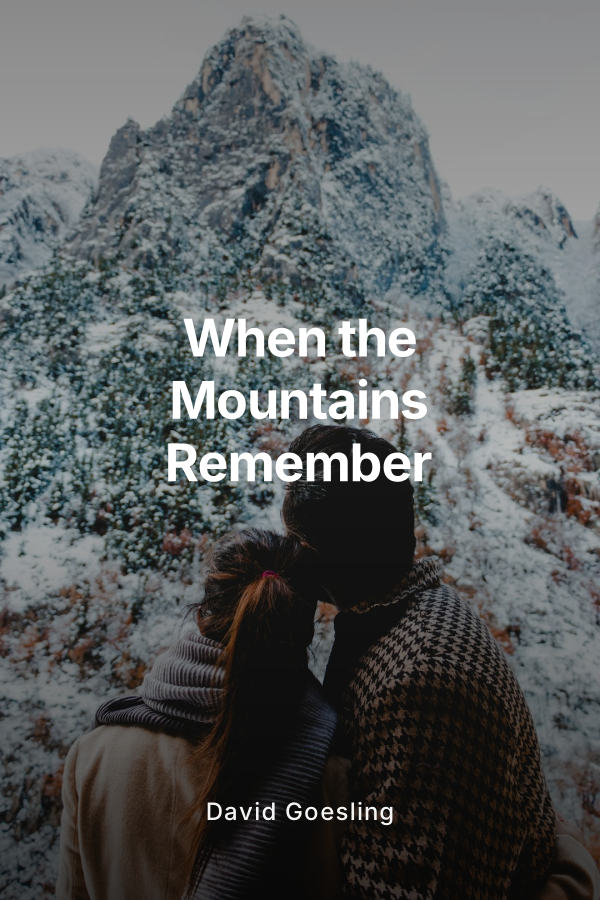
This young adult romance follows nineteen year old Rielle Emerson, who lives and works in a quiet alpine lodge tucked into the Mission Mountains of Montana. Her days are a pattern of peaceful, lonely routines: clearing tables in the lodge café after guests drift back to their rooms, watching dusk deepen over snow brushed peaks, and listening to other people’s laughter echo down hallways that never quite feel like home. On the surface, she appears capable and calm, but under that stillness lives a private conviction that she does not matter to anyone. Years earlier, her parents’ constant fighting ended in something even worse than their arguments. They both left her behind when she was fifteen, walking out of the only house she knew and never looking back. The echo of that abandonment shapes everything she believes about herself.
Rielle’s deepest fear is loss, separation, the moment the people she loves turn away. Her quiet dream is simple but powerful: to find some anchor of inner stability, some steady peace of mind she has never known. She tries to reach for that peace in the place she thinks she is most likely to find it, a romantic connection that will finally prove she is worth staying for. When twenty one year old Levi Thatcher walks into the lodge lobby with his parents and his seventeen year old sister Wren, Rielle’s controlled, solitary life begins to tilt.
Levi is a rancher boy from Oklahoma, more familiar with sun baked pasturelands than icy switchbacks and cedar shaded trails. He is strong, competent, and used to long days where hard work on the family ranch defines his worth. Under that easy competence lives a different kind of fear. Levi is terrified of losing control, certain that when life unravels there is nothing he can do to stop the damage. To stay steady, he clings to what he understands his ranch, his responsibilities, the role he has always played in his family. He tells himself that what happens back home matters more than anything he might feel on an impulsive trip to a distant mountain lodge.
The story brings these two guarded hearts together in a small Montana town that seems frozen in snow globe stillness. Their first interactions feel tentative and awkward, touched with the soft tension of two people who do not know exactly what to do with their sudden interest in each other. Rielle notices Levi’s patience with his younger sister, the quiet way he listens when others speak. Levi notices how Rielle blends into the background of the lodge and yet seems to carry the whole place on her shoulders, the way her eyes flick toward the door every time someone leaves, as if she is bracing for an absence she already expects.
As the days pass, the mountains frame their growing connection. They talk over steaming mugs in the nearly empty café, share stories during slow afternoons when the lodge is hush and the fire snaps in the stone hearth, and take careful steps toward trust. Levi draws close enough to glimpse the fragile lies Rielle tells herself. He begins to challenge her belief that she does not matter. Through small, consistent choices listening when she hesitates, showing up when he says he will, defending her when demanding guests treat her as invisible he becomes the first person in years who seems determined to prove that she is seen and valued.
Yet Levi’s own misbelief works against him. He keeps part of himself protected. In his mind, the ranch is reality, the fixed point around which his life must turn. Anything beyond that especially something as uncertain as love feels like a risk he does not know how to manage. Still, against his better judgment, he keeps leaning toward Rielle, until the line between friendship and something deeper blurs.
The fragile safety they are building shatters when Rielle’s past bursts into her present with brutal force. One afternoon, her father walks into the lodge as if nothing in the last four years has mattered. The sight of him in the familiar place that has become her refuge sends Rielle reeling. Shock and disbelief lock her in place. This is the man who raised his voice over the sound of breaking dishes, who slammed doors hard enough to rattle her bedroom walls, and then one day simply stopped coming home. Now he stands at the check in desk asking for her as if he has any right to her time or trust.
Rielle has no script for this reunion. She is frozen between a child’s wish for a parent to return and a young woman’s knowledge that what he did was abandonment. Her father claims he wants to make things right, to be part of her life again. Inside, Rielle feels something cold and sharp answer him. The girl who waited by the window has grown up. She tells him, with a voice that does not match the shaking inside her, that it can never happen. The years without him have left scars that no simple apology can erase.
Levi, who until now has known nothing of Rielle’s history, is drawn into the storm of her past without warning. He sees the way her hands tremble after the encounter, how her composed mask slips. For the first time, she shares the full story of growing up surrounded by her parents’ constant fighting and then being left alone when they both chose to walk away. Rielle’s confession is raw, stripped of decoration. She opens the locked door of her heart and lets Levi see the rooms inside that no one has been allowed to enter.
In an attempt to clear their heads, they decide to spend a day hiking through the surrounding forest. The trail leads them under spruce branches heavy with snow, past frozen creeks and still clearings where the mountains rise like guardians. The silent beauty around them stands in painful contrast to the tangle of emotions between them. Rielle is brittle and quiet, occasionally flashing with anger and hurt. Levi feels pulled between a desire to protect her and an uneasy sense that he is stepping into a life too complicated for him.
During their hike, nothing Rielle says is unreasonable. She is not asking for promises or begging him to stay. Yet as she explains her backstory in fuller detail, Levi begins to twist her honesty into something else in his own mind. His fear of losing control starts to whisper that this is a situation he cannot manage. Her history, her father’s sudden reappearance, the legal words she throws out in panic as she talks about restraining orders and the possibility of court all of it feels like more than he ever planned to carry. Old beliefs rise in him, telling him that his real duty is back in Oklahoma, that ranch life is concrete and necessary, while Rielle’s pain is a storm he is not equipped to weather.
The tension follows them back to the lodge café that evening, where they sit across from each other at a small table with half eaten plates between them. The gentle clink of cutlery from other guests and the low murmur of distant conversations seem to press around the bubble of silence forming at their table. For Rielle, the day has been a fragile test of whether she can share her broken story and still be accepted. For Levi, it feels like proof that he is in over his head.
It is here, in the quiet light of a normal dinner, that the betrayal takes shape. Levi’s choice is not born out of sudden anger but out of fear and selfish protection. Convinced she will pull him into endless complications or that her need for reassurance will swallow his already burdened sense of responsibility, he hardens himself as a form of defense. Instead of admitting he is scared, he chooses cruelty as a way to cut himself free.
The words he speaks land like blows. He tells Rielle that he has been lying when he tried to convince her she matters. He insists that she is, in truth, worthless and that no one will ever love her. He frames her trauma as neediness, her honesty as manipulation, and her longing to be chosen as proof that she is too much. At the same table where she has slowly learned to trust his voice, he uses that same voice to strike at the most tender places inside her. It is a deeply rooted betrayal, not only of their growing bond but of the self worth he has helped her begin to build.
For Rielle, the moment is devastating. Every old belief confirms itself in an instant. Her parents left. The messages they etched into her mind about not being worth the effort flare to life again, now spoken by the one person who seemed to be proving otherwise. The scene is dark and intense, marked by stunned silence on her part, cold finality on his, and a hollowing sense that the floor has dropped out from under her. Levi, in an attempt to regain control of his life, walks away from the table and from her, leaving Rielle in the echo of his rejection.
Soon after, Levi returns to Oklahoma and the ranch that has shaped his identity since childhood. He throws himself back into work, clinging to the familiar rhythm of early mornings, dusty corrals, and endless tasks. At first, he tells himself that he did the right thing, that he avoided being used, that his ranch life is objectively more important than a girl’s unresolved history. Yet the more he tries to sink into that certainty, the more he finds it slipping away.
Meanwhile, Rielle is left alone in Montana, the emptiness of the alpine lodge now magnified by fresh hurt. The days following the betrayal feel aimless and gray. She moves through shifts at the café on autopilot, haunted by Levi’s words and her father’s sudden ghostlike reappearance. Nights are the worst, when every conversation replays in her mind and she searches for what she did wrong, what made her so easy to discard. The loneliness she once accepted as normal now feels unbearable.
Slowly, however, something begins to change. In the quiet instances between guests and in the thin light of dawn before the lodge wakes, Rielle starts asking different questions. Instead of “Why am I not worth staying for?” she wonders, “What if my worth never depended on who stayed or left?” She remembers small acts of courage she has shown; the way she built a life for herself after her parents abandoned her, the boundaries she finally decided to draw with her returning father, and the resilience that has carried her this far. She acknowledges that Levi’s words were cruel and wrong, not a mirror of her true value.
Forgiveness for Levi does not come easily or all at once. It arrives the way the first snowmelt seeps through frozen ground unseen at first, yet slowly altering everything beneath the surface. Rielle chooses to forgive not because the hurt has faded, but because she refuses to let his betrayal define her future. She understands that forgiveness does not erase pain. It does not rewrite the past or make his choices any less destructive. What it does, slowly and quietly, is free her from living chained to that moment in the café.
Rielle’s healing is not a clean, triumphant arc. She still flinches at certain memories, still feels the ache of what could have been. The wound remains, but she begins to realize that she can carry a scar without letting it control her. Her growing sense of self worth rests on something deeper than anyone else’s opinion. She matters, not because someone chooses her, but because she exists with dignity, strength, and a heart that keeps beating in spite of everything.
Back on the ranch in Oklahoma, Levi’s certainty about his choices starts to crumble. The life that once felt meaningful and grounded begins to seem strangely hollow. He goes through familiar motions feeding livestock, fixing fences, riding the perimeter of the property yet he feels detached, as if he is watching himself from a distance. What used to anchor him now feels like going through the motions of a role that no longer fits.
He notices small things first. The conversations at the dinner table that he used to accept without question now strike him as repetitive, almost scripted. The sunsets over the fields, once a source of simple contentment, now carry an ache, because they remind him of the way evening light spilled over the Montana peaks. He realizes that the only place he has truly felt at home recently was beside Rielle, in the quiet moments when they shared more than surface talk. Without her, the ranch is only land and obligation, not a living home.
Slowly, Levi faces the truth he has been avoiding. His fear of losing control led him to cause deep harm. No one forced his hand. He was not helpless. He made a choice to protect himself at the cost of another person’s heart. Recognizing this is agony, but it is also the beginning of growth. For the first time, he stops telling himself that events just happen to him and instead accepts responsibility for what he has done. He acknowledges how worthless his life on the ranch feels now, not because the work itself has no value, but because he used it as an excuse to abandon someone who trusted him.
As he reflects more deeply, Levi sees that his earlier belief about being used was twisted and unfair. Rielle had given him honesty and vulnerability, not manipulation. He had mistaken the weight of her story for a trap rather than a gift of trust. This realization humbles him and strips away his defenses. He understands that if there is any chance of repairing what he broke, he will have to confront not only Rielle’s pain but his own fear of losing control.
Abruptly, Levi decides to return to Montana. The choice is not impulsive in the same way as the family trip that first brought him there; it is a deliberate step toward accountability. Leaving the ranch is an acknowledgment that home is no longer defined by a piece of land alone, but by where his heart calls him. He boards a bus or a plane bound for the small mountain town, carrying with him a determination to listen more than he speaks and to offer no excuses for his past cruelty.
In Montana, winter has tightened its grip. Snowstorms roll down from the heights, swallowing the roads and blurring the edges of town. Rielle moves through her days with a cautious kind of steadying strength. She has decided she can survive without Levi. She has even chosen to forgive him in her heart. Yet the memory of his betrayal lives with her like a quiet ache that occasionally flares when she least expects it.
Their reunion arrives on a day when snow thickens the air and turns the streets into ghostly corridors. Rielle steps out into town on an errand, bundled against the cold, her breath pooling in front of her. The storm makes everything close and quiet, muting sound and color. Amid the swirl of white, a familiar figure appears, walking toward her with hesitant steps. Levi looks older somehow, as if the months apart have carved new lines of understanding into his face.
The scene is hushed, almost fragile. There is no grand gesture, no dramatic crowd. Just two people standing in the snow, wrapped in cold air and unresolved history. Levi speaks first, his words soft and full of a remorse that feels real, not performed. He tells her plainly that he was wrong, that he chose to hurt her because he was afraid and selfish. He names his betrayal, refusing to minimize it or hide behind excuses. He describes how life on the ranch lost its meaning without her, how empty his days felt when he realized that the only place he ever truly felt at home was beside her.
Rielle listens, heart pounding, snowflakes clinging to her lashes. When she answers, her voice carries both strength and vulnerability. She tells him that she has already forgiven him, that she made that choice for her own sake long before she knew she would see him again. But she does not let the moment turn into easy reconciliation. She draws a clear boundary, explaining that forgiveness did not erase the hurt. The betrayal will always be part of their story. She will not pretend otherwise. She looks him in the eye and admits that while she cannot forget what he did, she wants him to try again if he is willing to stay and grow with her.
Levi accepts this fully. He does not demand a clean slate or rush past her pain. Instead, he affirms that she matters deeply to him, independent of whether she chooses to take him back. He tells her that she is not worthless, that his earlier words were a lie born out of his own brokenness, not her worth. He promises, not perfection, but honesty. Where he once allowed fear of losing control to dictate his choices, he now decides to face uncertainty with her instead of running from it.
In the gentle silence that follows, their shared understanding hangs between them like breath in cold air. The snowstorm wraps the moment in a strange kind of privacy. Rielle steps closer, not because all her wounds have vanished, but because she sees a path forward where pain and hope can exist side by side. Levi waits, not reaching for her until she makes her choice plain.
Their first and only kiss arrives as something quiet and reverent, a tender seal on a new beginning rather than a triumphant ending that claims everything has been solved. It is an expression of mutual decision: to love in full awareness of the past, to build something slowly on ground once broken. In that snow filled street, Rielle and Levi accept that forgiveness does not erase pain but can make room for growth. Their story closes on this promise of a shared future, framed by the same mountains that watched them break apart and find each other again, a testament to a love that learns to stay.