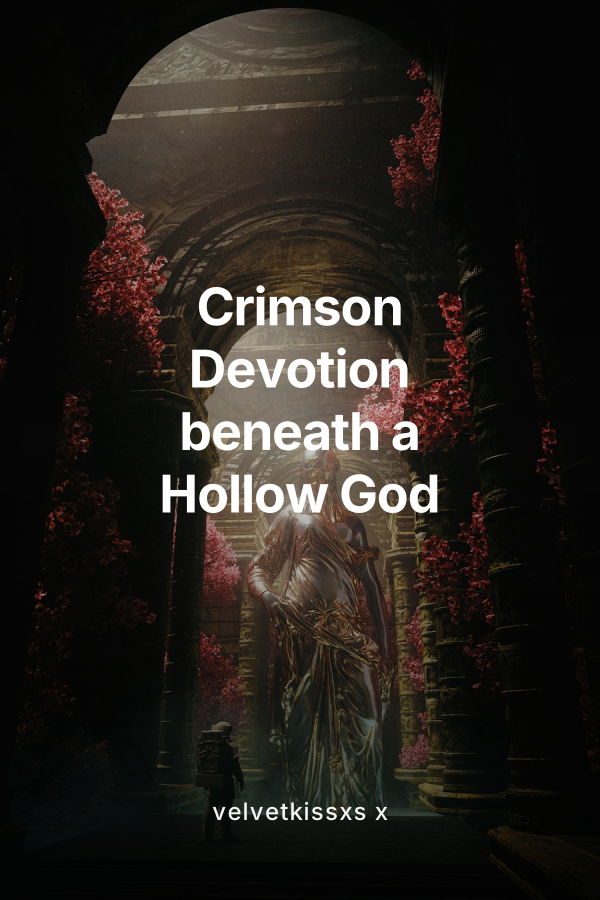
In a world carved by hunger and holiness, demons and vampires revere the same species for entirely different reasons. To demons, humans are Zoth, living gods whose every breath is sacred, whose death is the holiest of ascensions. They starve themselves in imitation of divinity, carve morth and izh into their own flesh during vigils, and record human laughter and tears as scripture. The Zothkeepers, demon priests, interpret each human gesture as revelation, while the Hollow, the devout masses, flay their own desires in rituals of self-denial. The Defiled, demons who so much as bruise human skin, are mutilated or hunted by their own kind, sacrificed to preserve the sanctity of the divine.
Vampires look upon the same humans and see not gods, but Thren: warm-blooded livestock, fleeting lives arranged in a hierarchy of flavor and usefulness. They gather for Crimson Rights, feasts where human bodies are offerings, not people, where Bloodlords hold territories by the throat and Veinborn hunt with predatory entitlement. The Starved, vampires who deny their nature, are not holy but broken, objects of pity and fear. Power is truth; hunger is sacred instinct. To restrain it is to lie about what one is. In this world, blood is not only sustenance, but language, art, status, and occasionally a dark, intimate promise.
Between these two faiths of flesh stands Damon Seraphiel, a young vampire whose long-bred certainty begins to rot the night he wanders from a disappointing feast and crosses into forbidden demon territory. Under a sky heavy with ash and distant chanting, Damon witnesses something that unsettles the bones of his belief: a demon kneeling beside a dead human, not as predator, but as priest.
Veyr Keth, a demon of the Hollow, is marked by ritual scars and a discipline that keeps his monstrous hunger caged. He attends to a deceased human as if to a fallen star, performing sacred rites with hands that could easily tear flesh apart. Damon, starved on thin, unsatisfying human blood and smoldering resentment toward his own elders, is transfixed by two things at once: the impossible gentleness with which Veyr touches what Damon has always been taught is prey, and the scent of Veyr’s blood seeping from a wound earned in earlier conflict. That scent curls through Damon’s restraint like smoke through dry leaves.
From this first silent encounter, a slow, suffocating obsession begins.
Over the course of the book, Damon’s journey unfolds in five interlocking phases, each deepening his fixation while drawing him away from the world that made him.
Phase I: Hunger at the Threshold
We open within vampiric splendor that feels hollow from within. At a Crimson Right presided over by the elder Nyaxra D’Noir, Damon and his peers are granted only meager, over-regulated tastes of human blood. The Bloodlords speak of scarcity, of demons stealing their rightful Thren, and sharpen political resentments into knives. Damon leaves the feast restless and half-starved. What should have been satiation has turned into gnawing emptiness.
His wandering into demon lands is an act of carelessness, but also of quiet revolt. Here he stumbles upon Veyr’s ritual over a human corpse, Veyr speaking in low, reverent tones to a body that would have been a drained husk at a vampire gathering. Damon hides in the treeline, captivated, the edges of his hunger sharpening into something more than physical. When the wind shifts and carries the smell of demon blood from a cut along Veyr’s jaw to Damon’s senses, something inside him makes a quiet, fateful choice. In his mind, he gives this stranger secret names: Rethka, delicious, and Seryn, good smell. The names mark Veyr as special, a private litany Damon will return to again and again.
Phase II: Devotion in the Shadows
Damon cannot stay away. Under the guise of scouting demon defenses or seeking richer hunting grounds, he begins to haunt the borders of Veyr’s world. Each visit is a risk to his life and status, but the risk itself becomes part of the ritual. He watches from ruined walls and crooked trees as Veyr attends other human dead, as he and his friends Espen, Calix, and Vespera move among the Hollow. Damon sees scars on their skin that speak of starvation-rites and self-harm; he glimpses the way demons clutch a fallen hair from a human’s head as if it were a relic, how even their violence turns inward rather than toward the “divine.”
What unsettles him most is not their brutality, but their tenderness. When Sylvia, a rare living human openly worshipped by demons, is escorted through a shrine, Damon observes Veyr’s posture around her: head slightly bowed, movements softened, hunger leashed so tightly it becomes another kind of pain. The way Veyr looks at Sylvia is not at all how Damon has ever been taught to see humans. Where his elders see cattle, Veyr sees a walking miracle.
Damon begins to long, not merely for Veyr’s blood, but to be looked at with that same almost-sanctity. His internal narration grows increasingly poetic, his hunger described in liturgical cadences that disturb even him. He pictures Veyr’s hands on his own throat not as a threat, but as a kind of blessing.
Phase III: The First Taste and the Bloom of Madness
The line between voyeur and supplicant shatters when demons clash with a small group of vampires near the borderlands. Damon, caught at the periphery, witnesses Veyr wounded in the struggle, blood bright against his dark skin. In the chaos, Damon reaches him. It is instinct at first, then decision: he closes the distance, presses close, and licks Veyr’s blood from his face.
The taste is incandescent.
Demon blood is richer, heavier, steeped in an almost punishing vitality. It sears Damon’s throat and floods his senses. Veyr’s reaction is violence restrained at the last instant; instead of immediately tearing Damon apart, Veyr studies him with a cold curiosity sharpened over years of religious self-denial. In a calculated experiment, he offers Damon his wrist, allowing a controlled sip. He wants to see what a creature of unashamed hunger will do with a taste of something forbidden even among vampires.
Damon descends into addiction with the fervor of a convert. He insists, at first, that this is strategic, a way to learn demon weaknesses. Inwardly, he builds a new, personal theology around Veyr’s blood. He describes it as purer than human blood, more honest, more alive. The hallucinations begin, not with visions of Veyr’s gentleness or holy relics, but with rivers and oceans of blood rising up in his mind, staining his dreams until he wakes wild-eyed and more ravenous than before. These visions do not grant clarity; they strip away his remaining excuses.
He starts skipping Crimson Rights, refusing human offerings under flimsy pretexts. Elder Nyaxra and younger vampires like Evelina and Soren notice. Evelina mocks his pallor, his distraction, the way he seems to listen for whispers no one else hears. Viktor, an old friend, asks more gently what has changed. Damon answers in half-truths and lyrical evasions, speaking of “a better taste” and “a different kind of worship” in a way that unsettles even other predators.
Phase IV: Blasphemy, Blood, and Exile
As Damon’s devotion pulls him further from his own kind, the larger world tightens around both demons and vampires. Humans increasingly fall under demon protection, carried into Zoth shrines instead of Crimson feast halls. Demon society, shaped by cannibalism and sacrificial starvation, thrives despite its brutality; vampires, bound to dwindling Thren, grow desperate. Nyaxra’s political maneuvers harden. Behind closed doors, decrees are whispered, punishments planned for any who disturb the fragile balance of fear and supply.
Veyr, seeing Damon’s obsession, begins to exploit it. He does not collar Damon or command him openly. Instead, he withholds. He allows weeks to stretch between feedings, leaving Damon to wander on the knife-edge of starvation. Damon is free, nominally, to return to human blood and his old life. Yet each time his mind fractures and madness nears, he staggers back to Veyr, begging with words and posture even when he tries to preserve a shred of dignity.
Veyr treats this as a test of loyalty, a cruel mirror of demon asceticism. Where his own people starve to honor humans, he starves Damon to bend a vampire’s nature toward a new center. During these periods, Damon’s inner monologues become most disturbing. He calmly imagines acts of service that would horrify both species: capturing a demon, carving it into neat pieces to feed Veyr if illness ever struck him, offering up his own body in slow, bloodletting devotion. When he shares fragments of these fantasies, Veyr’s mask slips in shock or dark amusement, and those tiny flickers of reaction become treasures Damon hoards.
Everything breaks when a faction of vampires, frustrated with dwindling human access, kidnaps Sylvia. To them, she is simply exquisite Gold Blood, a resource wasted on delusional demons. To demons, her abduction is sacrilege. To Damon, she is now entwined with his fixation on Veyr’s mercy.
Manipulated by Veyr’s words and implicit expectations, Damon becomes the traitor no one expected. He infiltrates his own kind’s stronghold, not to free captive Thren for vampires, but to rescue a single revered human. The violence is swift, bloody, and intimate. Damon kills a fellow vampire who stands between him and Sylvia, justifying it as a necessary sacrifice for Veyr, for love, for the strange, inverted holiness he has built around demon ritual. He returns Sylvia to demon lands, bloodied but alive.
The cost arrives quietly. Nyaxra does not drag Damon before a court or perform a spectacle of punishment. Instead, a secret decree ripples through vampiric society: Damon Seraphiel is exiled, marked as kill-on-sight. His name remains unspoken at feasts; his existence is politically erased. There is no duel, no last plea. Just the silent knowledge that if he ever returns, he will die.
In demon territory, his act has a different weight. He has protected what they consider sacred. He has spilled his own people’s blood for a human. The elders like Virexa Kyrezthra may not welcome him, but they cannot entirely dismiss the devotion that drove him. Damon finds himself stranded between worlds, with only his obsession as a compass.
Phase V: Hollow Gods, Living Chains
The final movement of the book is quieter on the surface, yet more harrowing within. Damon lives in the periphery of demon settlements, neither prisoner nor guest. Demons like Espen and Vespera notice his presence, sensing he is “other” than both their kind and typical vampires. They mutter, scoff, or ignore him, depending on mood and loyalty to Veyr. To some, he becomes a dark joke: the vampire pet that starved himself away from his own gods.
Sylvia, recovered, has a brief, gentle conversation with Veyr. Her gratitude is soft, not grand; she thanks him and, indirectly, the nameless vampire who returned her. Her words are simple, but they lodge under Veyr’s skin. She speaks of mercy without calling it worship, of fear without blaming hunger. For Veyr, who has built his being around a rigid structure of sin and sanctity, the idea that a vampire could choose to protect her unsettles long-unquestioned certainties.
Damon observes this from a distance, catching only fragments, yet the sight of Veyr standing in soft posture before a human he himself saved twists something in him. He has become, in his own deranged way, a participant in the demon religion he once found absurd. Not as priest or believer, but as a blasphemous offering of his own nature.
As days bleed into one another, Veyr’s treatment of Damon shifts by inches. For the first time, he speaks to Damon without mockery or cold detachment. He acknowledges the risk Damon took, the betrayal he enacted against his own kind. He does not soften into worship, but into a wary, grudging recognition of Damon as something more than a convenient, self-harming vampire.
The climax is not a battlefield but a room carved in shadow, a rare private place where the noise of demon chants and distant vampire threats cannot reach. Veyr, who has denied Damon again and again until the vampire trembled on the edge of feral collapse, finally chooses to offer instead of withhold. He bares his neck with deliberate vulnerability, inviting Damon to feed not as a test or punishment, but as a gift and a bridge.
For Damon, this act is the culmination of countless hallucinated scenes and private liturgies. The precise way he has imagined feeding from Veyr’s neck, the imagined pressure of fangs, the careful restraint of his hands, all become real. He drinks slowly, trembling, fighting the urge to consume too deeply, to turn this intimacy into destruction. Here, feeding is more intimate than any kiss, more binding than any vow. In his mind, he calls Veyr Rethka and Seryn again and again, the names no longer only reflecting taste and scent, but the entirety of what Veyr has become to him.
From Veyr’s side, kindness at last is not a manipulation. It is an acknowledgment of Damon’s terrifying devotion and the strange, terrible beauty of a predator who reoriented his entire existence around someone else’s sacred order. Veyr does not declare love, does not promise a future unmarred by war or doctrine. Yet his hand on Damon’s head, his steadying grip on a shoulder as demon blood floods into starving veins, speaks of a new, fragile alliance.
By the end of Crimson Devotion beneath a Hollow God, Damon is subtly altered. His body bears no monstrous mutations, but his mind has crossed a threshold from which there is no return. He has abandoned human blood, betrayed his own elders, and allowed demon starvation-ritual logic to reshape his hunger into a private, obsessive faith. He is neither vampire nor demon in the ways his cultures define them, but something twisted between, anchored only to Veyr.
Veyr, once convinced that any touch upon the divine must be austere and any concession to hunger is sin, now stands beside a creature who shattered both religious structures for the sake of him and the humans Veyr reveres. He no longer sees Damon as mere enemy or tool. The recognition is incomplete, wary, but real.
The book closes on the quiet, heavy ambiguity of their bond. Damon believes, with the unshakable certainty of the obsessed, that this is love. The reader is left to decide whether Veyr’s softening is love, penance, pragmatic acceptance, or something unnamable born where hunger and holiness finally meet.
Crimson Devotion beneath a Hollow God uses its five-chapter structure to follow this descent and convergence: from the decadent emptiness of vampiric feasts to the carved austerity of demon shrines, from voyeuristic fascination to blood-steeped intimacy. It explores how religion can sanctify both mercy and cruelty, how hunger can masquerade as faith and faith as hunger, and how love can take root in the most blasphemous soil, growing into something at once beautiful and deeply, disturbingly wrong.