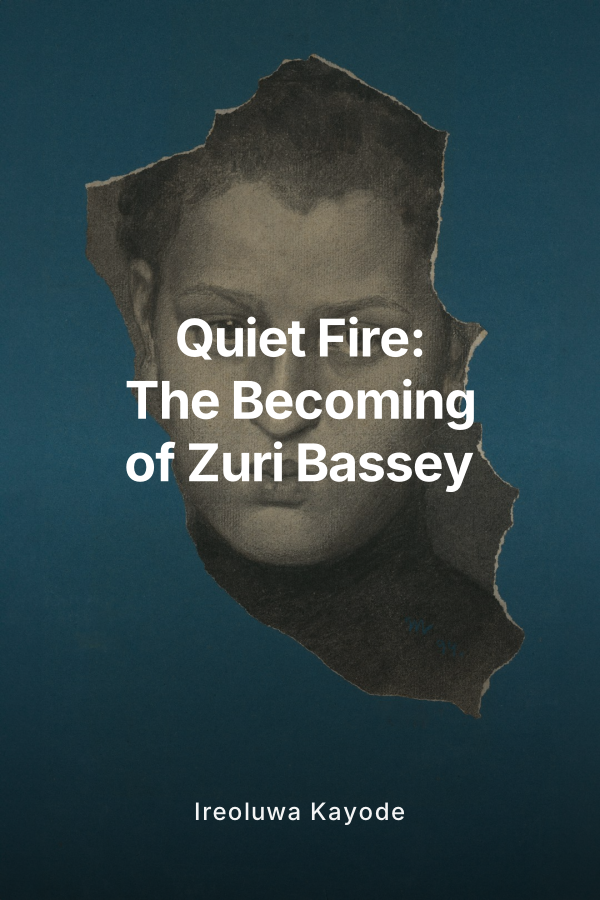
This novel follows thirteen year old Zuri Bassey, a Black girl in a mostly white private school in a big city, who has spent her entire life trying to be the perfect student and the perfect daughter. Her parents are loving but often busy and demanding, their expectations wrapped tightly around grades, behavior, and reputation. Perfection feels less like praise and more like armor. Zuri believes if she is flawless, she will be safe.
From the outset, the story moves between Zuri’s first person narration, full page diary entries, and a small number of key social media posts that ignite and reshape her world. The tone is emotional and reflective, sometimes raw, yet carries threads of hope and quiet humor. The outside plot of school drama, racism, and family crisis is woven with Zuri’s deep inner world as she struggles to name what she feels and to believe that her own voice matters.
Chapter by chapter, the book traces how Zuri learns to live in the tension between being “good” and being true.
At school, Zuri is one of only a few Black students. She occupies the polite, polished world of a predominantly white, wealthy private academy, where her intelligence is praised but her full self is never truly invited in. The school loves to celebrate diversity on brochures, but in the classroom race is something they hurry past or flatten with slogans. Early on, the reader sees how the school makes race invisible by shutting down a Black history project Zuri proposes, calling it “too controversial” and “not a good fit right now,” an early sign that the administration does not want to deal honestly with racism. Zuri swallows her disappointment and tells herself it is not worth making trouble. Being perfect, she believes, means not pushing too hard.
Her best friend at school is one of the few people who sees the tightness behind Zuri’s smile. This friend is quick tempered and justice minded, more ready to speak out than Zuri is. Alongside her, Zuri’s grandma, who lives across the city, is Zuri’s emotional anchor. Though her parents are caught up in work and their own pressures, Grandma notices the smallest shifts in Zuri’s voice and posture. The story slowly reveals the bond between Zuri and this older woman, who has lived through her own seasons of quiet and storm and who offers a deep, lived understanding of what it means to move through the world as a Black woman.
The central rupture of the novel begins with a racist video recorded on campus. In it, classmates mock Black hair and use slurs, while a teacher’s voice can be heard laughing in the background. Someone edits the clip with music and text for laughs. The video spreads through group chats and social feeds until Zuri’s best friend shows it to her at school. In that moment Zuri feels humiliation, anger, and a strange numbness crash into one another. Seeing the cruelty and the teacher’s casual laughter tears at the fragile trust she had in the institution around her.
Her best friend is immediately ready to report it, furious and shaking. Zuri, however, hesitates. She is afraid of getting in trouble, of being seen as the “angry Black girl,” of losing her “perfect student” status, of making teachers and administrators quietly turn against her. She is also afraid of what it will cost emotionally to step into conflict. So she does what she has been trained to do: she pretends she is fine. On the outside she keeps her usual poised calm. On the inside she is burning.
That afternoon Zuri sends an anonymous email to the school, describing the video and the harm it causes. It is her first small act of pushing back, chosen precisely because it lets her speak but still stay hidden. The following days, the administration responds in the most distant way possible: a vague school wide email about how the school “values all students” and how misunderstandings can happen online, framing the incident as a simple confusion and folding the whole matter into a reminder about “digital citizenship” rather than naming racism or taking responsibility. The message lands like a dismissal. Zuri reads and rereads the words “misunderstanding” and feels herself being misread, minimized, almost erased.
The school’s reaction cracks something open in her. The same institution that shut down her Black history project for being “too much” now refuses to acknowledge that what happened in the video is anything more than a minor misstep. Zuri understands, on a level that aches, that they prefer her silence over her truth. The betrayal is quiet but deep.
At home, Zuri is already under pressure. Her parents push her to maintain flawless grades and behavior, to avoid “distractions,” and to stay far from “drama” that might hurt her future. Their fear is rooted in love and in their own experiences of racism, but it lands on Zuri as a constant demand to be better than everyone else, to leave no room for error, to represent perfectly. The message is clear: one wrong move and the world will judge you harder. Their anxiety rises as the video circulates and whispers begin to move through the school. They want her to step away, to keep her head down, to focus on her work. They do not see, at first, that asking her to stay quiet is also asking her to accept a wound.
At nearly the same time, the family is struck by a death that shakes Zuri’s sense of safety. A relative who was central to family gatherings and stories dies, and grief seeps into the background of every scene. Zuri is expected to continue performing at school while navigating rituals of mourning at home. The adults around her are tired and sad and less emotionally available. In her diary she writes full page entries that blend anger, sorrow, confusion, and questions about what kind of future she can have in a world like this.
These entries are interwoven with the present tense of her days. The diary becomes the first place Zuri allows herself to be less than perfect, the one space where she can fear, contradict herself, and tell the truth without editing. Through them, readers see a girl learning to name her own interior life, which she has long hidden even from herself.
As tension at school builds over the mishandling of the video, another incident erupts. In class, the same teacher who laughed in the background of the video makes an offensive comment about race in a discussion that barely touches on Black history. When a student raises a question, the teacher brushes it aside and delivers a hurtful remark that implies students who talk about racism are making things worse. The words fall heavily, and the room goes silent. Zuri feels that familiar pull to stay quiet and keep her perfect image intact, but the silence feels different now. It tastes like complicity.
This scene becomes a turning point. It is followed by one of the book’s central diary entries, in which Zuri pours out her anger at the teacher, her fear of confrontation, and her resentment toward a school that makes her feel grateful just to be there while never fully accepting her. She also begins to question the meaning of perfection itself. Is it really safety, or is it a cage?
Zuri’s best friend urges her again to speak out publicly. Yet as Zuri begins to find her voice, cracks appear in the friendship. Her friend accuses her of changing, of becoming too consumed by the issue, of caring more about being a leader than about their bond. Underneath the accusation is jealousy and fear; the more Zuri steps forward, the more the friend feels left behind and vulnerable. Their conflict reveals how even well intentioned relationships can be strained when one person begins to claim more space.
Around this time, Grandma invites Zuri over and senses that something deeper is wrong. Rather than pressuring her to talk, Grandma shares a story from her own youth about facing racism and deciding whether to stay small or to speak. From that story, Zuri draws several quiet but powerful lessons: that fear never fully goes away but courage grows in community, that no one survives by perfection alone, and that silence can wound you just as much as other people’s words. Grandma encourages her to write, to remember that her story matters, and to choose her own path instead of living solely for others’ expectations.
As the novel unfolds, Zuri’s actions shift from secretive emails to more visible steps. She begins informally supporting and listening to younger Black students at the school who are struggling with similar feelings of invisibility and pressure. At first it is just hallway conversations, shared eye contact in class, a quiet “you’re not alone.” Gradually, this grows into deliberate mentoring. She helps them process microaggressions, encourages them to document their experiences, and shares bits of Grandma’s wisdom. Through mentoring, Zuri discovers that leadership is less about standing at a podium and more about showing up consistently for others.
The school continues trying to contain the situation without real change. Policies are updated in language but not in spirit. Meetings are held where adults talk more than they listen. Zuri finds herself torn between her role as a “model student” invited into these spaces and her awareness that token inclusion is not the same as justice. Her parents push her to use these invitations to build a better future for herself and to “play the game,” while Grandma quietly reminds her that games built on silence rarely lead to real freedom.
As her internal conflict grows, Zuri begins to question the stories she has believed about what it means to be successful. She sees how the pressure to be perfect has muffled her voice, how the demand to represent her entire community has made it nearly impossible to simply be a girl in pain, in curiosity, in joy. The diary entries deepen in complexity as she experiments with telling new truths about herself: that she is angry and tired, that she wants to lead and also wants to rest, that she loves her parents but resents their expectations, that she is proud to be Black and also weary of always having to explain her humanity.
The family death continues to reverberate in the background, connecting Zuri to a lineage that stretches before her. Funerals, photographs, and old stories reveal both loss and inheritance. She recognizes that those who came before her did not survive by being perfect but by being resilient, by loving one another fiercely, and by refusing to disappear. This realization subtly shifts her understanding of identity from something she must prove to something she already carries.
The climax of the story is not a single rally or protest but a series of deliberate, courageous choices. Zuri organizes a small group conversation with younger students, facilitated not by teachers but by students themselves, where they can speak honestly about race and school culture. She confronts the teacher who made the offensive comment, not in a public shouting match but in a measured, direct conversation, naming the harm and refusing to accept vague excuses. She works with others to propose a new mentoring and equity initiative, one that recognizes the particular needs of Black students instead of pretending everyone’s experience is the same. Each step costs her something: comfort, reputation, the illusion of being “good” in everyone’s eyes.
Her relationship with her best friend goes through its own reckoning. The friend tells her she has changed, accusing her of caring more about issues and younger students than about their own bond. Zuri initially shuts down, reverting to her old habit of swallowing conflict. Later, through another raw diary entry, she admits how much the comment hurt and how afraid she is of outgrowing people she loves. Eventually, the two have a difficult conversation about what it means for one person to grow louder in a world that punishes certain voices, and whether friendship can stretch to hold that change. Though they do not resolve everything neatly, there is a sense of earned understanding and a more honest connection between them.
Across the school year, a handful of social media posts serve as public markers of Zuri’s journey. A thoughtful captioned photo about the meaning of Black History Month, a shared resource list for students dealing with racism, a screenshot of a school statement that she responds to with measured critique. These posts never take over the narrative, but each one shows how her private reflections are gradually becoming public action.
The novel culminates not in a grand assembly speech but in an intensely personal scene: Zuri, alone in her bedroom, standing in front of her mirror. She has just come home from a long day that included difficult meetings, mentoring sessions, and a conversation with her parents where they finally heard, really heard, how their pressure is suffocating her. Her hair is in its natural state, not styled for anyone else’s comfort. On her desk lie open notebooks filled with diary pages and drafts of plans for next year’s student mentorship program.
In this quiet moment, she studies her reflection and allows herself to feel the full weight of who she is: a Black girl in a world that often refuses to see her fully, a daughter, a granddaughter, a student, a leader in progress. She thinks of the racist video and the first time she saw it. She thinks of Grandma’s story, of the relative she lost, of the younger students who now look to her. She thinks of how often she has tried to fold herself small enough to fit other people’s ideas of safety.
Then she makes a choice, one that is deeply internal yet transformative. She decides that her worth is not measured by her grades, her ability to remain calm under insult, or her capacity to carry others’ expectations. She decides that she will not pursue perfection if it means losing herself. She accepts her Blackness, her natural hair and skin, her loud and quiet feelings, her capacity for leadership, and her right to be imperfect and still deserving of love and respect. She chooses, finally, to belong first to herself.
The novel ends with Zuri beginning a new diary entry, this time not addressed to an invisible audience or future admissions committee, but to herself and to the younger Black girls who might one day read her words. She writes with a steadier hand, not because her world has become easy, but because she now knows that her voice has a place in it.
Readers close the book feeling proud of Zuri not because she becomes flawless or fixes every injustice, but because she learns to live as a whole person within an imperfect world. The story leaves them with the understanding that they do not have to be perfect to be powerful, that their grief and anger are valid, and that small, consistent acts of honesty and care can grow into quiet, sustaining fire.