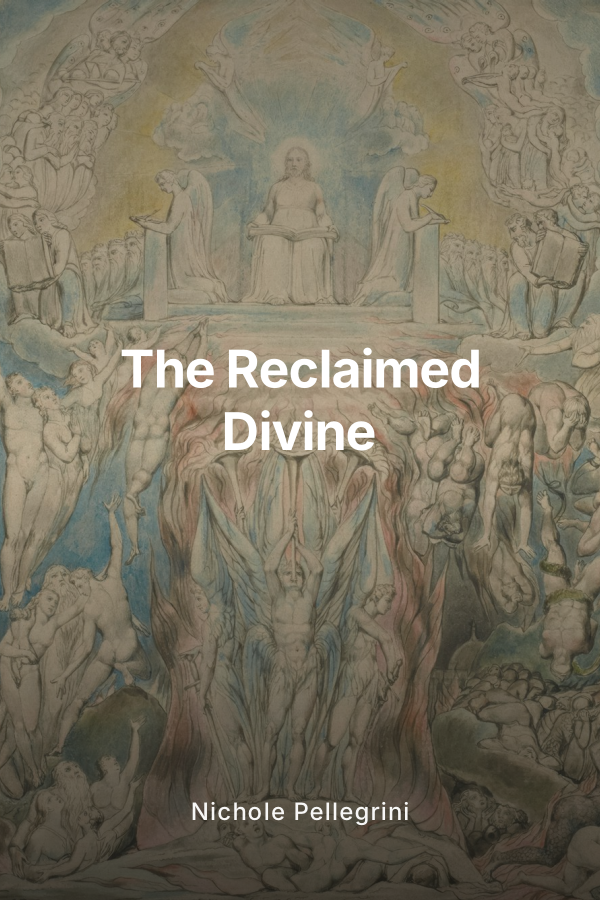
Beneath the glass-and-neon skin of the modern world, history lies in fragments: drowned spires off forgotten coasts, shattered ziggurats half-swallowed by desert, charred bones of libraries whose names survive only as rumors. The Sacred Order of the Purple Star has spent three thousand years walking through those ruins, salvaging one truth and burying another. The Order’s archives whisper a blasphemy that would break the world’s faith in history itself: every golden age, every catastrophic fall, has been another turn in an older wheel.
Gods do not die. They return.
The Reclaimed Divine is an epic, character-driven saga that lifts the story seeded in a single pilot episode and unfolds it into a five-part chronicle of reincarnated gods, desperate humans, and a war over who will decide the fate of the next age. Drawing from the intimate, high-concept foundation of the pilot script , the book expands that story into a mythic cycle spanning lost civilizations, secret orders, and a world that discovers its myths have human faces.
At its heart stand eight beings reborn as young adults in a near-future world.
Enlil, the Mesopotamian storm goddess, wakes up on a rain-scoured rooftop with thunder answering the tremor in her lungs . She is rage and weather and restless compassion in human form, a woman who feels imprisonment like a pressure drop before a hurricane. Across lifetimes, she has been ruler, rebel, tyrant, and savior. This time, she refuses to be only one.
Kali, the destroyer, remembers hands slick with blood and cities screaming her name as prayer and curse alike. In this life she wears her violence like shrapnel under the skin, terrified of the goddess coiled inside her. Every awakening drags her back through massacres and massacred loves, and every time she has to ask whether the world is safer with her dead.
Odin, the All-Father in the shape of a young hacker, is haunted by echoes he tries to outthink. Fragments of runes, dead languages on his tongue, the certainty that he has stood in these corridors staring at the same sealed doors before . In him, centuries of failed wisdom go to war with the arrogance that says this time he will outmaneuver fate.
Jesus is the reluctant fulcrum, a healer reborn as a soft-spoken young man who has no appetite for martyrdom a second time. His power is not in storms or blades but in the choice to step between violence and its target, to turn every attempted execution into a testament caught on a thousand camera feeds . He remembers enough of another cross to know he does not want the world to build him another.
Around them orbit stranger divinities and ideas made flesh: Anansi the trickster and hacker, Santa Claus as an avatar of belief and generosity, Boogeyman as the child-shaped shadow of fear, and Sin, lunar deity and Order scientist, who walks the fault line between captor and conspirator. Together they are the latest “core eight” in a long chain of incarnations that the Order has captured, studied, and quietly erased whenever their power rose too high .
The Order’s story, as they tell it, begins with a single apocalypse. Three thousand years ago, gods walked freely; the world burned. Humanity, in an act of desperate self-defense, shattered the divine and scattered it into human bloodlines . Since then the Keepers, one half of the Order, have watched the world for anomalies: storms answering whispers, statues bleeding, children pulling gravity apart in frightened sobs. They find the reincarnated gods, bring them to hidden compounds, and teach them to control the wildfire in their veins.
The Shadow faction tells a harsher truth. The Last Apocalypse was not last at all. It was one in a series.
When Odin hacks into a restricted archive, lines scroll past like clinical epitaphs: CYCLE 7: FAILURE – RESET INITIATED. CYCLE 12: FAILURE – RESET INITIATED. CYCLE 19: FAILURE – RESET INITIATED . Each “cycle” is a full era of human history, birthed and broken under the weight of awakening gods. Atlantis, the Bronze Age collapse, the fall of unnamed empires whose ruins litter the ocean floor and the deep desert, all map onto moments when divinity remembered itself and humanity lost control.
The Order did not start the wheel. They learned, too late, that it turns.
Long after the first cataclysm, shattered survivors bound themselves into a covenant. They would find the gods early in each new cycle, before old memories returned, and contain them. When containment failed, they would trigger a ritual that emptied the gods of memory and power, scattering them back into human lives like embers into ash. Project Reset. A mercy killing for eras.
Some in the Order, like the Keeper Leader, have clung to the original mission: guide the gods, protect humanity, and only call for Reset when there is no other way . Others, like Marcus Vane, commander of the Shadows, have given themselves wholly to fear. He has studied grainy ritual footage of past cycles, seen pantheons bound to altars, white light flensing them from existence , and taken one lesson: if you hesitate, the world ends.
“You think you are the first gods we have contained?” his philosophy insists. “You are the latest in a long line. The world is still here because we chose terror over faith.”
The book takes that tension and builds a narrative architecture around it. In Chapter One, the gods awaken and are taken to the compound, where the reader experiences the Order through Enlil’s fury, Jesus’s wary compassion, Kali’s despair, and Odin’s obsessive need to understand . Training rooms, observation decks, and sparse dormitories become a modern Olympus behind glass.
Enlil’s first storm in captivity nearly tears the training hall apart. Kali’s extraction session rips open memories not just of ancient battlefields but of more recent ages: a rebellion against human kings who had once been her allies, the red-lit streets of a city later turned to legend, the moment she realized she no longer remembered why she began destroying in the first place . Boogeyman’s nightmares of people whispering her name as a curse reveal themselves to be memories of parents teaching their children to fear the dark, cycle after cycle, to keep some fragment of her story alive and at bay at once .
In Chapter Two, Odin’s hacking and Sin’s reluctant honesty shatter the illusion of a single apocalypse. In a hidden archive room papered with forbidden history, Odin finds not only numeric cycle reports but images: stylized paintings and holographic reconstructions of god-groups from different ages, each with a storm-bringer, a destroyer, a trickster, a healer, a guardian, a fear-shadow, a lunar guide. Their faces shift with era and race, but something in their stances, in the way they stand too close or too far from one another, is achingly familiar . The revelation that “we have been here before” ceases to be metaphor; it becomes a ledger of failure.
Sin lays the rest bare. The ritual chamber under the compound is older than any modern state, built around a crystalline heart that has been fed with siphoned divine essence for nineteen cycles . Each Reset has left residue, a ghostly accumulation of power and memory. The Order believes that with the right configuration, this ritual can do more than reset. It can puncture the wheel itself: strip divinity from the world, turn gods into mortals forever, and end reincarnation once and for all .
For Marcus and the Shadows, this is salvation. A one-time crime against a handful of beings to prevent endless epochs of war. For the gods, it is annihilation dressed as mercy, a breaking of the cosmic balance that has always included them. The story refuses to offer comfort that one side is wholly right.
Chapter Three explodes into escape and confrontation. Anansi stretches time with trickster loops, Santa phases guards halfway into walls as harmless hostages, Boogeyman fills corridors with living shadow, and Jesus discovers that his power is not only to heal but to unmake violence itself, dropping whole squads into harmless sleep with a wave of light . The gods refuse to kill, even as Marcus authorizes lethal force, because they understand that any dead human is another stone laid on the altar of fear.
In the ritual chamber, Enlil and Kali face both Marcus and the crystal that holds every mistake they have ever made. When emergency activation sends tendrils of light lashing out to drag them into Reset, the crystal does not simply strip them; it pours nineteen lifetimes of shared memory into their minds .
They remember themselves as lovers on a ziggurat under a storm-blacked sky, as generals on opposite sides of a battlefield soaked in red clay, as queens who chose opposite bargains with humanity and paid for it with the world. They remember leading rebellions that turned into massacres, oaths of peace that failed under the weight of other gods’ fury, the moment they realized that every time they died, the Order’s ritual had been there, turning catastrophe into amnesia.
“We find each other every cycle,” Kali weeps as the crystal tears those echoes into the present. “We fall. We forget.” Enlil refuses to let that be the end. They choose to merge storm and destruction, not to end the world, but to shatter the cycle’s engine itself. Their kiss becomes an act of cosmic violence and defiance, exploding the crystal, burning the ritual chamber down, and freeing the hoarded power back into the bones of the earth .
They do not know what will grow from that seed.
Chapter Four leaves the compound in ruins and the world on fire in a different way. The gods emerge into a planet waking up. The energy released from the shattered crystal does not vanish; it resonates. All over the globe, people begin to awaken, some with small, strange gifts, some with terrifying echoes of forgotten gods . A young woman in Berlin throws lightning from her hands in blind panic while riot police close in; a child in São Paulo cracks pavement with a tantrum; a woman in Lagos finds the neighborhood dogs lining up at her door, awaiting commands they do not know how to obey.
Marcus does what he was bred to do. He steps to a podium and tells the world that a group of “enhanced individuals” has escaped a secure facility. They are dangerous. They must be contained . In a single press conference he reframes the gods as rogue weapons, his own failures as reluctant heroism. Protocol Omega, the decision to go public, is his answer to the shattered ritual: if he cannot erase the gods in secret, he will hunt them in the light .
The gods choose a different narrative. From a crumbling cathedral that becomes their accidental stage, they invite the world to watch. Anansi and Sin flood the networks with live feeds, leaked documents, archive footage of past cycles, making it impossible to dismiss their story as a hoax . Jesus stands unarmed in the nave while tactical teams advance, and when Marcus threatens to blow the entire building with hidden charges, Jesus calls his bluff by refusing to resist. One by one, the other gods join him in open vulnerability, choosing to die as themselves rather than live as monsters in the public imagination .
It works. Not perfectly, not cleanly, but enough. Operatives lay down their weapons. Cameras capture not rampaging gods but frightened, resolute people with impossible power choosing peace. Hashtags and protests erupt, demanding that these beings be treated as people rather than threats. The gods step out to a crowd bearing signs like “GODS ARE PEOPLE TOO” and “DIVINE RIGHTS” , and for the first time in any cycle, they are seen by humanity not as omens or tyrants but as something in between.
The final chapter pushes beyond the pilot’s ending, hinting at a future shaped by every choice that came before. The gods take the name “The Reclaimed” not as a boast but as a promise: they will reclaim their own stories from Order and myth, and they will help every new awakening do the same . They partner uneasily with the Keeper Leader and defected agents, building a fragile network meant to guide, not cage, this sudden diaspora of divinity .
Enlil and Kali stand under new skies, no longer certain that destiny wants anything but their repetition, and choose one another anyway. Odin and Sin sit with screens full of red dots marking fresh awakenings, planning a world-scale intervention that owes as much to activist networks and whistleblowers as it does to ancient runes . Santa and Boogeyman patrol safe houses and city streets alike, learning how to wield fear and hope as tools of protection instead of control.
And somewhere in the ruins of the first compound, or perhaps in a deeper archive beneath older stone, Sin finds a final inscription. It is not a threat or a comfort, just a report in the same blunt style as the files Odin first hacked: CYCLE 20: FAILURE – PARAMETERS ALTERED. CYCLE 21: PENDING. At the bottom, a newer line pulses to life as if written in the moment she reads it:
CYCLE TWENTY-TWO BEGINS.
The book ends on that haunting awareness. The Reclaimed have shattered the original ritual and exposed the Order’s sins. They have chosen empathy over domination, visibility over comfortable lies. But the wheel may be larger than any faction’s schemes. Perhaps cycles are not cages but tides. Perhaps the point was never to end them, only to change what they mean.
In its full arc, The Reclaimed Divine weaves together superhuman spectacle and philosophical struggle: is divinity safe in human hands; is humanity safe without it; and can beings who have broken the world, over and over, ever choose differently when the storm rises again? Through five chapters that move from captivity to revolt, revelation to revolution, and war to uneasy peace, the story invites readers into a world where every myth is a memory, every god is also human, and every ending is only the next turn of the wheel.