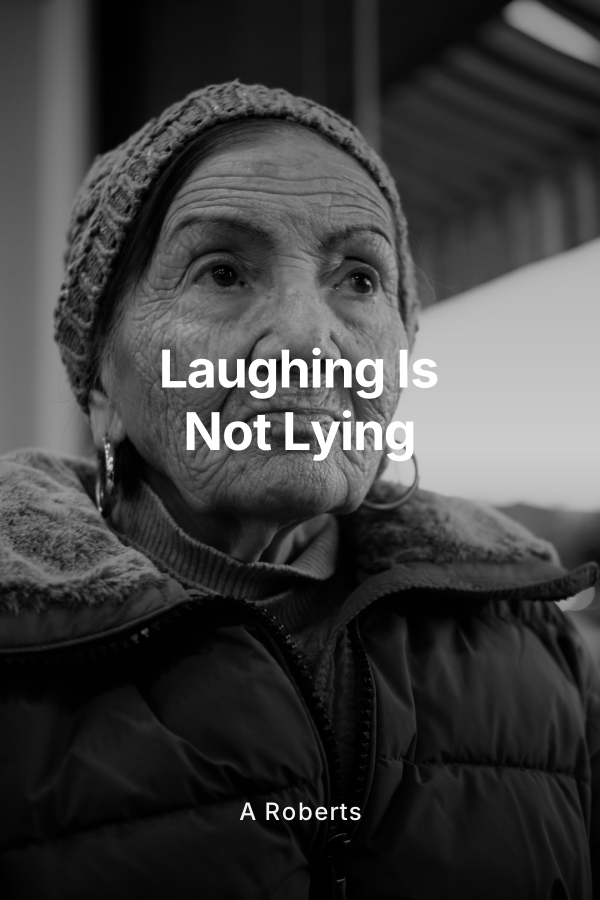
This book is a raw, two chapter memoir of a girl the system never really saw, except as a problem to be managed. It follows the journey from a five year old child already marked by abandonment, through abuse, homelessness, prostitution, addiction, pregnancy, and the brutal decision to walk away from her own children. Woven through everything is one central injustice: when a traumatized child does not cry in the “right” way, the world decides she is lying.
At the heart of the story is a stark contrast between who she truly is and what the legal system, police, and social services choose to record. On paper she is a thick, dog eared file of “incidents” and “disruptions” shuffled across desks by professionals who never look up long enough to meet her eyes. In reality she is a terrified child who has learned that in rooms full of adults paid to care, she is still completely alone. The book exposes how quickly a “troubled child” becomes an object: the police see a threat, social services see a caseload, the courts see a future statistic, and nobody sees a scared kid desperate for safety.
The first thread of the story reaches back to a defining moment of abandonment. At ten years old she watches her mother walk away at a train station, the metal tracks vibrating, the horn screaming, and a car waiting to carry her mother into a different life. It is not told as a distant memory, but as a crack that splits the ground under her feet. That day teaches her that paths do not just appear, people choose them, and sometimes those choices mean leaving a child behind in the cold. Weekends that should have been visits become lessons in abandonment. A dark, empty house shifts from being a place to being a metaphor for who her mother has become and for what she expects from the world. Every unanswered knock, every echoing room confirms a cruel truth: she is optional.
From there the book tracks the escalation from emotional desertion into abuse. Meeting her mother again at ten does not bring comfort; instead, it opens the door to fresh harm. The abuse that follows is not treated as a single revelation but as a slow suffocation that shapes how she sees love, safety, and her own worth. The narrative moves in and out of these years through flashbacks, letting readers feel how the past barges into the present without warning. Instead of listing events, the story lingers on what it means to be a child who is scared in her own home and has nowhere that feels like a refuge.
A crucial turning point comes at fourteen, when she finally reaches for help. Numb with exhaustion and dread, she speaks to the people who are supposed to protect children: social workers, the department of social services, the very structures built to catch those who are falling. Her body, however, betrays her. Faced with the terror of naming her abuse, she giggles. Not because it is funny, not because she is lying, but because that is how her nervous system clings to survival. Her smile is a shield against shame and panic. Instead of seeing this as a trauma response, the professionals in front of her see it as proof of something else: a child who is “off,” “messed up,” unreliable. In a single interview, her coping mechanism is used to discredit her.
This dismissal is not painted as a simple misunderstanding. It is framed as professional negligence. Social workers are trained, or should be, to look beyond surface behavior to the pain underneath. When they take a frightened child’s nervous laughter at face value and mark her down as an inappropriate, difficult case, they fail in their most basic duty. They are not neutral. They inflict a second wound on top of the first, turning the experience of seeking help into a fresh trauma. The scene where her underwear and personal belongings are mocked during a police search drives this home. Dumping her bag out like rubbish, smirking over a child’s private things, these officers strip away more than possessions; they strip away dignity. They do not see a victim, they see a problem in a hoodie, something to control and ridicule rather than protect.
The book insists that nervousness is not a lie detector. Some people freeze, some cry, some dissociate. She laughs. That is how her body keeps from shattering. But in rooms where credibility is decided by how much you resemble a “perfect victim,” there is no room for this complexity. Her fear is misread as manipulation, her attempt to stay calm is documented as pathology. The narrative returns, again and again, to the refrain that laughing does not mean you are lying. Each time, it lands harder, as the reader sees how this misunderstanding closes door after door that should have been open to her.
Once the system has logged her as a troublesome, unreliable child, the path ahead narrows. She moves through care homes and temporary placements, never truly belonging anywhere. Each move confirms the message that she is too much, too loud, too complicated. Eventually, there is nowhere to land at all. Homelessness is not introduced as a stray plot point but as the logical outcome of years of not being believed and not being properly helped. On concrete benches and in doorways, the question of survival becomes brutally simple: how do you eat, where do you sleep, and what is left of you that has not already been taken?
It is in this desperate landscape that prostitution arrives, not as a sensational choice but as the “only way out” she can see. The book does not glamorize it or reduce it to a single stereotype. It sets out the slow, grinding math of hunger, cold, and constant fear, and how selling her body starts to feel like the only thing she has left to trade. The line between choice and coercion blurs when the world has already told you your body is not really yours. Drugs follow, not as a careless indulgence but as an anaesthetic. They are the plank she lays over the raging water of nightmares, the only way she knows to stop old scenes from replaying when she closes her eyes.
Despite the darkness, the narrative is laced with harsh, absurd humour that keeps it human. There are scenes where she wakes on a bench to find that someone has stolen only her shoes, leaving her in socked feet to face the day. Another night, high with a friend, she is handed car keys by someone who cannot drive and forgets that she cannot either. They roll a stolen car straight into a pile of bins, step out, and lie on the ground laughing until their sides hurt, surrounded by the smell of crushed rubbish and the sound of their own ridiculous survival. In another moment, a simple taxi ride that should have cost five pounds runs up to over one hundred, because she has forgotten where she lives. These stories are not comic relief for its own sake. They show how humour becomes a lifeline, the only way to carry pain that would otherwise be unbearable.
Motherhood cuts into this chaotic life with a new kind of agony. When she becomes pregnant, it is not wrapped in romance or stability but in the reality of work with clients and a body already shaped by trauma. She learns she is carrying a little girl and is told that the baby will not live, that she cannot carry girls. The abortion that follows is not presented as a clean, clinical event, but as a tearing grief. She says goodbye to a daughter she never got to hold, while carrying the belief that her body itself is flawed and dangerous to female life. That loss lodges deep inside her and comes to symbolize everything she was never allowed to keep.
Later, becoming pregnant by a client and entering into a relationship with him opens a new chapter of violence. What begins as a twisted version of care turns quickly into another pattern of control and harm. This is not just another bad man in a long list; he embodies the cruel logic she has been taught, that love and pain come in the same package, that bruises and isolation are the price you pay for not being alone. The book takes time with this relationship, showing how easy it is to confuse attention with love when you have been starved of both, and how hard it is to leave when your sense of self has already been eroded by years of neglect and abuse.
The heaviest weight in the book is the story of her own children. She does not present herself as a heroic mother battling all odds. Instead, she tells the truth that sits in her chest like a stone: she believes she should never have had children. She begged for a hysterectomy and no one listened. She brought life into a world she did not trust and into arms that were already full of unhealed wounds. The narrative does not excuse or justify; it lays bare the numbness, the floods of shame, the desperate knowledge that she cannot give them what they deserve. When she walks away, she knows exactly how the world will see her. A mother who leaves is a monster. A father who leaves is barely mentioned, or shrugged off as typical. The double standard is unmistakable.
The book uses this contradiction to probe deeper into how society judges women and mothers. It explores how trauma, lack of support, untreated mental pain, and poverty box people into impossible choices, then condemns them for making those choices. Her self hatred is given full space on the page, but so is the context: the years of professional neglect, the secondary traumas, the failed interventions. Instead of asking “Why did she walk away?” the narrative leads readers to the harder question: “Why did every safety net let her fall this far?”
Throughout both chapters, a present day voice occasionally surfaces, not to tidy up the mess but to look it directly in the eye. She acknowledges that there are memories she has tried to avoid, scenes she still struggles to face, particularly around her children and the abortion of her daughter. These reflective passages are not long lectures. They are quiet moments of reckoning, where she admits how it feels to carry labels like “failed mother” and “troubled child” into adulthood, and how long it has taken to disentangle her own worth from what was done to her.
By the end of the book, there is no simple redemption arc, no neat conclusion that claims everything is healed. Instead, there is a fierce, clear demand: that systems stop looking for “perfect victims” and start listening to the messy, uncomfortable ways real people survive. That police and social workers be held accountable when they mistake nervous laughter for deceit and dismiss children whose bodies are screaming in all the wrong ways. That society recognize how easily a five year old abandoned at a train station can become a homeless, addicted adult, and how many points there were along the way where real care might have changed the outcome.
“Laughing Is Not Lying” is not just a story of suffering. It is a testimony to survival in a world that misread, mislabeled, and mishandled a vulnerable child at almost every turn. It invites readers to cry, to laugh at the absurdity of some moments, and to sit in the discomfort of others. Most of all, it asks them to remember that behind every dog eared file and every “troubled” case number is a human being whose life could unfold very differently if someone were finally willing to see past the smile.