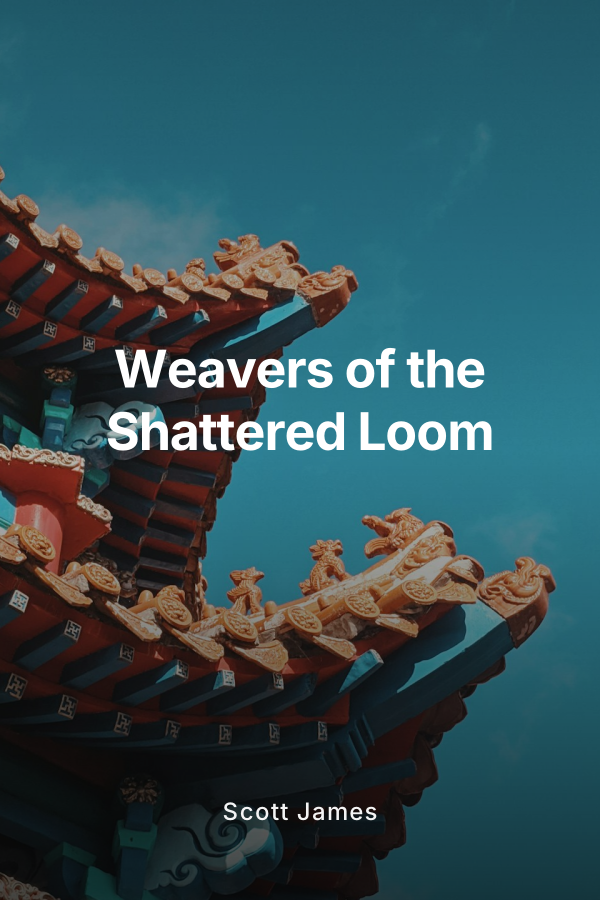
In the world of Arasyl, reality is cloth and every living thing is born with a single inner Thread. Those Threads are not metaphors but tangible strands of luminous force that can be seen, touched, and rewoven by a rare kind of mage known as a Weaver. Threadcraft shapes everything: cities hang over chasms on braided spellcords, contracts are bound with stitched oaths that tighten around a liar’s throat, and the dead are buried in uncut shrouds so their Threads can dissolve back into the Loom that underlies the world.
Magic here does not arise from words, wands, blood, or elements. Instead, it is the art of altering the tension, pattern, and color of living and conceptual Threads. A Weaver might slacken the Thread of gravity in a single stone, making it buoyant, or embroider courage into a frightened soldier’s spirit. Yet every alteration steals a fraction of durability from something else. To strengthen one Thread, another must be frayed. The cost is not always immediate nor obvious, which makes Threadcraft as morally perilous as it is powerful.
At the center of this tale is Kael Dyrin, a streetwise thief with an impossible affliction. In a world where each person has only one Thread, Kael has none. To Thread-sighted eyes he is a hole in the Loom, an absence rather than a presence. This absence makes him a perfect infiltrator: stitched wards do not recognize him, binding oaths slide off him like water, and scryers staring into the Loom see only static where he stands. Kael has survived the brutal underbelly of the river city of Lyr by selling the one thing only he can offer. He breaks the unbreakable, unbinds the unbreakable, and steals what was supposed to be conceptually unstealable.
Kael’s comfortable run of jobs ends when he is hired by an exile Weaver named Seris Eltane. Once a prodigy of the High Atelier, she was disgraced and banished for claiming to have glimpsed a flaw in the Loom itself. Seris believes that the Loom, originally whole, has been secretly cut and spliced for centuries by a nameless cabal known only as the Splicers. The unnatural storms, the plagues of rust that eat through stone, and whole valleys dropping out of existence are not divine wrath or random disasters. They are loose ends from a grand rewoven pattern coming apart.
Seris needs Kael to break into the Skyloom Citadel, seat of the Weaver Guild, and steal a forbidden relic: the First Shuttle, a mythical tool said to have woven the original Loom. Kael accepts, drawn by the staggering payment and the chance to strike at the guild that has always treated him as a defect. But he quickly discovers that the true prize is not the Shuttle itself, but the revelation that he is not truly threadless.
The novel’s magic system grows from three interlocking principles. First is Visibility. Some gifted individuals are Thread-sighted and can perceive the Loom in exquisite detail, the way a master calligrapher sees flaws in a stroke of ink. Most Weavers are born seeing only the brightest Threads, but can train their senses to pick out subtler patterns such as loyalty, fear, or memory. Second is Manipulation. Threadcraft requires anchoring a change in at least three places: the target Thread, the payment Thread, and the Weaver’s own Loom-mark, a signature twist which records their intervention. Third is Consequence. Every act of weaving leaves behind a Pattern Echo, a faint bruise in reality that accumulates over time. Horrors called Snarls form where Echoes knot and tangle, birthing regions of paradox where cause and effect unravel.
As Kael and Seris advance their heist, they recruit a small band of outcasts whose relationships with the Loom are as strained as their own. Lysa, a former oath-bound city warden whose Thread was half severed in battle, now lives with every emotion faint and distant. She offers knowledge of guild security and a soldier’s practical mind. There is also Teren, a black-market Pattern-smith who brands smuggled sigils into Threads, altering identities for those who can pay. Finally they enlist Yrin, a child prodigy raised in a monastery that studies “silent Threads” the Loom cannot fully read, prophets whose visions come from gaps rather than patterns.
Each member reveals new applications and limits of Threadcraft. Lysa demonstrates how partial cuts to a Thread can numb pain or dampen memory. Teren shows how a person can carry multiple overlapping identities if their Thread is carefully braided and masked. Yrin reveals that what looks like an absence can be a different kind of Thread entirely, one that does not sit in the Loom but slips alongside it, like Kael himself.
The journey to the Skyloom Citadel drags the crew across Arasyl’s diverse regions, each with its own cultural relationship to the Loom. In the cliff city of Vardel, people believe cutting any Thread is sacrilege, so their magic focuses entirely on knotting and binding, creating inescapable prisons and unbreakable bridges that must never be altered. In the marble republic of Selvar, Threadcraft is commodified. Families auction off tithes of their own Threads to fund trade expeditions, shortening their natural lives for wealth and political influence. In the desert realm of Ashkar, nomads embrace unraveling. Their funeral rites involve slowly teasing a dying person’s Thread into a hundred smaller strands, weaving them into talismans so the deceased can remain as literal support for their descendants.
These varied practices highlight both the richness and the danger of Threadcraft. The more Kael learns, the more he questions Seris’s insistence that the Loom is broken. Perhaps it is simply changing in response to the many hands pulling it taut in different directions. Yet in sites of old catastrophe, he witnesses Snarls first-hand. One ruined town exists out of temporal order, its people trapped in rutting cycles of repeating days because the Pattern Echoes have looped their Threads. Another valley flickers between barren wasteland and lush forest every few minutes, two incompatible weavings fighting for dominance.
The heart of the magic system’s uniqueness lies in the idea of Null Threads. Seris’s forbidden research concludes that apart from the visible Loom there is a secondary, hidden network she calls the Underweave. It deals not with what exists, but with what has been cut away, forgotten, denied, or prevented. Kael’s supposed lack of a Thread is actually a rare alignment with this Underweave. He is less a hole in the Loom and more a node in a negative pattern, a walking record of absences. That is why oaths cannot bind him, wards cannot see him, and prophecies lose coherence around him. His presence creates a small counterweight wherever the Loom is drawn too tight.
When Kael unleashes this latent potential for the first time, trying to stop a Snarl from consuming a coastal village, he discovers he can unmake weavings not by tearing them apart, but by “remembering” what the Loom removed to make room for them. A bridge conjured from stone’s strength returns that strength to the mountain it came from, collapsing the crossing but stabilizing the cliff that was slowly weakening. A warrior’s magically enhanced courage is balanced by restoring her capacity for fear, making her more cautious and less easily manipulated.
This revelation divides the crew. Seris sees Kael as the missing tool needed to repair the Loom, the living counterpart to the First Shuttle. She wants to reach the Citadel and rewrite the world’s foundational pattern, removing centuries of clandestine editing by the Splicers. Teren, ever the pragmatist, sees limitless profit in the ability to erase spells cleanly without leaving the Pattern Echoes that normally accompany severing. Lysa fears that giving anyone such total rewinding power risks wiping out hard-won healing along with harm.
Parallel to the external heist unfolds a quieter inner conflict. Kael has built his identity on being unseen and unbound. His immunity to magic meant he never had to answer to oaths, never had to risk being altered without consent. To embrace his status as a Null Thread is to accept a different kind of obligation. The Underweave reacts strongly to intention, so every choice he makes resonates widely. A selfish act of erasure could make entire communities unravel. A compassionate one could restore lost possibilities at a cost no one can fully predict.
The Splicers finally reveal themselves as more ideology than organization. They are not a single cabal but a generational tradition within the guild, families of Weavers who believe the Loom should be actively sculpted to guide history. They were behind the quietly shortened Threads of demagogues and the subtle reinforcement of artists, inventors, and peacemakers. They also caused genocides, engineered plagues, and shored up tyrants when it suited their long game. The world, in their view, has always been an unfinished tapestry that must be designed.
To confront them in the heart of the Skyloom Citadel, Kael and his allies must infiltrate the Grand Gallery where foundational Weavings are stored. These are not mere objects, but living patterns that define constants such as mortality, memory, and meaning. The climactic set piece becomes not just a battle of swords and spellthreads, but a struggle over the logic of the magic system itself. Seris aims to unmask all hidden edits, forcing every Thread in the world to suddenly carry an honest record of what has been done to it. The Splicers plan to capture Kael and lash his Null Thread across the Loom, turning him into a permanent eraser that wipes away any resistance.
As we reach the culmination, the novel leverages every established rule and limit of Threadcraft. Pattern Echoes in the Citadel surge into a catastrophic Snarl when multiple foundational Weavings are disturbed at once. The walls ripple, time stutters, and characters find themselves walking through earlier versions of their own lives, old weavings overlapping new. Yrin’s visions become navigation tools, guided by the silent Threads that chart absence paths. Lysa’s half-cut Thread lets her stand where others are either frozen in loops or torn into strains, mediating between past and present selves.
Kael makes the pivotal choice that defines both his character arc and the future of magic. Rather than using his power to restore an imagined original Loom or surrender it to the Splicers, he chooses to weave a new covenant into the Underweave itself. Using the First Shuttle as a focus, he anchors a rule that no Thread, living or conceptual, can be altered without leaving a legible record that its owner can sense. Memory of change becomes intrinsic to the pattern. Oaths, enhancements, curses, and blessings continue to function, but cannot hide their costs from those who bear them. Snarls still form, yet the people within them can now feel the history of edits that led to their condition and potentially cooperate in untangling themselves.
In doing so, Kael sacrifices his invisibility. His Null Thread fuses partially with the Loom, giving him a fragile new presence within it. For the first time, he can be bound, healed, blessed, or cursed like anyone else. The world feels painfully sharp and overwhelming, but also genuine. Seris loses her dream of total repair and instead shoulders the more ambiguous task of helping communities adapt to transparent magic. The Splicers fracture, some embracing the new era of accountable weaving, others retreating into the fringes where the Loom still thins and breaks.
The story closes on quieter resonances rather than simple triumph. In Lyr, old contracts flare as those once cheated suddenly taste the bitterness of stolen years. In Vardel, the church of the Uncut Thread splits over whether sacred bindings should speak back when they tighten. In Selvar, markets crash and recover as Thread-tithes start to sting in the bones of those who sell them. Ashkar nomads begin to tell new stories, in which the dead can feel pride or resentment at how their woven talismans are used.
Kael, now a reluctant symbol, travels with a smaller circle: Lysa, relearning her own dampened emotions in full; Yrin, studying how silent Threads sing in a world that hears them more clearly; and Teren, trying to invent fairer forms of identity weaving in a society that cannot forget alterations. They follow rumors of new kinds of Snarls and unprecedented weavings, for the magic system did not become simpler. It became more honest, which is its own sort of complexity.
“Weavers of the Shattered Loom” offers a fantasy world where magic is not a trick or a distant force, but the visible infrastructure of reality and choice. The unique Threadcraft system invites readers to explore questions of consent, memory, power, and repair. Every spell is a trade, every trade has a trace, and even absence has a pattern. In this world, to live is to be woven, but to be free is to know how, when, and by whom your Thread has been touched.