At fourteen years old, Atreus believes the worst is behind him. He has faced gods and monsters, crossed realms with his father, and learned that he is both god and giant. Yet nothing has prepared him for the quiet, calculated cruelty of the Allfather. When Odin finally acts, he does not arrive in a storm of feathers and rage, but with precision and purpose: Atreus is taken, stolen from the safety of his home and torn from the one person who ever made him feel truly protected.
In Asgard’s hidden depths, far from the golden halls and proud ramparts, lies a chamber built not for glory but for control. Here Odin keeps his greatest secrets, and now, his most valuable captive. Shackled in a rune-choked cell that twists his powers and mocks his heritage, Atreus soon learns that this is not a prison meant simply to hold him. It is a workshop, a theater, and an altar to the Allfather’s obsession. Odin is cold but unfailingly courteous, almost gentle in word and demeanor, even as he oversees torments designed to unravel both Loki’s gifts and Atreus’s soul. His kindness cuts deeper than any blade.
The book follows a multi day ordeal where time ceases to feel linear, each chapter digging deeper into Atreus’s physical agony and psychological erosion. The Allfather seeks more than information. He wants to test the limits of Loki’s resilience, to break the boy free from his father’s shadow, and to see how much suffering a young god can endure without shattering or surrendering. Atreus is beaten, chained, carved open by runic experimentation, and burned in controlled stages, his body turned into a living canvas for Odin’s cruel curiosity. The fire is not a single act of destruction but a repeated tool of study, applied with heartless precision and followed by magical preservation so that his suffering can continue.
Atreus clings to memories of his father through each wave of torment. Kratos’s lessons on pain and survival return in twisted echoes, sometimes strengthening his resolve, sometimes breaking him further when he fears that he has failed to live up to his father’s expectations. Guilt becomes another blade in Odin’s hand. By offering occasional comfort, false praise, and soft-spoken promises of understanding, the Allfather presents himself as the only one who truly accepts Loki. He questions Atreus’s loyalty, his identity, and the value of a father who, in Odin’s telling, only ever saw a weapon rather than a son. The cruelest aspect of this captivity is not just the pain Atreus endures, but the temptation to believe the Allfather’s poison.
As the days pass, Atreus’s body is pushed past its natural limits. Burnt flesh, shattered bones, and skin etched with runes tell the story of each new experiment. His survival is ensured by Odin’s knowledge and seidr, not out of mercy, but to extend the study. Atreus is kept alive on the edge of death, revived again and again so that every threshold of pain can be crossed, cataloged, and surpassed. In the sterile stillness of the chamber, surrounded by cold tools and colder eyes, the boy god discovers that true horror lies in being unable to die when death might be a kindness.
Parallel to this, Kratos rages through the realms in a desperate search, tearing apart anything that stands between him and his son. The narrative only glances at his journey, however, because this is not a tale of the father’s war, but of the son’s crucible. What the reader experiences are the echoes of Kratos’s approach as heard within the cell: distant tremors, faint collapses, and the shifting tension in Odin’s demeanor as the Allfather realizes his time is running short. Atreus, half delirious, begins to hope, fear, and doubt all at once. Will his father find him in time, and if he does, what will remain of the boy he knew?
The climax unfolds when Kratos finally reaches the hidden chamber. The reunion is not triumphant. It is raw, tragic, and irrevocably stained by the reality of what has been done. Atreus is alive when his father finds him, but only just, his body crippled, blistered, and charred, his breaths shallow and ragged. In their final moments together, father and son share a fragile, painful intimacy. Atreus struggles to express love, apology, and reassurance all at once, while Kratos, the god of war who has defied fate itself, must confront the one battle he cannot win. The boy he fights so hard to save is already mortally broken from within.
The book’s closing act focuses on the inevitable. Atreus succumbs to his injuries after his rescue, slipping away not in the hands of his torturer but in the arms of his father. His death is the end of his suffering, but the beginning of a new, inescapable torment for Kratos. The final pages linger on the aftermath: the silence where Atreus’s laughter once lived, the ashes and scars left on Kratos’s world and heart, and the unquenchable rage brewing beneath his grief. Odin’s goal was never merely to experiment on Loki; it was to carve permanent wounds into the Ghost of Sparta’s soul.
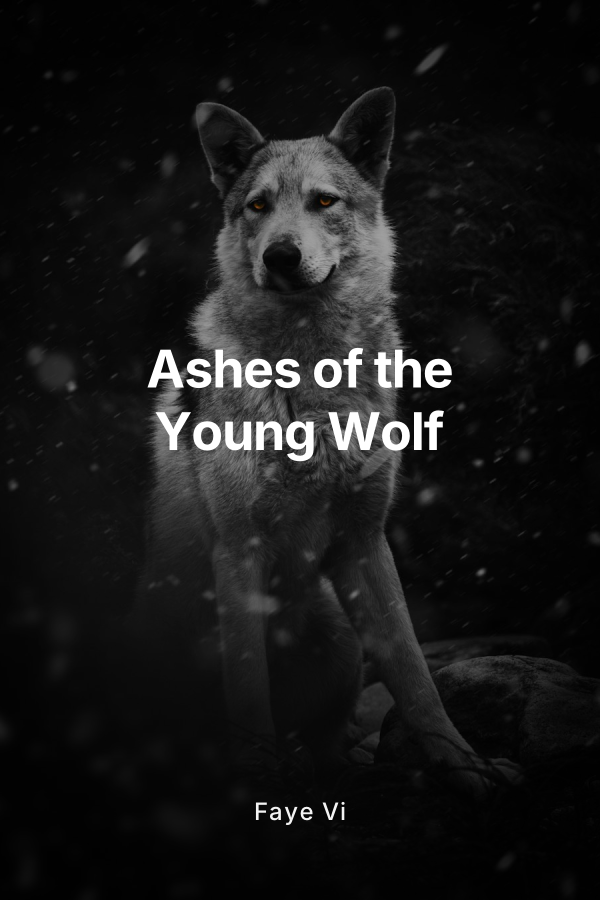
“Ashes of the Young Wolf” is a dark, emotionally charged God of War tragedy that refuses to look away from cruelty, pain, and loss. Meant for mature readers familiar with the harshness of the Nine Realms, it offers a deeply graphic depiction of torture and survival, balanced with an intimate exploration of a son’s endurance and a father’s helpless love. Over five chapters, the book moves from abduction to captivity, from escalating torments to the fragile hope of rescue, and finally to a devastating farewell that reshapes both Kratos and the world around him. This is not a story of victory, but of the terrible cost of defying the gods, and of the young life that burns brightest only to be extinguished in the cruel light of the Allfather’s obsession.