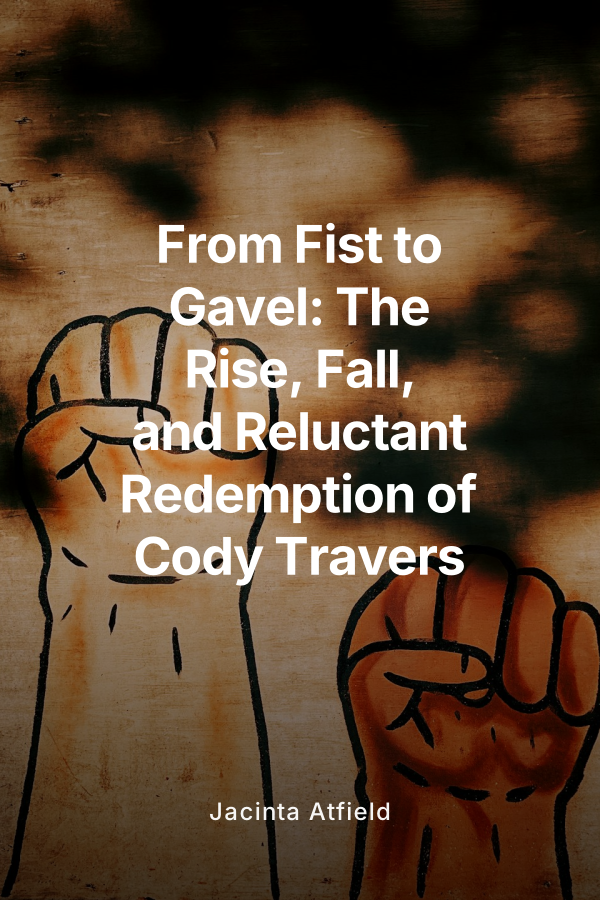
This book traces the turbulent life of Cody Travers, charting his evolution from a hotheaded street savior to a jailed brawler and, finally, to the reluctant mayor of the very city that both forged and nearly destroyed him. Drawing on his full narrative arc across Final Fight and Street Fighter V, it explores how a man who once solved every problem with his fists learns, slowly and painfully, to seek justice without losing himself in violence.
Across four chapters, the book opens on Cody’s heroic phase in Metro City, when he and Mayor Mike Haggar tear through the Mad Gear gang to rescue Haggar’s kidnapped daughter, Jessica. Cody is presented as a good-natured young fighter whose instinct to throw hands is matched only by his instinct to protect those he loves. He is not yet a criminal or a cynic, just a combative romantic who believes that if he hits hard enough, he can beat back every form of evil. This early period captures the pure, arcade-like simplicity of his world: good guys, bad guys, and the rush of righteous violence that seems to fix everything overnight.
The second chapter follows Cody into his downward spiral, where peace proves more suffocating than any war. Unable to adjust to normal life after the fall of Mad Gear, he becomes addicted to the thrill of fighting itself, drifting from back alley to back alley in search of an opponent who can make him feel alive again. His arrests start as inconveniences and become a lifestyle. Cody embraces the role of the chained brawler in prison stripes, drifting far from Jessica and everything he once fought to protect. This section examines how his identity collapses when he no longer has a clear enemy to punch, turning a former hero into a self-destructive wanderer who breaks out of jail as casually as others step out for air.
The third chapter shifts into Cody’s reluctant redemption, grounded in the Street Fighter V era. Mike Haggar returns not as the brawling partner of old, but as the architect of Cody’s second chance, arranging his exoneration and installing him as the new mayor of Metro City. Cody steps into city hall with the soul of a fighter and the patience of a man who never wanted a desk. The book delves into his frustration with regulations, paperwork, and political theater, contrasting his restless nature with the slow grind of legal justice. Over time, he learns to bend the system without breaking it, to direct his temper toward reform instead of riots, and to accept that saving a city now requires signatures and strategy as much as shattered bricks.
The final chapter studies the fragile balance Cody finds between his past and present. He remains an anti-hero at heart, a man who still hears the siren call of the fight every time a criminal smirks or a gang resurfaces in Metro City’s shadows. Yet he now wields both his fists and his authority with a new restraint, pushing himself to seek justice rather than chaos. The book closes on Cody as a figure caught between the alley and the office, the cell and the council chamber, embodying a rare kind of growth in a world that usually freezes fighters in time. His story becomes a meditation on responsibility, addiction to conflict, and the hard path of changing not just the city, but oneself.
Throughout, From Fist to Gavel speaks to fans of character-driven game lore and readers who are drawn to flawed protagonists. It reframes Cody Travers not as a side character in someone else’s franchise, but as the centerpiece of a grounded, emotionally charged journey from brawler to bureaucrat, showing how even the most reckless hero can learn that real strength sometimes means not throwing the punch at all.