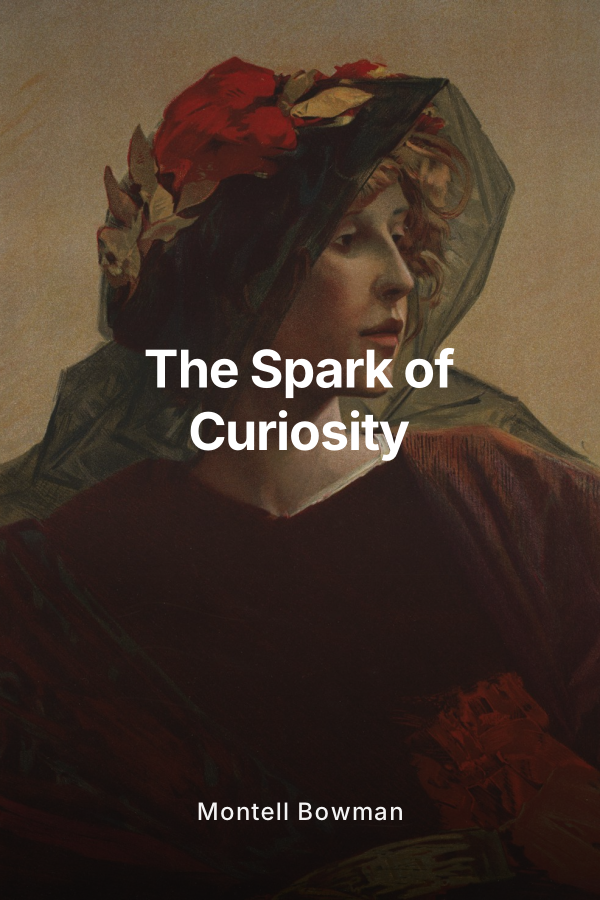
This non fiction book explores the universal yet often overlooked force that drives our greatest learning, creativity, and change: the moment something becomes genuinely interesting to us. Anchored in psychology, everyday experience, and clear, vivid explanations, it traces how curiosity moves from a passing feeling into a lifelong path, and how intentionally choosing “interesting topics” can quietly redirect the course of a life.
Across five chapters, the book examines why certain ideas, problems, and stories grip our attention while others leave us cold, what happens in the brain and mind when curiosity is activated, and how this internal spark can be deliberately cultivated rather than left to chance. It avoids technical jargon and dense academic debate, instead making research accessible through concrete examples, relatable scenarios, and practical insights. The goal is not simply to inform readers about curiosity, but to help them treat interest itself as a tool they can learn to use.
The narrative begins by unpacking the first moment of engagement: the way a question, image, or unexpected fact breaks through the noise of daily life. It shows how this moment is shaped by personal history, values, identity, and context, and why what feels fascinating to one person feels irrelevant to another. Readers see that there is no single list of “objectively interesting” topics, only patterns between their inner world and the outer one. This understanding dismantles the quiet shame many feel about their own interests and replaces it with clarity and permission to follow them more deeply.
From there, the book explores the mechanics of attention. It explains how the mind decides what to focus on, why it wanders, and how modern environments often scatter or override our natural curiosity. Instead of treating distraction as a moral failing, it reframes it as a design problem, then offers ways to build a personal environment that nudges the mind toward genuine engagement instead of shallow stimulation. Readers learn to distinguish between fleeting novelty and lasting fascination, and to recognize the early signals that a topic might sustain deeper exploration.
A central section maps the life cycle of an “interesting topic.” It begins as a spark, continues into active exploration, and eventually matures into either a stable passion, a professional path, or a quietly meaningful side interest. Through this lens, readers can reinterpret their own histories: hobbies they abandoned, subjects they once loved in school, questions they never had time to pursue. The book shows how to rekindle dormant interests and how to gracefully let go of others without guilt, treating curiosity as something that ebbs and flows rather than a single fixed calling.
Attention is also given to the emotional side of curiosity. The book explores how wonder, confusion, frustration, and even fear interact with our desire to know more. It addresses common blockers such as perfectionism, comparison with experts, and the belief that every interest must be productive or monetized. Instead of arguing that curiosity always feels good, it acknowledges that deep interest sometimes leads through uncertainty and difficulty, and shows how to navigate those phases without losing heart.
Practical chapters translate these ideas into everyday choices. Readers are invited to experiment with small, low risk steps for following their curiosity within the constraints of busy lives: adjusting how they read, learn, work, and even socialize. The book proposes simple frameworks for choosing what to explore next, for building modest but consistent learning rituals, and for creating projects that turn abstract interest into something visible and satisfying. These tools are framed not as rigid systems, but as starting points that anyone can adapt.
Finally, the book zooms out to look at the social dimension of interesting topics. It examines how communities form around shared curiosities, how conversation can either awaken or extinguish interest, and how to find people who both challenge and deepen one’s fascinations. Readers see how their interests fit into a larger cultural landscape and how following what intrigues them can contribute, in however small a way, to the ongoing exchange of ideas and creativity that shapes the world.
The intended audience is the thoughtful general reader who feels a pull toward learning and creating, yet often feels scattered, overwhelmed, or unsure where to direct their limited time and energy. By the final chapter, readers will not only understand curiosity more clearly, they will also possess a concrete, personal map of what truly interests them now, why it matters, and how to keep that spark alive over the long arc of their lives.