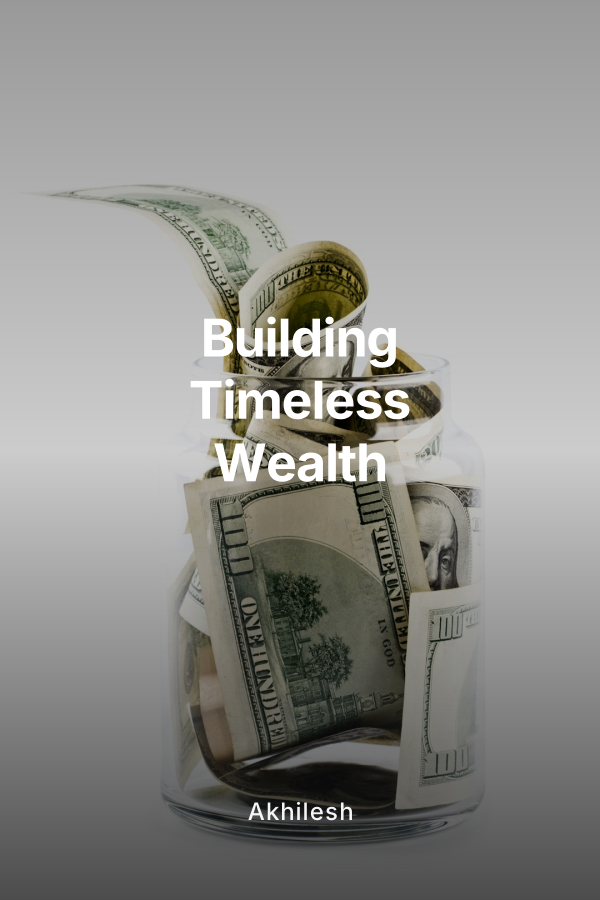
“Building Timeless Wealth” is a focused, hard-hitting guide for ambitious people who are tired of trading hours for money and ready to build something that outlives them. Instead of romanticizing hustle, it explains how wealth really accumulates over time - through ownership, leverage, intelligent protection, and the deliberate pursuit of freedom.
The book is built around five strategic shifts, each explored in its own chapter. Together they form a staircase that takes you from being a replaceable worker inside other people’s systems to becoming the architect of assets, structures, and institutions that quietly compound for decades.
Chapter 1: The Decision To Become Timelessly Wealthy
The opening chapter begins where most people never start: with a decision that being “comfortable” is not enough. It draws a sharp line between wishing for money and becoming genuinely unwilling to stay in your current financial reality. Desire is treated as a serious economic force, not a motivational slogan.
Here you redefine wealth. It is not just a number in an account, but the ability to control your time, your environment, and your options. The book contrasts linear income - money that stops the moment you stop working - with timeless wealth, which is built on assets that pay you whether you are present or not.
You are guided to build a clear personal vision: what you want your money to do for you, for the people you love, and for your future self 10, 20, 40 years from now. The chapter shows how belief in that vision is not blind optimism, but a commitment to learn skills, change environments, and keep adjusting until the vision matches reality.
By the end of Chapter 1, wealth is no longer a vague dream. It is a destination on your internal GPS, with a direction of travel and a timeframe measured in years and decades, not days.
Chapter 2: From Worker To Architect - The Five Levels of Ownership
Chapter 2 reveals the invisible ladder that separates most of the population from the people whose names you never hear but whose decisions shape entire markets. It breaks down five levels of ownership:
- You do the work - you trade time and effort for a paycheck.
- You run the business - you own the operation that others work inside.
- You own the critical assets - the things businesses must pay to use.
- You own portfolios - many assets spread across sectors and locations.
- You own the owners - structures that hold entire portfolios and direct capital.
The chapter shows why most people remain trapped on level one, even when their salary rises. Their income still depends on showing up. In contrast, each higher level moves you closer to the front of the line where money flows first and risk is spread across systems, not just your body and your job.
Realistic examples illustrate how a reader might move up one level at a time: from employee to small operator, from operator to first asset, from single asset to a simple portfolio, and eventually into ownership structures that sit above individual assets. The emphasis is not on fantasy but on structure. You see that wealth is not mysterious - it is architectural.
By the end of this chapter, you can locate yourself on the ownership ladder and see a concrete path to the next level.
Chapter 3: Leverage, Systems, and the End of Hustle
This chapter dismantles the modern cult of “grind” and replaces it with a more adult understanding of power: leverage. You discover why working harder inside a low-leverage system feels like running in sand. Extra effort just keeps the machine running instead of building anything new.
The book explains the main forms of leverage available to an individual:
- People - hiring, partnering, and leading.
- Capital - using money as a tool instead of a finish line.
- Code and tools - technology that acts on your behalf, day and night.
- Media and distribution - messages and offers that reach many people at once.
- Structures - systems, processes, and legal entities that keep working without you.
You learn how to place your effort into systems that multiply it, rather than absorb it. The chapter explores three key transitions: choosing environments where output can scale, eliminating distractions so your energy concentrates, and staying in one direction long enough for momentum to form.
Momentum is reframed as a quiet phase where progress compounds invisibly before it becomes obvious to the outside world. Instead of chasing constant novelty, you are shown how to stack small improvements inside one system until it starts working for you instead of the other way around.
By the end of Chapter 3, you understand that timeless wealth is not the reward for endless exhaustion. It is the outcome of putting focused effort into the right structures, with the right leverage, for long enough.
Chapter 4: Protecting the Machine - How the Wealthy Outlive Themselves
Building wealth is only half of the game. Keeping it - through market cycles, bad decisions, family drama, and human nature itself - is the other half. Chapter 4 lifts the curtain on how serious wealth is protected.
You are introduced to a crucial idea: separating ownership, control, and benefit. Most families mix these three into one person. That person can then sell assets impulsively, over-spend, or be wiped out by lawsuits, divorces, and taxes. In contrast, enduring fortunes are placed inside structures that enforce rules long after any individual is gone.
The book walks you through the logic behind tools like trusts, holding companies, legal protections, and governance frameworks in plain language. Not as technical trivia, but as practical ways to:
- Prevent a single heir from liquidating everything for cash.
- Shield core assets from personal mistakes or legal attacks.
- Release money slowly and intelligently across a lifetime.
- Reward productive behavior without enabling self-destruction.
- Keep decision-making power in competent hands while many can benefit.
This chapter also explores the biggest threats to family wealth: uncontrolled lifestyle inflation, impulsive partners, ego-driven projects, tax-triggering liquidations, and the psychological danger of unearned entitlement. You see how structures can be designed specifically to defend against each of these.
By the end of Chapter 4, you no longer see money as a pile of cash, but as a machine that must be engineered, housed inside the right containers, and governed by rules that can survive changing generations and emotions.
Chapter 5: Quiet Power and True Freedom
The final chapter answers the question: “What is all this wealth for?” It connects money, ownership, and structure to something deeper - power and freedom.
You explore different levels of freedom: physical, financial, time, location, emotional, social, and strategic. The book shows how each level builds on the ones before it and how money, used correctly, unlocks them in sequence. The goal is not just to be rich on paper, but to be free in practice - free to choose your work, your company, your geography, your pace, and your contribution.
Alongside freedom, the chapter maps out levels of power, from feeling completely at the mercy of circumstances to quietly shaping the rules others live by. Power, here, is not portrayed as domination, but as the ability to make reality bend toward your values at increasing scale - in your household, your company, your community, and beyond.
You are given a vivid picture of what life feels like when wealth is timeless: mornings without financial anxiety, the ability to protect and uplift your family, the option to walk away from any toxic situation, and the privilege of solving real problems in your community because you can.
The book closes by inviting you to think in decades rather than days, to treat your life as a sequence of chapters instead of a single grind, and to view money as a tool for building multiple rich lives across one lifetime - not a scoreboard to impress strangers.
“Building Timeless Wealth” is not a fantasy manual. It is a practical manifesto for people who are ready to step out of the noise, understand how the financial game is really structured, and methodically climb from laborer to owner, from visible hustle to quiet power, from temporary success to wealth that does not end with them.