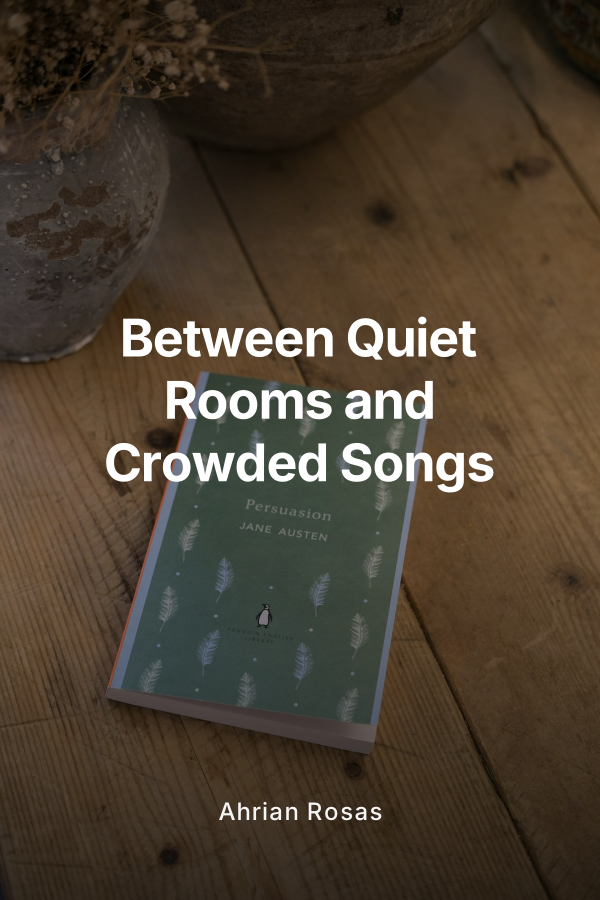
This memoir follows a child born in Wheat Ridge, Colorado, and raised in Thornton, Colorado, who comes of age inside two different but deeply loving worlds. On one side stands a white, American mother named Rebecca, whose love often looks like calm evenings, small gatherings, and unhurried time together. On the other side stands a Mexican father named Miltion, whose love unfolds in loud monthly parties, holidays filled with music, and relatives moving in every direction speaking both Spanish and English. The narrator, second-born between an older sister, Ayla, and later a younger sister, Zavala, grows up trying to locate a clear sense of self within this vibrant, sometimes overwhelming blend of cultures and personalities.
The story begins in the quiet spaces of the mother’s side of the family, exploring what it means to start life as a 3-month-old baby in a home that feels gentle and controlled compared to the chaos that will come later. The narrator reflects on being the second child in a young family, cradled by a mother whose style of affection is steady, calm, and often expressed in simple, understated moments. These early scenes are bathed in soft light and small sounds, the hush of suburban Colorado days, the routine of church, and the intimate sense of belonging that comes from a closely knit household with pets underfoot and parents who are present and affectionate.
As the memoir deepens, the narrative begins to contrast this softness with the intensity of the father’s world. On Miltion’s side of the family, celebrations arrive like weather: monthly parties full of relatives, music turned up high, voices talking over one another, and Spanish and English flowing together so quickly that the child’s thoughts can barely keep up. The narrator remembers Christmases and Easters that pulse with color and movement, the sensation of being held inside a loud, loving storm of Mexican traditions, endless dishes of food, and cousins and tías and tíos orbiting around a home that never seems to grow quiet.
Throughout these scenes, the memoir lingers on the feeling of being both entirely included and quietly left out. The narrator is almost always surrounded by family. There are two sisters, two leopard geckos, a snake, and two dogs, and the house is often full. Yet the heart of the story insists that being in the middle of a crowd and being seen are not the same thing. Some of the most poignant reflections appear in memories where the parents and sisters go out together, leaving the narrator at home. In those hours alone, the house feels suddenly too large, the quiet too sharp, and the child’s thoughts swirl around questions of place and importance in a family of five. These episodes do not shatter the closeness with parents or siblings, but they mark the tender edges of being one of three, where attention is shared and sometimes missed.
Identity, in this memoir, is not a fixed label but something that emerges slowly from the tension between two inherited worlds. The narrator navigates being Mexican and American at the same time, experiencing holidays that lean heavily toward the father’s side, monthly parties that center Mexican customs and extended relatives, and smaller, quieter hangouts with the mother’s side that feel more casual and low-key. Church weaves through both sides of life, offering a sense of rhythm and ritual that grounds the narrator, even when language, volume, and expectations change from one family gathering to another.
The tone of the book moves intentionally from gentle to overwhelming. Early chapters rest in the soft textures of baby photos, the memory of being three months old framed by stories told by parents, and the early understanding that love can speak in murmurs. As the narrator grows, the story accelerates into crowded rooms, thick with the smell of food and the heat of too many people in one space. The memoir gives sensory detail to what it is like to stand small among loud speakers and louder relatives, to feel the music through the floor, to hear one’s own name called in two accents, and to hold both comfort and overstimulation at once.
Despite moments of loneliness, the memoir never abandons the deep affection at the core of this family. The narrator’s connection to both parents remains warm and strong. With Rebecca, tenderness might look like casual conversations, small family get-togethers, and a quieter, more relaxed approach to life. With Miltion, affection is a shared delight in parties, cultural traditions, and a kind of joy that is experienced in groups rather than alone. The narrator learns to read each parent’s love language, recognizing that while one offers peace and the other offers celebration, both are expressions of care.
The presence of pets in the household becomes another subtle thread in the story. The leopard geckos, the snake, and the two dogs offer a different kind of companionship, one that is constant and uncomplicated. When human relationships feel tangled and attention feels scarce, these animals give the narrator a sense of being needed and noticed. In the background of parties and hangouts, there is always a dog’s steady gaze or the quiet, observant stillness of the geckos. These creatures underscore the memoir’s attention to the small, often overlooked details that make a life feel full.
The book also reflects on place. Thornton, Colorado, is not simply a setting but a landscape of in-between spaces. It is a suburban environment where the Mexican side of the family gathers in homes that seem to swell with people during celebrations, and where the American side leans into everyday simplicity and slower-paced time. The narrator comes to see Colorado as a backdrop that holds both snow and sun, both quiet Sundays and explosive holiday nights. The state becomes a metaphor for the narrator’s own mixed identity, a place where different climates coexist and shape the person growing up there.
As the narrative arcs toward reflection, the memoir examines what it means to be the second child in a loving but busy household. Being between an older and a younger sister means that the narrator is both looked up to and overshadowed. The memoir lingers on the dynamic between the siblings, moments of closeness and shared jokes, offset by times when the narrator feels like the extra voice in a conversation that already has two main characters. In these reflections, the book explores how birth order and family size can influence a child’s internal story about their own importance, even when love is present and genuine.
Throughout, faith appears not as a rigid doctrine but as a steady current. Church life offers structure and community, shaping the narrator’s understanding of belonging and purpose. The memoir does not present religious experience as simple or one dimensional. Instead, it treats church as another gathering space, one that sometimes feels like the quieter cousin of the father’s monthly parties, with its own rhythms of music, prayer, and shared meals. These spiritual settings become places where the narrator wonders about identity, gratitude, and the meaning of family.
By its conclusion, the memoir offers a layered portrait of what it means to grow up carrying more than one culture inside a single body and heart. The narrator comes to see that the overwhelming parties and the gentle hangouts, the moments of being left behind and the times of being surrounded, the English and the Spanish, the snow outside and the warmth of crowded living rooms, all belong to one continuous life. There is no clean separation between Mexican and American, between loud joy and quiet love. Instead, there is a single childhood shaped by both, and a young person learning to claim all of it as their own.
“Between Quiet Rooms and Crowded Songs” promises a memoir of rich sensory detail and deep emotional honesty. It is a story for anyone who has ever stood in a room full of people and wondered where exactly they fit, and for anyone raised between cultures who has felt both overwhelmed by love and quietly alone inside it.