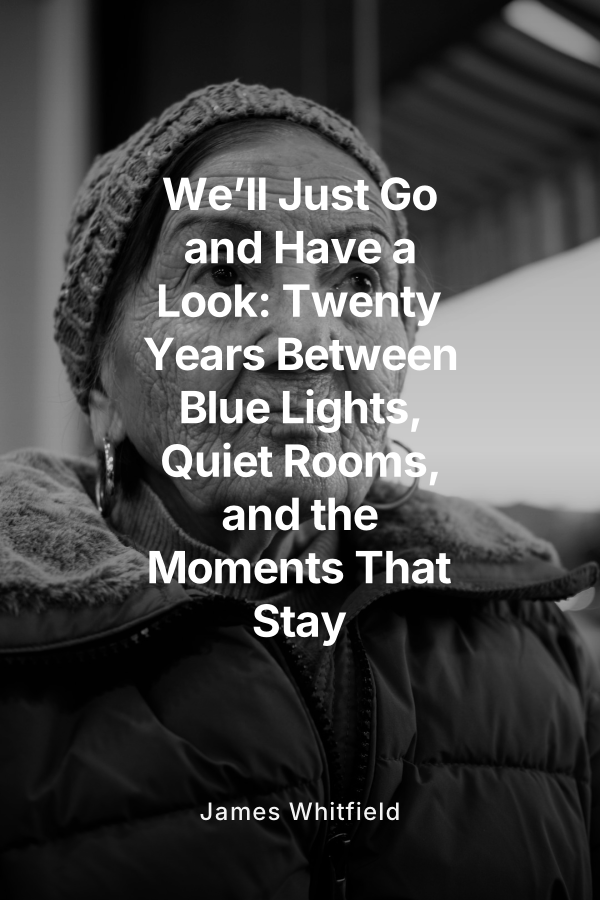
This memoir traces two decades of answering other people’s worst days, from the back of an NHS ambulance to specialist rescue teams, helicopter medicine, and finally a critical care flight role on a rescue chopper in New Zealand. It is not a chronological logbook so much as a map of the jobs that refused to stay put, the ones that still surface on quiet evenings and in supermarket queues.
At its heart is a simple working rhythm: you turn up, you try to work out what is going on, you do what you can, and then you live with whatever that did or did not change. The book opens on an ordinary coastal training day that stops being pretend the moment a fisherman points at the water. A clean, almost textbook rescue becomes the first time the author feels training, luck, and another person’s life intersect for real. A week later a local paper accidentally places his photo under a headline about a sex offender, and the job’s central truth lands: you do not control the narrative, only your part in it.
From there the story drops to ground level, into the years on the road where the work is mostly front doors and beige carpets rather than high drama. Ordinary houses, worst days. Cardiac arrests played out between a sofa and a coffee table. Welfare checks that turn into arrests because “just not himself” was the only language a neighbour had. The calls that sound minor on a dispatch screen but unravel into something life changing when you step through the door. These chapters show how quickly “routine” becomes a dangerous word, and how much of the job happens in the thirty seconds after you say, “You did the right thing calling us.”
Threaded through those scenes is the slow discovery of the cracks in the system. An elderly man who spends twenty four hours on his living room floor because his non urgent fall kept being leapfrogged by more dramatic calls. Patients who are medically stable but adrift in the gaps between social care, mental health services, and overrun GP practices. The author does not preach policy; he lets one living room at a time show how “we got there in time” often means “we arrived just before the consequences became undeniable,” and how there is nothing in the drug bag for all the hours before the ambulance pulls up.
The middle of the book moves into Hazardous Area Response and specialist rescue, where the kit multiplies and the risks change shape. Here the tone widens to include the absurdity that keeps people afloat: industrial floor cleaners ridden like rodeo bulls, cheese eating competitions on residential courses, lockers mysteriously relocated to heights that technically require safety harnesses. Under the nonsense sits a quiet study of trust. You learn how much easier it is to clip into a rope system with someone you have already seen fall off things and get back up laughing. That familiarity becomes the foundation for the jobs where laughter is impossible.
Alongside the camaraderie are two juxtapositions that define this period. On one bridge, a suicidal man changes his mind too late and ends up stuck on the wrong side of the barrier with dead legs. The team secure him, talk about life choices, and eventually winch him to safety on a fire service aerial ladder. Months earlier, in a different place, another man steps off a building in front of emergency services and does not get a second chance. The medical drills are similar. The endings are not. What lingers for the author is not heroism but the randomness of which version of that story you drive into next, and the understanding that you do not get to choose.
The HEMS chapters step up the altitude and the pressure without changing that underlying uncertainty. The first proper day on the helicopter refuses to be gentle. A cardiac arrest at a house fire tests all the newly earned responsibility of leading airway management and direction on scene, followed almost immediately by a child dragged from under a lorry, arm catastrophically injured, father watching every move. There is no tidy arc from competence to control, just a constant threading between inner doubt and outward steadiness, between the glamour people imagine when they see a flight suit and the reality of feeling slightly sick in the back of a land ambulance on the way to a trauma centre.
Later, as COVID arrives, the narrative shifts again. Full PPE becomes routine. Roads fall uncannily quiet. The job turns, in part, into persuasion. Convincing people with textbook chest pain that they really do need hospital even when news footage has taught them to be more afraid of corridors than of infarcts. More jobs sit in that grey zone between medical emergency and systemic failure: a man left on his floor far longer than anyone would accept for their own parent, pressure sores marking not the original fall but the time it took help to arrive. The chapter does not shout at policy makers; it simply stays with the mentor quietly crying in a hallway after a preventable job, letting that image say what statistics never quite manage.
Mental health runs through the memoir not as an abstract theme but as repeated, awkward, human encounters. A young woman in crisis who will only agree to come to hospital if one of the crew wears the large, dirty cartoon head sitting in the corner of her room. The author’s colleague eventually does exactly that, riding in an ambulance dressed as a battered teddy because it is the only thing that works at three in the morning. Elsewhere, a teenager sits on the wrong side of a bridge rail, legs numb, while the team negotiate not with pathology but with embarrassment and gravity. These stories illustrate how much pre hospital care is not about drugs or devices but about finding something, anything, that builds enough trust for a person to move one step away from the edge.
Not every chapter is heavy. The infamous industrial tumble dryer call appears later as deliberate light relief: three teenagers wedged inside an out of service commercial machine, an entire multi agency response gathered for a piece of avoidable idiocy. It is funny in the telling, but it also becomes a lens on over response, bureaucracy, and the inescapable truth that sometimes you deploy high level capability to unstick someone from the consequences of a very poor decision. Humour, throughout, is never decoration. It is presented as part coping strategy, part social glue, part quiet rebellion against days that would otherwise be unbearable.
Parallel to all the professional progression runs a more private thread: what this life does to a person away from work. Relationships that thin out under the constant drag of shifts, exams, and “just one more” promotion. Coming home so emptied out that there is very little left to give to the people who waited. The difficulty of explaining to anyone outside the world why you can be exhausted after “a quiet shift,” or why minor everyday complaints are suddenly hard to relate to after an evening spent in a blood spattered living room with two bodies and one surviving family. There is no melodramatic collapse, just an accumulation of small absences and a belated recognition that life has quietly reorganised itself around the job.
The latter chapters pick up the Coastguard work and the eventual move to New Zealand, where the same skills are deployed against a different backdrop. Long water searches that gradually morph from rescue to recovery operations, reading tide and wind not as scenery but as moving machinery that decides where bodies will and will not surface. The author develops an unwanted “eye” for where the sea will give a person back, and learns that sometimes the most you can offer a family is an end point to their wondering. Search patterns and drift models become ways of searching time as much as geography.
The book closes in the present, with the author working as a Critical Care Flight Paramedic on a rescue helicopter in New Zealand. It is framed as the best version of the job he has found so far: a mix of critical care, search and rescue, and environments that still feel challenging rather than purely draining. Yet there is no triumphant full stop. The cost in relationships is still unresolved. The imposter voice from early HEMS has not completely gone, it has just become more familiar. What has changed is the level of honesty. The final pages sit with the idea that you can be proud of the work, angry at the gaps around it, and uncertain about the rest of your life all at the same time.
Across its five chapters, We’ll Just Go and Have a Look offers an unvarnished portrait of modern emergency care from someone who has seen it from several angles and altitudes. It is part love letter to the teams who quietly hold one another together, part field report from the edges of a fraying system, and part attempt to make sense of what it means to build an identity around turning up when other people dial three numbers. It does not promise neat closure or constant heroics. Instead it offers something rarer in books about this work: a calm, humane, often darkly funny account of what it is actually like to keep walking up ordinary paths, not knowing which version of the job waits on the other side of the door, and going to have a look anyway.