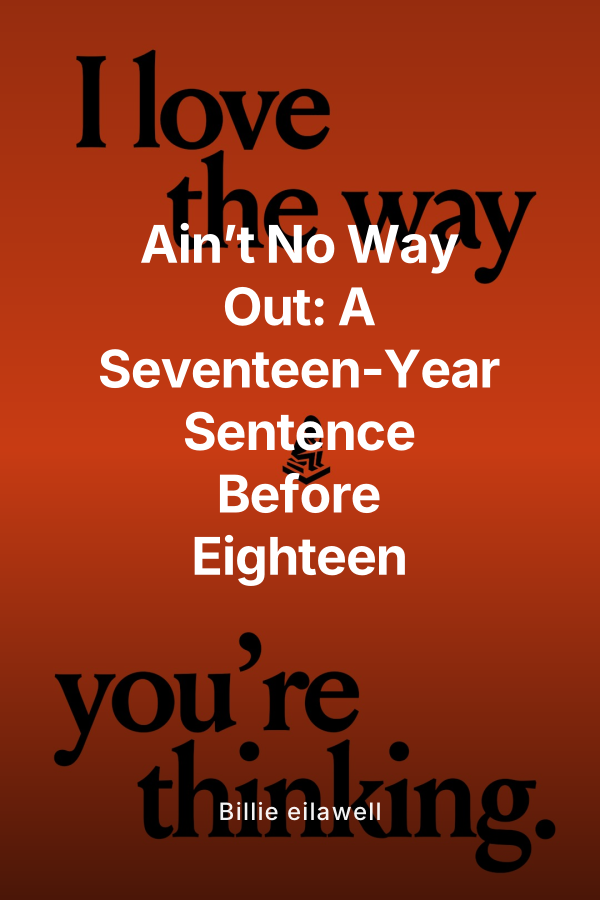
Russell Brewster is fifteen, high more often than he is sober, and already on a first-name basis with the local cops. His mom died of cancer when he was little, leaving behind a hollowed-out house and a father who loves him but has never figured out how to keep him from slipping through the cracks. Russell tells himself he does not care. He has his crew, his pills, his smoke, his record with juvenile services, and a hard shell of swagger and slang that keeps the world at arm’s length. In his neighborhood, growing up broken feels normal.
Everything fractures the night he sleeps with Roxanne Clements, a twenty-two-year-old family friend who once babysat him and read him stories in the quiet after his mother’s chemo sessions. Roxanne is the one person who still talks to him like he is more than his rap sheet. She is trying to build a life of her own with a steady job and her own tiny apartment, holding herself just far enough from the mess of Russell’s daily chaos. Neither of them plans what happens. Neither of them truly believes there will be consequences.
Weeks later, Roxanne shows up on his doorstep, pale and shaking, and tells him she is pregnant. In that moment, Russell’s blurred, half-lived existence slams into focus. The drugs, the fights, the shoplifting, the court dates, the endless half-hearted promises to his dad that he will do better suddenly collide with something he cannot dodge. There is a heartbeat in the middle of his wreckage, and it is not just his.
Told entirely in Russell’s raw, unfiltered first-person voice, the book plunges readers inside a mind that thinks in the clipped rhythms of the streets. He talks the way he lives, saying “ain’t” without apology and dropping the “g” off the end of his words, a rough slang that exposes both his bravado and his fear. Roxanne, by contrast, speaks with clarity and control, her calm, measured language forming a sharp counterpoint to Russell’s jagged inner monologue. Their conversations become a tug-of-war between two worlds: the adult world of responsibility and the adolescent world of denial, each syllable revealing how far apart they really are.
As the pregnancy forces its way into the open, Russell’s life begins to tilt. His father, blindsided, oscillates between rage and heartbreak, seeing both the ghost of his dead wife and the frightened boy she left behind. Social workers, school officials, and probation officers circle, each with their own language for what Russell has done and what should happen next. Some see a predator. Some see a victim of circumstance. Very few see a confused teenager who is only now realizing that choices do not reset just because you want them to.
The streets offer him an easy out. His crew tells him it is not his problem, that Roxanne can “handle it” or “take care of it,” that he is too young to let some mistake chain him down. The drugs beckon louder than ever, promising to pull him back into a haze where nothing is real enough to hurt. At the same time, small, ordinary moments with Roxanne chip away at his defenses: feeling the flutter of the baby’s first movements under her ribs, sitting with her in a clinic waiting room while announcements drone overhead, hearing her quietly recite the cost of diapers versus her hourly wage.
Step by painful step, Russell confronts parts of his past he has never faced. Memories of his mother’s hospital rooms, the soft hush of her voice, and the way Roxanne once held his hand during those long nights resurface and clash with his current reputation as the neighborhood screwup. He begins to wonder whether the version of himself everyone expects is the only one he is allowed to be. Responsibility stops being a vague adult word and becomes a crying child in his imagination, a life that will one day ask where he was when it all began.
Ain’t No Way Out traces the months of Roxanne’s pregnancy and the crumbling of Russell’s old identity. Court dates and clinic visits twist together. Fights with his dad explode into the open, exposing years of bottled anger over his mother’s death. Roxanne wrestles with her own conflicted heart, torn between protecting herself from legal and social fallout and wanting Russell to step up as a father instead of another name on a birth certificate. Their power imbalance, age gap, and shared history make every decision heavy with both guilt and tenderness.
The book does not sanitize Russell’s world. It shows the small, grinding humiliations of juvenile court, the numbing rituals of probation check-ins, the taste of cheap drugs and cheaper bravado. Yet running through the grime is a current of possibility. Between rushed meetings with school counselors and late-night walks through their neighborhood, Russell starts to see flickers of another future: one in which he finishes school, finds legitimate work, maybe even earns back some of his father’s trust. Those glimmers war constantly with the pull of his old life.
At its core, this is a story of an impossible choice: how do you grow up fast enough to protect someone who did not ask to be born into your disaster, when you have never learned to protect yourself? Ain’t No Way Out explores teenage fatherhood, consent and power, grief, addiction, and the thin line between a “bad kid” and a broken one. Russell’s journey is not clean or simple. He relapses, he runs, he lies, and he hurts people. But he also shows up in unexpected ways, learning that courage sometimes looks less like a dramatic sacrifice and more like showing up to a parenting class after a long shift at a dead-end job.
In the final chapters, as the baby’s birth nears, tension peaks. Legal consequences, family conflict, and Russell’s still-fragile sobriety threaten to implode everything he has tried to build. The story refuses to offer a neat fantasy where love fixes every wound. Instead, it offers something quieter but more enduring: the possibility that a boy who has always believed he “ain’t worth nothin’” can choose, one hard decision at a time, to become the kind of man his child might one day be proud to know.
Poignant, gritty, and fiercely intimate, Ain’t No Way Out is a coming-of-age story set in the split second between childhood and adulthood, where one reckless night can alter several lives forever. Through Russell’s voice, readers are invited to witness the messy, painful birth of responsibility inside a boy the world has already written off, and to ask whether there is ever truly no way out, or if the hardest roads sometimes lead to the first real chance at redemption.