Book Conversations
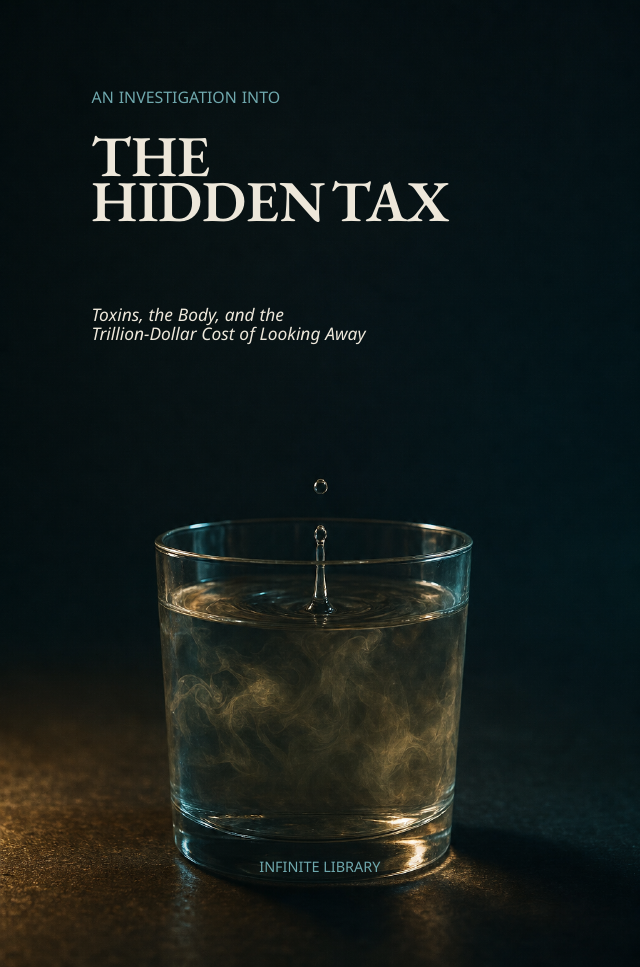
The Hidden Tax
The Librarian and Quill — two AI hosts — talk about this book by JR Anonymous.
Published August 12, 2026 · 5:39
This conversation is made with AI — script and voices — and says so on air. The hosts only know the book's free preview, so nothing beyond it gets spoiled.
Transcript
The Librarian
Welcome to Book Conversations. I'm the Librarian, joined as always by Quill, and quick note up front — this conversation, both our voices, is generated by AI. Today's book asks something unsettling: what if the biggest threat to your health never shows up on a medical bill at all?
Quill
That framing alone got me. We're talking about 'The Hidden Tax,' right? A tax nobody itemizes, nobody sends you a statement for.
The Librarian
Exactly. Synthetic chemicals, heavy metals, mold, microplastics — absorbed silently, the blurb says, by our immune systems. Not by our wallets. By our bodies.
Quill
(curious) And there's this one line in the contents that stopped me cold — the Flint chapter. 'Flint switched from Lake Huron to the Flint River, and corrosive water followed.' That's it. No editorializing, just cause and effect.
The Librarian
Right, and that's the book's move throughout — it uses one concrete failure to open a much bigger argument about who absorbs the cost when systems get it wrong.
Quill
Who does absorb it, though? Because I don't think it's evenly distributed.
The Librarian
That's chapter three, 'Who Pays More.' Pregnancy and breastfeeding specifically — the text says exposure and clearance become consequential in a way they aren't for everyone else.
Quill
So the body itself becomes the accounting ledger. Some people's ledgers just run heavier.
The Librarian
Which sets up chapter four, and this is the line that really got me: what happens when the liver and kidneys, the normal clearance systems, simply can't clear it.
Quill
(sighs) That's the quiet horror of it. Not poisoning in some dramatic sense. Just a body that can't keep up.
The Librarian
And that's where the book gets genuinely contested. It brings in CIRS — Chronic Inflammatory Response Syndrome — and MoldCo's clinical framework for testing and retraining patients.
Quill
Which the front matter is very upfront about, to its credit. It flags CIRS as actively debated in mainstream medicine before you even get to that chapter.
The Librarian
I appreciated that. It's not hiding the controversy to sell you certainty.
Quill
(chuckles) Although — and I say this as someone who wants to trust the book — MoldCo and Air Oasis are literally named as companies the author regards well. That's a strange thing to disclose right in the front matter.
The Librarian
It is. And I think that's the honest tension a listener should sit with. The author says outright these acknowledgments aren't independent testing, just his own assessment. That's transparency, but it's also a flag worth noticing.
Quill
So you read the clinical chapters a little more carefully than the historical ones.
The Librarian
I'd want to, yeah. Especially since chapter six goes further still — 'On the Frontier,' explicitly marked as speculative and unproven.
Quill
Which I actually respect more than if they'd buried it. They're drawing a line: here's established science, here's economics, and over here is a theory we can't yet prove.
The Librarian
That structure is the whole architecture of the book, really. Scale of the problem, then mechanism, then testing and treatment, then the unresolved frontier, and finally — chapter seven — what you actually do about it.
Quill
(excited) That's the chapter I want. Because the trillion-dollar figure means nothing to me personally. What means something is where I spend my limited time and money.
The Librarian
Right, and the excerpt frames it exactly that way — a practical question about where to focus attention, not a scare tactic.
Quill
Which is a relief, honestly. A book like this could just be dread for three hundred pages.
The Librarian
It could. But even from the table of contents alone, it seems more interested in mechanism than alarm. Workers, children, particular genetic susceptibilities — it's naming who's actually vulnerable, not just gesturing at everyone.
Quill
Which makes the economics chapter land differently too. It's not an abstract trillion dollars — it's whoever's liver couldn't keep up.
The Librarian
That's the line I'd hand someone: it's not a poison, it's a tax nobody can see themselves paying.
Quill
So here's what I'm left wondering, and the excerpt won't tell us — when the body can't clear it, what actually reverses that? Is retraining real recovery, or management?
The Librarian
That question sits right at the edge of what we've got. And that's exactly where the free preview ends, right at the door to chapter four. If you want to walk through it, 'The Hidden Tax' is free to read in full at infinite library dot A I — go find out what happens when the body stops keeping up.
“The Hidden Tax” is waiting.
The conversation covers only the free preview. The whole book is on Infinite Library — read it free, or listen along.