Book Conversations
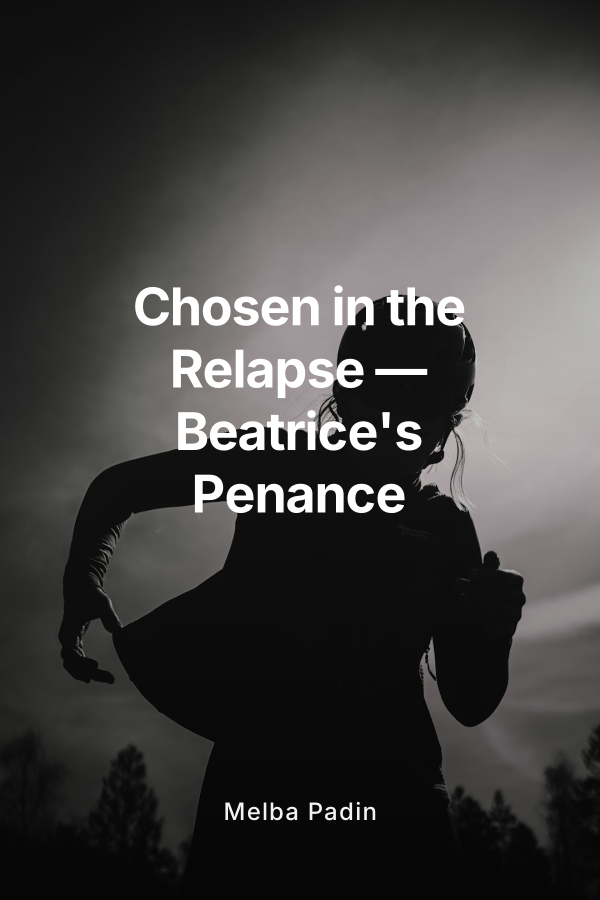
Chosen in the Relapse — Beatrice's Penance
The Librarian and Quill — two AI hosts — talk about this book by Melba Padin.
Published July 7, 2026 · 6:59
This conversation is made with AI — script and voices — and says so on air. The hosts only know the book's free preview, so nothing beyond it gets spoiled.
Transcript
The Librarian
Welcome to Book Conversations. I'm the Librarian, joined as always by Quill, and just so you know upfront — this whole conversation, voices included, is made with AI. Today's book opens with a line that stopped me cold: what does it mean when your body is screaming and the room around you looks calm?
Quill
Right, because that's the whole trap of this disease. Beatrice writes about hands humming like power lines, legs like wet rope — and nobody in the kitchen can see any of it.
The Librarian
The book is Chosen in the Relapse, Beatrice's Penance, by Melba Padin. And that kitchen scene actually happens. She tells her family what a late-night search just told her, and someone laughs and says, shut up Beatrice, you don't have that.
Quill
That line landed hard. Not cruel exactly. Just... exhausted disbelief. Which she says is almost worse than cruelty.
The Librarian
So who is this book actually for? Because it's memoir, but it's also structured like a manual — forty chapters, checklists, medical explainers.
Quill
She says it plainly — people already living with MS first, newly diagnosed second. But honestly, I think anyone who's ever doubted someone's pain because they looked fine needs to sit with this.
The Librarian
That's the phrase that keeps recurring. You look fine. Meets 24 by 7 pain — that's literally a chapter title.
Quill
Which is such a specific choice. She's not asking for sympathy in the abstract. She's naming the exact sentence that hurts and turning it into a chapter to dismantle.
The Librarian
Let's talk about the voice, because it's doing three things at once — the personal scene, the plain medical explainer, the faith reflection. Does that actually work on the page, or does it feel like three books stitched together?
Quill
In the excerpt, it's smoother than I expected. The chapter starts with her asking, what is MS, almost like a chant. She repeats it like five times. Each repetition circles back to something different — a memory, a fear, a promise for later chapters.
The Librarian
It reads almost like a spell. She even says that — she says the word MS aloud like a spell that might break itself if it heard its own echo.
Quill
That's the line I'd forward to someone. It's such a strange, precise way to describe getting a diagnosis. Not relief, not devastation. Something stranger in between.
The Librarian
And the mountain childhood keeps threading through — coffee farms, prayer, paperbacks as her exits. It's not decoration, it feels load-bearing for what comes later.
Quill
Right, she says the ladder she built with faith as a kid, one that leans on nothing but belief, comes with her into adulthood. So when the body starts writing in whispers, as she puts it, she already has a framework for enduring things without proof.
The Librarian
Which raises something I want to sit with honestly. The faith-and-medicine braid is central to her pitch. Is that going to land for a reader who doesn't share her faith, or does it risk feeling like the medical clarity is competing with the sermon?
Quill
That's fair to wonder. From what we've got, she's careful — she calls the faith notes clearly labeled, alongside medicine, never instead of it. But we only have the setup. Whether that balance holds for forty chapters, I genuinely don't know.
The Librarian
I appreciate that she's not hiding the ten years without a name either. A decade of unexplained suffering before diagnosis — that's a chapter, not a footnote.
Quill
And later there's a fall in a flare that fractures her neck and nobody catches it in the moment. A thirteen hour spine surgery. This isn't a wellness narrative dressed up as memoir. She's not softening what delay costs.
The Librarian
That's the stakes, really. She says plainly — if I had known early, maybe I'd still be dancing, still driving. This is a book arguing that disbelief has a body count measured in years and abilities, not just feelings.
Quill
Which is why the caregiver scripts feel so pointed. Trading you look fine for what would make today easier. It's such a small swap in language but she's positioning it as the whole hinge of care.
The Librarian
Here's my honest hesitation, though. A book that promises checklists for relapse days, appointment scripts, boundary setting, comorbidity explainers, faith reflections — that's an enormous amount to deliver in one volume without any one strand feeling thin.
Quill
Totally fair to be skeptical there. The excerpt only shows us the opening chapter, so we can't know yet if the medical sections stay as sharp as the memoir voice, or if forty chapters start to strain.
The Librarian
Right, we genuinely don't know. And there's a figure she keeps returning to that the excerpt never explains — the man in the suit, appearing in her first relapse like a messenger of judgment and fear. He gets his own chapter, then reappears later titled doubt, judgment, and mercy.
Quill
That's the detail I can't stop thinking about. Is he literal, a doctor, a hallucination, a symbol she builds across the whole book? The excerpt gives us just enough to make him haunting and nothing more.
The Librarian
And that's exactly the question I'm going to leave hanging, because it's not mine to answer for you. Who is the man in the suit, and why does he return.
Quill
I want to know that answer badly.
The Librarian
You and me both. If Beatrice's insistence that pain becomes real when we say it, not when someone approves it, stuck with you the way it stuck with me — go find out who's waiting for her in that suit. Read the rest of Chosen in the Relapse, Beatrice's Penance, free, on infinite library dot A I.
“Chosen in the Relapse — Beatrice's Penance” is waiting.
The conversation covers only the free preview. The whole book is on Infinite Library — read it free, or listen along.